2,387 videos 1,376,944,188 views US Joined Aug 30, 2018
Charlie Kirk is the Founder and President of Turning Point USA, the largest and fastest growing conservative youth activist organization in the country with over 250,000 student members, over 150 full-time staff, and a presence on over 2,000 high school and college campuses nationwide. Charlie is also the Chairman of Students for Trump, which aims to activate one million new college voters on campuses in battleground states in the lead up to the 2020 presidential election. His social media reaches over 100 million people per month and according to Axios, he is one of the "top 10 most engaged" Twitter handles in the world. He is also the host of “The Charlie Kirk Show,” which regularly ranks among the top news shows on Apple podcast charts.
Charlie Kirk Dismantles Retired Federal Employee's Defense of Socialism and Government Bureaucracy at Campus Event
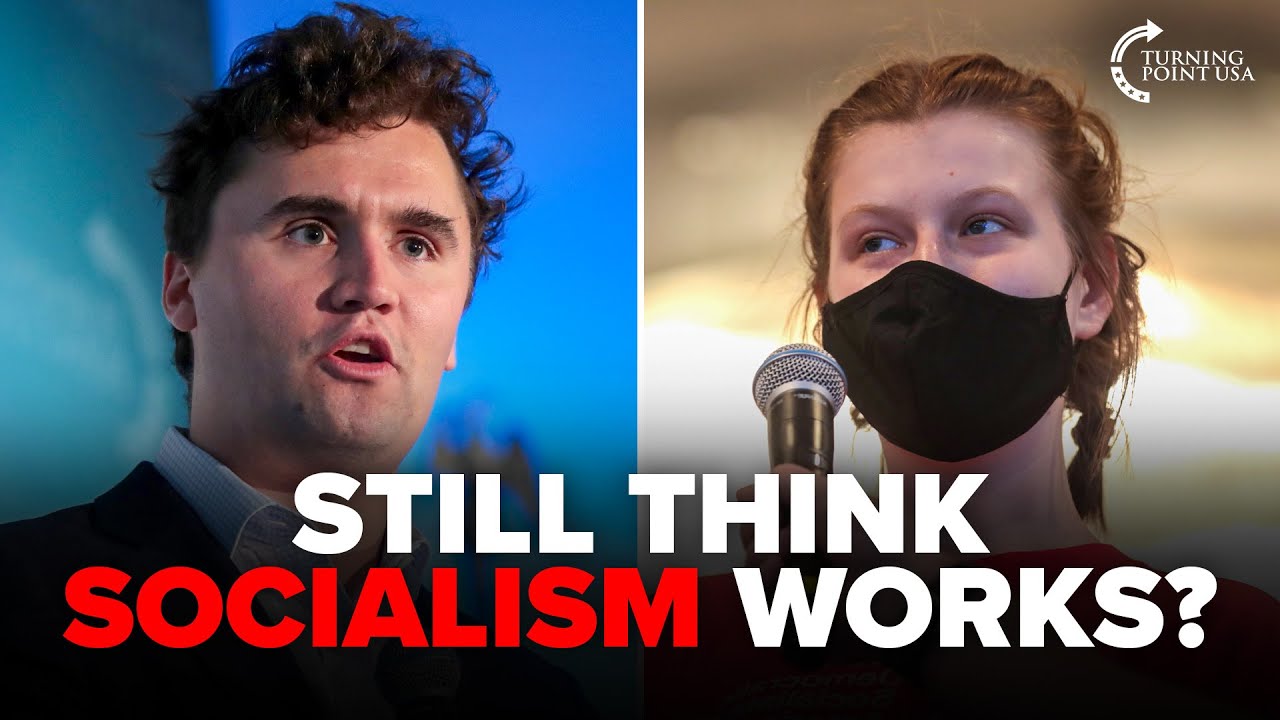
Charlie Kirk engages in a rigorous debate with a retired Department of Agriculture employee who defends socialism and government programs. What starts as a discussion about income tax and socialism quickly exposes fundamental disagreements about government efficiency, waste, and the role of private versus public institutions. The conversation reveals striking admissions about bureaucratic dysfunction, from contractors hired to do government workers' jobs to the superiority of Catholic schools over public education. Kirk systematically demonstrates the failures of government-run programs while distinguishing between voluntary charitable action and forced wealth extraction.
The conversation begins when a retired federal employee claims that socialism works for everybody, pointing to income tax as an example. Charlie Kirk immediately challenges this definition, questioning where socialism has actually worked. The individual insists that socialism is simply "where everybody pays in" for the common good, but Kirk pushes back, asking whether the person voluntarily gives more to the government than required.
The retired employee claims to give more than required by not taking all available deductions, revealing he worked for the Department of Agriculture doing payroll for much of the government, writing 700,000 paychecks twice a month. This admission sets the stage for a deeper examination of government efficiency and waste.
Exposing Government Waste and Inefficiency
When Kirk asks about waste in the food stamp allocation within the Department of Agriculture, the retired employee admits there is "definitely" waste. Kirk seizes on this contradiction: how can someone defend government programs while admitting they're wasteful? The response—"we have to do something"—draws Kirk's criticism as a horrible argument for spending trillions of dollars.
The conversation then turns to government employees who don't perform their jobs well. The retired employee admits there were "a lot" of incompetent workers, but claims they weren't fired. Instead, contractors were hired to do their work. When Kirk expresses skepticism that government employees actually get fired, citing civil service protections, the employee references the MSPB (Merit Systems Protection Board) as having a 90% approval rate for dismissals, though Kirk remains unconvinced given the well-known difficulty of terminating government workers.
Finding Common Ground on Government Size
Despite their disagreements, both Kirk and the retired employee agree that government is too big. Kirk lists programs he rejects: income tax, welfare, food stamps, Housing and Urban Development, and the Department of Education. When asked about Social Security, Kirk expresses concern that young people are forced to pay into a system they won't benefit from, noting that Social Security's annualized growth rates are "lackluster at best."
Kirk emphasizes that the government takes 7% of his generation's earnings to subsidize older Americans. While he acknowledges the need for a safety net, he distinguishes this from a "hammock," a point the retired employee seems to accept.
Public Versus Private Education
The debate shifts to education when discussing government funding for universities. Kirk argues that private institutions exist and work well, while the retired employee counters that they work through donations, which he characterizes as "socialism." Kirk rejects this comparison, pointing out that if college tuition represents socialism—with rising costs, inefficiency, unchecked administrators, and underperforming professors—then it's an example of something that doesn't work.
The comparison between Catholic schools and public schools proves particularly illuminating. Both agree that Catholic schools perform much better than government-run schools. Kirk provides specific data: in Louisiana, educating a student in a Catholic school costs about $8,900 per year compared to $14,000 per year in the public system. Yet Catholic education produces much higher quality outcomes, with students more likely to attend college and stay out of gangs.
The retired employee attributes public school failures to "incompetent administrators," but Kirk argues this misses the point: administrators will always be incompetent in government systems because the incentive structure doesn't require competence to keep their jobs. In contrast, markets work because good ideas continue and bad ones are terminated.
Voluntary Charity Versus Forced Extraction
A critical distinction emerges when discussing care for incompetent or struggling individuals. Kirk argues they should be taken care of by churches, community members, and individuals. The retired employee calls this "socialism," but Kirk firmly disagrees: this is volunteerism, not socialism. Giving money to a church, a synagogue helping poor people, or a mosque running a food shelter represents voluntary charitable transactions.
Socialism, Kirk emphasizes, is the involuntary extraction of wealth to fund social utilities. The key difference is choice: someone can leave a church, but you cannot escape government taxation. While the retired employee counters that you can leave the country, Kirk notes that some socialist countries, like Cuba, will kill you for trying.
The Case of Russia and Healthcare Systems
The conversation touches on Russia, which Kirk describes as a "crony fascist dictatorship" rather than a republic. He explains that Putin is essentially president for life, their democracies are a sham, and oil and natural gas reserves are owned by an oligarchic bureaucratic class—far from a market-based system.
Kirk identifies a neutral court system that allows the adjudication of differences as a core component of capitalism, something Russia completely lacks. When the discussion turns to Russia's socialized healthcare, Kirk states flatly that it doesn't work well. The retired employee challenges this, asking why not, but Kirk maintains that socialized healthcare simply doesn't work in general and definitely not in Russia.
A Personal Healthcare Story
The retired employee shares a personal experience of going to an emergency room with a serious blood problem—a blood pH level of six. He claims the hospital ran tests, determined he had a serious issue, and then "showed him the door," which he views as a violation of the Hippocratic oath. Kirk questions this narrative, asking what the prescribed treatment would be for such a condition.
Kirk points out that if doctors cannot determine what's wrong or what treatment to apply, then emergency care has limited options. The conversation reveals that pH imbalance can have multiple causes—genetics, diet, and other factors—with widespread scientific disagreement on treatment. Kirk argues that even in Russia's socialized system, there wouldn't be a special treatment for this condition any more than anywhere else. He concludes by asserting that American healthcare, despite its problems, is better than Russia's system.
The Fundamental Disagreement
Throughout the exchange, Kirk systematically argues that the most dysfunctional parts of American society are based in government control and resource misallocation. He cites the Veterans Administration as an example of a socialist program that runs horribly, and disaster public schools as socialist institutions that fail their students. The retired employee largely agrees with these assessments but maintains that some form of collective payment system is necessary.
Kirk doesn't dispute the need for basic government services—police, firefighters, roads and bridges, and a national military—but insists these should be as localized as possible. He opposes the federalization of programs, arguing that local control produces better outcomes. The Department of Transportation, he notes, is "a mess" that's "widely inefficient" and "doesn't work well at all."
The core philosophical difference comes down to incentive structures. Kirk argues that government bureaucracies lack the incentives that make markets work efficiently. In the private sector, good performance is rewarded and poor performance leads to consequences. In government systems, incompetence can persist indefinitely, with contractors hired to cover for failing employees who never lose their jobs.