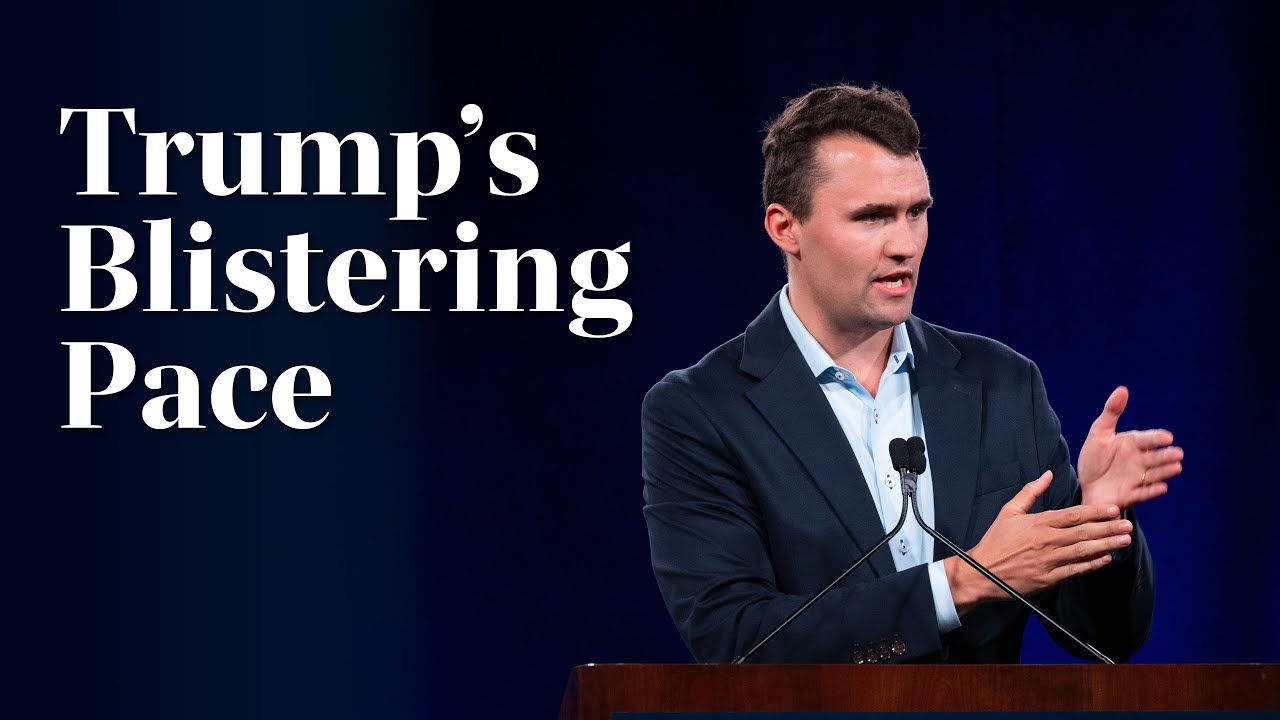
Charlie Kirk on America's Broken Foster Care and Adoption System and Why Conservatives Must Act
Enjoying this? Share it with someone who needs to see it.
Up Next
Charlie Kirk Rallies Young Conservatives at Historic Turning Point USA Student Action Summit in Tampa
20:51
Charlie Kirk and Candace Owens Launch New Turning Point USA Headquarters in Arizona
16:58
Charlie Kirk Rallies Arizona Crowd After RFK Jr Endorsement of Donald Trump
17:45
Charlie Kirk on America's Broken Foster Care and Adoption System and Why Conservatives Must Act
Charlie Kirk addresses what he calls one of the most broken systems in America: foster care and adoption. Kirk argues that adoption is prohibitively expensive and bureaucratically complex, leaving millions of Americans waiting to provide homes for children. He challenges the notion of "unwanted children," pointing to countless couples, including those in same-sex relationships and dealing with infertility, eager to adopt. Kirk also exposes the disturbing failures within the foster care system, including abuse scandals in religious institutions and the inadequate prosecution of perpetrators. He contends that the foster care system serves as a true pipeline to gang violence and incarceration, particularly in inner cities, and calls on conservatives to reimagine what a successful system could look like while expressing skepticism about government-led solutions.
Charlie Kirk identifies foster care and adoption as among the most broken systems in the country. He emphasizes that the adoption process is prohibitively expensive and excessively difficult, with waiting lines that stretch for years. According to Kirk, millions of Americans are waiting for the opportunity to adopt children, yet bureaucratic barriers prevent these connections from happening.
Kirk challenges the narrative that there are "unwanted children" in America, pointing to the overwhelming demand from prospective parents. He notes that countless people in same-sex relationships, as well as heterosexual couples facing infertility, desperately want to become parents but face insurmountable obstacles in the current system.
A Call for Bipartisan Action
Kirk proposes a strategy for change, suggesting that if every person approached their Republican officeholder and demanded they speak about adoption daily, real reform could become possible. He sees potential for bipartisan appeal on this issue, arguing that supporting adoption aligns naturally with pro-LGBT positions since many same-sex couples seek to adopt.
He believes conservatives need to make adoption reform a central talking point and policy priority, bringing together diverse constituencies around the shared goal of connecting children with loving families.
The Foster Care System's Catastrophic Failures
Kirk describes the foster care system as equally problematic, characterizing it as abusive and horrible. He specifically addresses the abuse scandals that have emerged from foster care homes run by religious institutions, calling them a "black eye" on the system.
While identifying as Christian but not Catholic, Kirk condemns the abuse committed by priests in foster care settings. He expresses outrage at what he sees as inadequate sentencing for perpetrators, noting cases where priests accused by fifteen boys serve only four years in prison when they should face indefinite incarceration.
Kirk emphasizes that Catholics themselves agree that these perpetrators are dramatically under-incarcerated given the severity of their crimes and the number of victims affected.
The Foster Care to Prison Pipeline
Kirk identifies what he considers the true prison pipeline in America: the foster care system itself. He explains that children who enter foster homes in inner cities face a high likelihood of exposure to gang violence, creating a direct pathway to incarceration.
This connection between foster care placement and criminal justice involvement represents one of the most troubling aspects of the broken system, according to Kirk. The failure to provide safe, stable environments for vulnerable children creates cascading negative consequences that extend throughout their lives.
Skepticism About Government Solutions
Despite recognizing the urgent need for reform, Kirk expresses deep skepticism about government's ability to fix the foster care and adoption systems. He states plainly that he doesn't believe government will be able to solve these problems and suggests that government involvement would likely make things worse.
Kirk points to existing public-private partnerships in foster care as evidence of government's inability to improve outcomes, calling these hybrid models "horrible" and "absolutely horrible."
A Conservative Vision for Reform
While doubtful about government-led solutions, Kirk argues that conservatives need to take a much closer look at what a successful foster care and adoption system could look like. He admits he wants to learn more about the issue and discover the best approaches to solving these deeply entrenched problems.
Kirk's call to action centers on conservatives developing and championing alternative models that move beyond traditional government bureaucracy while still ensuring children find safe, loving homes. He frames this as both a moral imperative and a policy opportunity that could unite different constituencies around shared values of protecting children and supporting families.