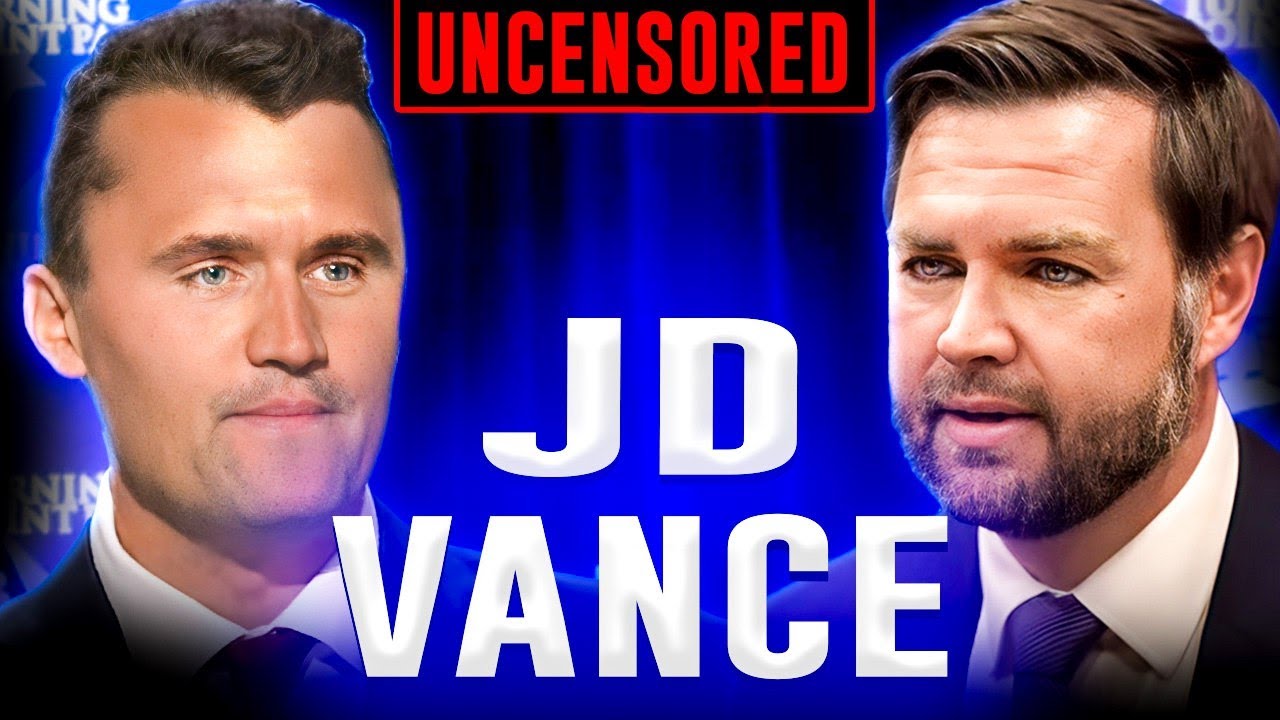
Charlie Kirk on Bitcoin Reserve, National Debt Crisis, and Why the US Dollar is Losing Power
Enjoying this? Share it with someone who needs to see it.
Up Next
Tucker Carlson on Usury, Credit Card Debt, Russia, and Why He Openly Supports Donald Trump
33:52
Charlie Kirk on Trump's Tariffs Plus Deregulation Strategy and the Path to Economic Independence from China
14:31
Charlie Kirk Defends Trump Against Oxford Professors Who Compare Him to Hitler and Weimar Germany
1:08:45
Charlie Kirk on Bitcoin Reserve, National Debt Crisis, and Why the US Dollar is Losing Power
Charlie Kirk makes a compelling case for why the United States should establish a strategic Bitcoin reserve, drawing on Michael Saylor's mass adoption theory and the possibility of Bitcoin reaching a million dollars. Kirk examines the national debt crisis, the failure of government spending reform, and why breaking up BRICS nations is essential to preserving the dollar's world reserve currency status. He warns that America's handling of the Russia-Ukraine conflict has accelerated de-dollarization and undermined global trust in the dollar as a safe haven. Kirk dissects the warfare-welfare alliance in Washington that perpetuates endless spending, explains why economic growth is the only path forward despite mounting debt, and shares his surprisingly optimistic vision for America's future despite the challenges ahead.
Charlie Kirk firmly believes the United States should establish a strategic Bitcoin reserve. When asked who should pay for it, Kirk suggests tariff revenue could potentially fund the initiative. He points to Michael Saylor's mass adoption theory, explaining that certain things like the English language and the US dollar catch on over time through a volitional process that becomes unstoppable. Kirk believes Bitcoin follows this same pattern.
The only asterisk Kirk acknowledges is quantum computing, which could potentially crack cryptography. However, he notes that if quantum computing cracks Bitcoin, it would also compromise bank accounts and stock trading systems across the board.
Kirk finds Saylor's argument particularly profound: because Bitcoin is a legitimately scarce resource, it will likely continue rising in value. Saylor makes the provocative claim that Bitcoin could increase 10x over the next decade, meaning a strategic Bitcoin reserve could potentially pay down the national debt and cover deficit losses. Kirk agrees with Saylor's assessment that Bitcoin is more likely to reach a million dollars than zero.
Where the World's Wealth is Flowing
Kirk identifies a fundamental problem: the world's richest people are running out of places to park their money. There are only so many penthouses in London and Paris to buy, only so many ranches in Wyoming to acquire, and only so many shares in companies like Nvidia, Apple, and Microsoft that wealthy individuals can justify purchasing.
This creates a wealth inequality dynamic where newly created money flows upward, and then that money needs to find a home. Bitcoin has become that home. Once mass adoption takes hold and the wealthiest families on the planet start parking serious money in Bitcoin, its scarce nature and ease of transfer make it a winner. Kirk believes Bitcoin has reached this mass adoption tipping point and will continue rising to the surface.
The National Debt is Already a Crisis
When asked at what point the national debt will become a major problem, Kirk states it already is. He sees a solvable path forward, though he takes issue with some Congressional Budget Office estimates regarding Trump's proposed legislation, which critics claim will add two trillion to the debt over ten years.
Kirk emphasizes the need to cut significantly more spending and notes that while Donald Trump agrees, he faces frustration with Republicans on Capitol Hill who resist cuts. However, Kirk identifies the worst possible scenario: not growing the economy. Having big debt is bad, but not growing with big debt is catastrophic. Growing with big debt is somewhat manageable, while growing with debt reduction would be the ideal scenario.
The calculus, according to Kirk, requires the debt to be outpaced by two things: GDP growth and inflation. If GDP grows faster than both inflation and the debt-to-GDP ratio, the situation becomes manageable. This forms the premise behind tax cut proposals like no tax on tips, no tax on overtime, depreciation allowances, and extension of the Trump tax cuts. A pro-growth agenda is essential because a debtor nation without growth faces disaster.
What Happened to DOGE
Kirk doesn't believe DOGE is finished. He credits Elon Musk with making a significant philosophical contribution by making everyone realize how much government waste exists and how much inefficiency permeates the system from technological and operational standpoints. Kirk sees DOGE as a cultural mindset that will hopefully remain embedded in the Republican party for years to come.
However, Congress showed little incentive to implement DOGE recommendations. Kirk notes that Elon simply wanted people to code and write descriptions of where money went, since currently you can send money without documenting its purpose. Even this basic request met a wall of resistance.
Kirk acknowledges there is immense waste in the federal government and hopes it can be reined in over the coming months and years, but he describes it as a beast and a wild monster that's hard to control. He's careful not to make excuses, but points out the reality: an entrenched permanent bureaucracy of millions of people exists, and federal judges are actively preventing the Trump administration from implementing reforms, blocking layoffs, aid cuts, and other measures in what Kirk considers unconstitutional interventions.
Blockchain the Entire Federal Government
Kirk's goal is to put the entire federal government on blockchain and make every dime of federal spending visible online in real time. Citizens should know what every department is spending on a day-by-day, month-by-month basis through a transparent federal database.
When asked about national security risks, Kirk acknowledges certain things could be blackboxed, but maintains that people deserve to know what the Department of Interior, Department of Veterans Affairs, and other agencies are spending money on. Are they buying fifty-dollar hammers? Two-hundred-dollar bandages? It's the people's money, not the government's.
Kirk emphasizes this fundamental point: the money belongs to the people watching. Citizens earn the money, they are the sovereign who create the government, and the government extracts it from them with their consent through voting and elections. Therefore, citizens have a right to know where that money goes. It doesn't magically become the government's money.
The Warfare-Welfare Alliance
Kirk identifies a problem worse than simply having no penalty for overspending: there's an active incentive to keep spending more. Washington DC operates through two wings—the Republican warmongering caucus that wants to spend money on war, and the welfare caucus that wants to expand social programs.
These warfare and welfare caucuses reach a bipartisan agreement: the warfare faction wants to invade the world, while the welfare faction wants to put the world on welfare. Their compromise is simple—authorize warfare spending in exchange for welfare spending, allowing both sides to get their pet projects funded while spending more money.
Kirk describes how the welfare faction tells the warfare faction: "Don't invade the world, but if you invade the world, can we invite the world?" The warfare people don't like bringing in millions more people, but they agree because the welfare people then agree to put those people on welfare. This unholy bipartisan agreement has defined every major public policy budgetary debate for the last 30 years.
Why Kirk Remains Optimistic
Despite identifying these systemic problems, Kirk insists he's not a cynic but a super optimist who has never been more optimistic about the country. He saw what he calls "insane doomerism" a year ago when people believed they would never let Trump win and would try to take him out. He watched that doomerism die.
Kirk believes one of Trump's greatest contributions is pushing the art of the possible, demonstrating that dramatic change is actually achievable. He applies Tony Robbins' philosophy: don't go to your garden and say "there's no weeds, there's no weeds"—instead, spot the weeds and pull them out. Kirk isn't delusional; he's an optimist who tries to find the best case scenario, then applies human agency and action to make it reality.
The US Dollar is Losing Ground
Kirk acknowledges serious concerns about the US dollar, noting that its status as the world reserve currency has declined dramatically over the last 20 years. President Trump is focused on breaking up BRICS—Brazil, Russia, India, China, and South Africa.
Kirk mockingly calls South Africa the "DEI pick" and questions why it's considered any kind of world currency power. He sees India as easy to peel away, noting that the US already has great relations with India and that JD Vance conducted a state visit there that received little media coverage. Kirk also credits Trump with stopping the India-Pakistan war, which was simmering and could have become catastrophic.
Brazil under Lula is a disaster in Kirk's view—a complete Marxist and communist, whereas Bolsonaro should still be prime minister. This leaves Russia and China as the core problem. Kirk's best case scenario involves ending the Russian-Ukrainian war and creating separation and daylight between the growing marriage of Russia and China, which he considers bad for America, the West, and the world.
The Swift Banking System Mistake
Kirk argues it's imperative that the US dollar remain the world reserve currency. America's reckless involvement in the Russia-Ukraine war has only accelerated de-dollarization. When the US took Russia out of the Swift banking system and confiscated their dollars, it sent a message to every other nation that uses dollars: America is no longer a safe haven.
Regardless of how wrong Putin was for invading Ukraine, Kirk argues the US never should have taken this action. By essentially saying "if you misbehave, we might take away your dollars," America de-incentivized people and nations from trusting the dollar as a safe haven. This fundamental breach of trust has lasting consequences for the dollar's global standing.