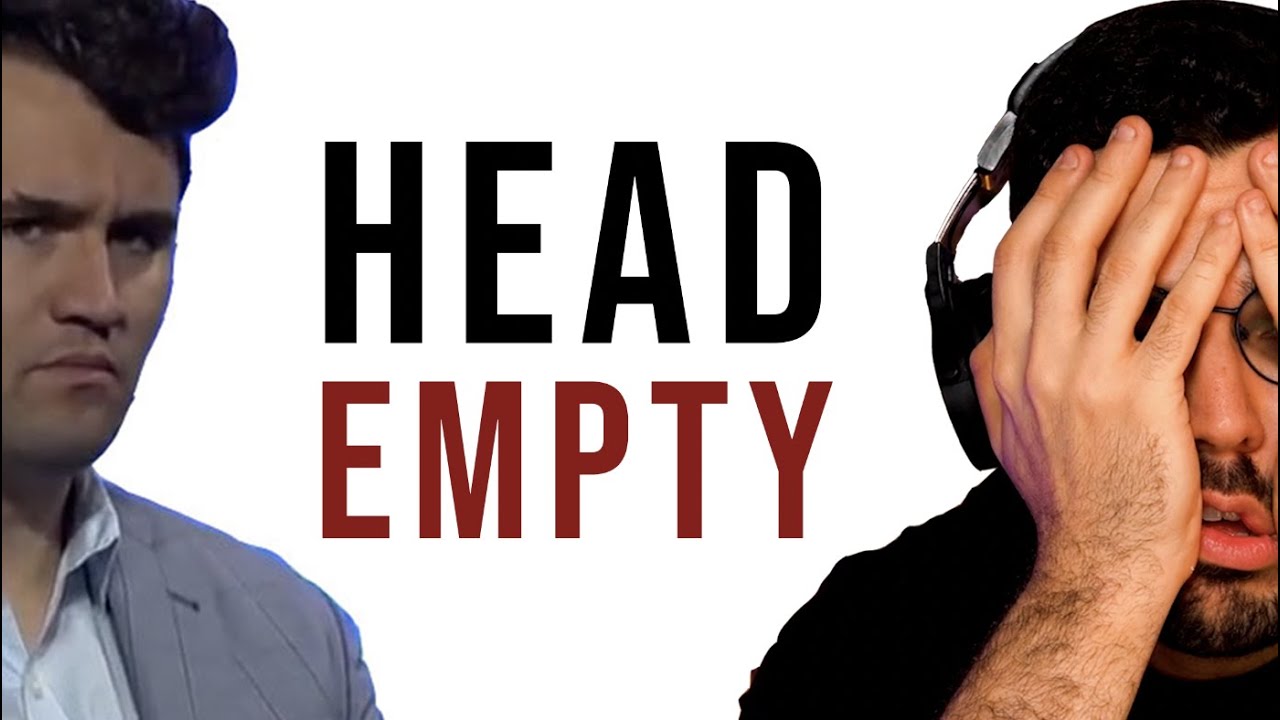
David Pakman Breaks Down Why Charlie Kirk's Viral NBA Diversity Argument Falls Apart Under Scrutiny
Enjoying this? Share it with someone who needs to see it.
Up Next
Elon Musk Explains the Woke Mind Virus and Why Free Speech Matters More Than Ever
21:21
Charlie Kirk Reveals President Trump's Hidden Victory Against DEI: The Disparate Impact Executive Order Explained
15:05
Tim Black Responds to Charlie Kirk's Controversial Statements on Race, DEI, and Civil Rights Act
14:48
David Pakman Breaks Down Why Charlie Kirk's Viral NBA Diversity Argument Falls Apart Under Scrutiny
David Pakman dissects one of Charlie Kirk's most viral debate moments where Kirk uses NBA and NFL demographics to argue against diversity initiatives. While Kirk's sports analogy sounds convincing on the surface, Pakman reveals why comparing athletic performance metrics to complex professional hiring is fundamentally flawed. From unconscious bias in hiring to the difference between equality of outcome versus equality of opportunity, Pakman exposes the logical gaps in Kirk's reasoning and explains why sports represent extreme outliers that cannot be extrapolated to all of society. This analysis demonstrates how debate skill and actual truth-seeking are two very different things.
Charlie Kirk from Turning Point USA has built a substantial following by debating college students on campuses across America. One of his most viral moments involves an argument about affirmative action and diversity, equity, and inclusion hiring practices using sports as an analogy. In the clip, Kirk asks his debate opponent to imagine if the NBA, which is 75% black, suddenly implemented a diversity policy limiting black players to only 30% of the league. He then poses the same hypothetical for the NFL, which is 50% black, asking whether quality would decline if Roger Goodell instituted a 30% cap on black players. Kirk's conclusion is that unqualified white people would fill those positions and the quality of play would drop, therefore the same logic should apply to all hiring: just hire the best, regardless of demographics.
The argument sounds compelling on its surface, and Kirk's confident delivery helped the video go viral. However, David Pakman applies critical thinking to reveal why this reasoning is fundamentally flawed and why these debates often measure debating skill rather than adjudicating truth or reality.
Why Sports Are a Terrible Analogy for Hiring
The core problem with Kirk's argument is that sports represent a narrow, extreme case that cannot serve as a model for all of society. The NFL and NBA are complete outliers that measure pure, specialized physical skills: how fast you can run the 40-yard dash, how high you can jump, your agility, your endurance. These abilities are easily measurable and quantifiable.
In most jobs, that sort of easily measurable physical ability is not the metric at all. Success in most professions is based on complex, varied skills including leadership, communication, creativity, and critical thinking. You cannot take a world where vertical leap and sprint speed dominate and apply it to hiring a doctor, an engineer, a teacher, or a CEO. Sports leagues are the exception, not the rule, which is precisely why Kirk selects them for his analogy.
The Myth of Obvious Merit
Kirk acts as though it's very easy to spot "the best" in regular jobs, but this assumption ignores reality. In sports, statistics like points, yards, and tackles are completely quantitative. Hiring in professional contexts is completely subjective. This subjectivity is where unconscious biases about race, gender, and increasingly about class shape who we think is "the best."
Historically, this explains why we're even having these conversations. Entire groups of highly qualified women and highly qualified black people were systematically excluded from opportunities, not because they weren't the best, but because of bias. The discussion around diversity initiatives is not about seeking equality of outcome; it's about equality of opportunity. Pretending that merit naturally rises without bias, just like in the NBA or NFL, is complete fantasy because hiring the best requires addressing the barriers that sometimes prevent the best from even being seen.
The Myth of the Level Playing Field
Kirk imagines a level playing field where everybody is already getting a fair shot. If that were true, it would be great, but it's not reality. In the NBA, a poor black teenager can get noticed if he dunks over some seven-footer at a high school game. In law, technology, business, and academia, you might not even get into the room without elite schooling, networking opportunities, or the right mentors. Access to these resources is shaped by wealth and, at least historically, by race.
Talent might be universal, but access is not. Diversity initiatives don't lower the bar; they try to expand the pool and fix a pipeline that might be broken so that ability can decide who actually wins rather than privilege. If you want a real meritocracy, you have to fight the advantages that exist. You can't pretend they aren't there.
The Straw Man of Hard Quotas
Nobody is proposing hard racial quotas like Kirk describes. Saying only 30% of NBA players can be black is a ridiculous straw man because in real life, diversity policies don't cap groups. They widen participation, and that's the real goal.
Furthermore, we don't need perfect representation in every field. There's no doubt that even if unconscious bias and historical discrimination play a role, there can still be perfectly benign reasons why one group might be over or underrepresented in certain areas. For example, looking at population demographics, 50.3% of the population is women. But there was a point at which zero percent of the Senate had ever been women. A sensible person would look at that and recognize that something is going on—there has to be a barrier, whether ideological, legal, or something else that would explain why, despite being 50.3% of the population, there had never been a woman senator.
On the other hand, you might hypothetically have 38% or 42% of the Senate be women, and someone might say that because 50.2% of the population is women, this discrepancy must be fixed immediately. Not necessarily. That may not be the case. You may actually have an explanation that is not the zero percent scenario, which represents a very obvious problem. In some areas, slight variations from population percentages are acceptable and don't indicate systemic barriers.
It's a straw man to suggest that diversity advocates are demanding exact representation in every industry that mirrors population demographics perfectly.
Debate Skill Versus Truth
Charlie Kirk, as usual, sounds very good. He's very well prepared. But the argument is bogus, and a lot of college kids are falling for it. These debates serve as referenda on who is better at debating, not as adjudications of truth or reality. Kirk's viral moment demonstrates how a confident delivery and a simple analogy can be persuasive even when the underlying logic is fundamentally flawed.
Video Transcript
All right. As I'm sure many of you know, there
is this guy, Charlie Kirk from Turning Point,
USA, who goes around to college campuses and he
debates mostly college kids. And he's built a
huge following for being a great debater and just
owning everybody and destroying liberals. And one
of the things that I do think occasionally is
useful to do is really to down his arguments
and you will see that these debates. Are really
referenda on who is better at debating. They're
not really adjudications of the truth or reality.
So I'm going to play one for you here and then
we're going to talk about it. This is only a
minute. The topic is sort of like affirmative
action, D.E.I. Hiring type practices. And Charlie
Kirk went viral with this video because he made
such great points. But I'm gonna apply just a
little bit of critical thinking and you will
see these are not really great points. Let's first
look at the viral video. Then we'll break it down.
So right now the NBA is 75% black. If all of
a sudden the NBA said, we want more diversity,
it's too black, right? Because we want to
have more diversity. And they would say,
we are not allowed to have any more than 30% of
the NBA be black. Would the quality of the NBA
go down? The quality of NBA, arguably right
now, yeah, it would. So half of the NFL is
black. If all the sudden, Roger Goodell, boo, we
don't like Roger Goodel. If he came, he's like,
hey. Diversity is our strength, we're only going
to say 30% of the NFL is black. You would have
other unqualified white people that would then
get positions in the NFL and the quality of
play would slip. So you get the argument. You
then extrapolate that to other walks of life.
You think to yourself, let's just hire the best.
It should be the best, no matter what the thing
is like, but I don't think there should be
restrictions to anybody, as long as you're
good at what you do, it doesn't really matter.
OK, so the analogy here to hiring is to sports.
Now, I know some of you have asked me why is
Charlie Kirk like eating and glitching and
twitching and doing weird things the entire time?
I have no idea. I don't I have. No clue. I noticed
it. I'm not going to get into that. Let's talk
about the analogy to sports sports are a really
narrow, extreme case. Sports are not a model
for all of society in any way. It's a terrible
analogy. He talks about the NFL and the NBA. These
are these are complete and total outliers. They
measure pure specialized physical skills. How
fast can you run the 40? How high can you jump?
How agile? How what's your level of endurance in
most jobs? That sort of easily measurable physical
ability is not the metric. It's a terrible analogy
because in most jobs, success is based on complex,
varied skills. Leadership, communication,
creativity, critical thinking. So when Charlie
Kirk says extrapolate my analogy from the NBA
and NFL to everything, it's a terrible thing to
extrapolate. You can't take a world where vertical
leap and sprint speed dominate and apply it to
hiring a doctor or an engineer or a teacher or
a CEO. Sports leagues are the exception, not the
rule. And that's why Charlie Kirk is selecting
it. The best. Is not some pure obvious thing
outside of the world of sports. The speaker acts
like it's very easy to spot the best in regular
jobs. It's not in sports stats like points, yards,
tackles. These are completely quantitative. Hiring
is completely subjective. And so that's why
unconscious biases, whether they be about race
or gender or increasingly about class shape who we
think is the best. And when you look historically,
this is why we're even talking about this.
You had entire groups, highly qualified women,
highly-qualified black people and others who
were systematically excluded from opportunities,
not because they weren't the best, but because
of bias. So this is not about seeking equality
of outcome. It is about equality of opportunity.
And so when we pretend that merit naturally rises
without bias, just like in the NBA or the NFL. To
complete in total fantasy because hiring the best
requires addressing the barriers that sometimes
prevent the best from even being seen. You know,
the concept of the fair competition, um, that he
talks about, it doesn't necessarily exist without
some intervention. Uh, Charlie Kirk imagines a
level playing field where everybody's already
getting a fair shot. If that were true, that would
be great, but it's not true in the NBA. A poor
black teenager can get noticed. If he dunks over
some seven footer at a high school game in law,
in technology and business and academia, you
might not even get into the room without elite
schooling or networking opportunities or the
right mentors. And that is shaped by wealth.
It's shaped to some degree, at least historically
it was by race. And so talent might be universal,
but access is not Diversity initiatives don't
lower the bar. They try to expand the pool and
fix a pipeline that might be broken so that then,
yes, ability can decide who actually wins rather
than privilege. So if you want a real meritocracy,
you have to fight the advantages that exist. You
can't pretend that they aren't there. Nobody
is proposing hard racial quotas like Charlie
Kirk describes, saying only 30 percent black.
Players in the NBA is a ridiculous straw man
because in real life, diversity policies
don't cap groups. They widen participation
and that's really the goal. The other thing is
we don't need perfect representation. Um, what,
what I mean by that is the following, there's no
doubt that even if unconscious bias plays a role,
historical discrimination plays a roll, et cetera,
there can still be perfectly benign reasons why
one group. Might be over or underrepresented in
certain areas. So if you look at the population
and you say, OK, 50.3 percent of the population
is women. But as was the case at a certain point,
zero percent of this Senate has ever been women,
There was a point at which there had been no
female senator. A sensible person would look and
look at that and go, OK. That doesn't make sense.
There has to be something going on there
that is a barrier. Uh, either ideologically
or legally or something that would explain
why, despite being 50.3% of the population,
there has never been a woman senator. On the other
hand, you might have 38 or 42% of the Senate be
women. Hypothetically, we don't, but imagine
that you did. And then you would say, well,
42% percent of the senate is women and 50.2% of
population is women. We must fix this immediately.
No, not necessarily. That that that may not be
the case. You may actually have an explanation
that is not this zero percent very obvious
fiasco in some areas. And that's OK. So so
it's a straw man to suggest that we need exact
representation in every industry that mirrors
population demographics. So Charlie Kirk,
as usual, sounds very good. He's very well
prepared. But it's bogus. It's nonsense. And a
lot of college kids are falling for this stuff.