Up Next

Tyler Robinson Preliminary Hearing Day 2: Surveillance Video Shows Suspect on Campus, DNA Evidence Links Robinson to Rifle and Screwdriver
8:02:13

Tyler Robinson Preliminary Hearing: Chilling Surveillance Video Shows Charlie Kirk's Alleged Killer Preparing for Assassination
31:29
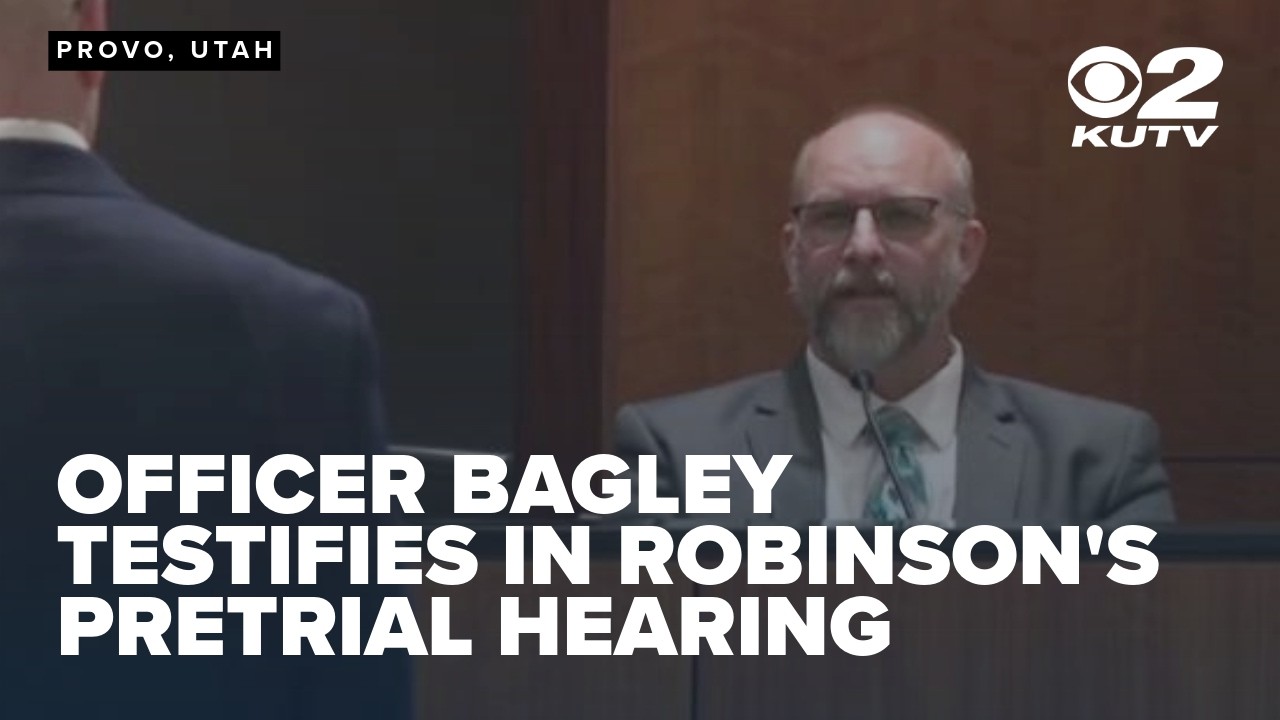
Officer Bagley Testimony Reveals Sniper Position Evidence After Charlie Kirk Campus Shooting Incident at UVU
40:18
Officer Christopher Bagley's Complete Testimony in the Charlie Kirk Shooting Investigation at Utah Valley University
Officer Christopher Bagley, a 26-year law enforcement veteran, provides detailed testimony about the September 10, 2025 shooting incident involving Charlie Kirk at Utah Valley University. Bagley describes securing the Hall of Flags walkway during Kirk's speaking event, hearing a rifle shot at 12:23 PM, discovering evidence on the Losee Center rooftop including a disturbed gravel pattern consistent with a sniper position, and the subsequent investigation. His testimony reveals critical details about the crime scene, security protocols, evidence preservation, and the chaotic moments following the shooting that injured the conservative speaker before thousands of students. The cross-examination exposes gaps in campus security planning and challenges in the investigation.
Officer Bagley's Background and Campus Familiarity
Officer Christopher Bagley brought 26 years of law enforcement experience to his testimony in the preliminary hearing. He had worked at the Utah Valley University Police Department for five years as a senior officer before the September 10, 2025 incident, following 13 years with the Utah County Sheriff's Office, six years with Springville City Police Department, and one year with Salt Lake County Sheriff's Office. His experience included specialized roles in K9, SWAT, motors, and detective work.
Bagley became intimately familiar with UVU's campus through daily patrols, training other officers, and using the university's extensive video surveillance system. He knew every classroom, entrance, exit, and the surrounding neighborhoods to the north and east of campus. This familiarity proved crucial when he needed to quickly navigate the campus during the emergency response.
The September 10, 2025 Event
Bagley arrived on campus at approximately 11:00 AM for an overtime shift to provide security for a special event featuring speaker Charlie Kirk. He had signed up for the shift knowing there would be a guest speaker, though he did not attend any briefing or receive operational plans for the event. Only six UVU officers were assigned to cover an event that would draw several thousand people to the campus courtyard and amphitheater area.
Upon arrival, Bagley was immediately assigned to secure the south end of the Hall of Flags walkway, a red brick pathway that runs above and adjacent to the outdoor amphitheater where Kirk would be speaking from beneath a white tent. People had been throwing objects down from the walkway toward the tent, necessitating the security presence.
The Shooting at 12:23 PM
While stationed on the Hall of Flags walkway, Bagley could see the right side of Charlie Kirk's shoulder as he answered questions beneath the tent. At precisely 12:23 PM, Bagley heard what he immediately recognized as a gunshot. He saw Kirk lean suddenly to the left and move further under the tent to the north side. The crowd of several thousand people began screaming and running in all directions.
Bagley's training allowed him to distinguish the sound as a rifle shot rather than a handgun - describing it as a longer, more violent bang or crackle sound coming from the east. He immediately left his post and attempted to descend the outdoor stairs between the Fugal building and the Hall of Flags, jumping over people who were lying on the steps or running upward in panic.
Initial Response and Crime Scene Assessment
Within approximately 30 seconds of the shooting, Bagley heard over the radio that officers had a shooter in custody near the tent. This initially led him to believe the threat had been neutralized and the shooter was close to Kirk's location. He shifted his focus to assessing injuries and began canvassing the courtyard area.
Bagley encountered a young person near a wheelchair who appeared to be convulsing on the second or third tier of grass, but the father confirmed it was a seizure unrelated to the shooting. Finding no other apparent injuries, Bagley began pushing people off the grass to preserve the crime scene, knowing evidence like shell casings might be present.
Discovery of the Empty Holster
As the chaos began to subside, Bagley noticed an empty pistol holster lying on the top tier of grass on the south side of the courtyard, near the Fugal building. He pointed this out to Chief Long, who was nearby. At that moment, Bagley's perception shifted - he realized the sound he heard was more consistent with a rifle shot than a handgun, despite the empty holster suggesting a pistol might have been involved.
Looking up from where the holster lay, Bagley had a direct line of sight to the Losee Center building to the east. The four-story building with its gravel rooftop stood in the exact direction from which he believed the shot had originated. He decided to investigate the rooftop immediately.
Investigation of the Losee Center Rooftop
Bagley proceeded through the Sorenson Center, climbing four flights of stairs to reach the fourth level of the Losee building. He then accessed the outdoor public stairway on the south side of the building between the Losee Center and the Computer Science building. At 12:44 PM - approximately 21 minutes after the shooting - he hopped over a guardrail that served as a natural barrier to the rooftop.
About 10 to 15 feet west of the guardrail, in the gravel, Bagley discovered a red and black screwdriver that appeared out of place. He did not touch or disturb this potential evidence. More significantly, he observed a distinct disturbance in the gravel on the southwest side of the roof that appeared consistent with someone lying in a prone sniper position.
The Gravel Disturbance Pattern
The disturbance Bagley observed showed impressions that suggested elbows, knees, and feet - the typical contact points for someone lying prone with a rifle. This position provided a direct line of sight to the white tent where Charlie Kirk had been speaking. The southwest corner of the Losee building rooftop offered an unobstructed view down into the courtyard, though part of the view was blocked by the Sorenson building's white roof.
Bagley noted that despite the clear indication someone had been lying in position on the roof, he found no spent shell casings - which would typically be ejected by many types of rifles. He searched the area thoroughly, looking over the edge and checking to ensure the gravel wasn't disturbed elsewhere, but located no casings or unshot ammunition.
Securing the Rooftop Crime Scene
Recognizing the significance of his discovery, Bagley immediately secured the rooftop crime scene with yellow police tape. He placed tape around the disturbed gravel area and at the natural barrier of the guardrail to prevent anyone except law enforcement from accessing the scene. He instructed a female county deputy sheriff not to allow anyone inside the crime scene without proper authorization, then left to review surveillance footage.
Video Surveillance Review
At approximately 1:00 PM, Bagley went to the UVU Police Department located in the Gunther Trade building on level three, directly south of the Losee building. There he accessed the campus video surveillance system to review footage from the rooftop. The footage showed an individual running to the western edge of the roof, dropping down into what appeared to be a prone position in line with Kirk's tent, then standing up after the shooting and running northeast across the rooftop.
The individual then jumped from the northeast corner of the Losee building down to the grass below - a drop that would have required climbing over the roof's edge. Bagley had only viewed this footage twice since the incident and could not identify the individual's face, specific clothing markings, height, or weight from the video, though he described the person as not heavy-set and more of a skinnier build. He observed what appeared to be a long black object in the person's left hand as they ran, possibly covered with something like a towel or blanket, but could not definitively identify it as a weapon.
Northeast Drop Zone Investigation
After reviewing the video footage, Bagley returned to the scene to investigate where the individual had jumped from the building. He went to the northeast side of the Losee building and discovered a deep shoe impression embedded in the grass directly below where the person had dropped down. Looking up at the cement edge of the roof, he observed fresh scuff marks that had not been there previously, consistent with someone climbing down from the roof.
Bagley secured this second area with yellow crime scene tape, extending it around trees and down to the back sidewalk of the LDS Institute building to preserve any additional evidence. He instructed two uniformed Orem police officers not to allow anyone inside this crime scene except law enforcement or investigators.
Campus Layout and Access Points
The testimony provided detailed information about the campus layout crucial to understanding the incident. The outdoor amphitheater sits centrally on campus, surrounded by several major buildings: the Fugal building to the south, the Woodbury Business Building to the southeast, the Sorenson Center to the northeast, and the Losee Center to the east. The Hall of Flags connects buildings on the western side of the courtyard.
The LDS Institute building sits north of the Losee Center, with a multi-level parking structure directly west of the Institute building. This parking structure can be accessed via Campus Drive on the north end at level one, with an exit on level two at Heat Plant Road. The structure includes stairs connecting all levels and a tunnel to the Institute building. From this parking structure, it takes only a couple of minutes to walk to the courtyard area.
The neighborhoods to the north and east of campus are connected by streets including 800 South, 850 South (which runs parallel below 800 South), 600 West, 720 West, and 925 South. These streets form a horseshoe pattern: 850 South runs east-west, with 720 West forming the left side of the horseshoe running north-south, connecting at the bottom to 925 South, which wraps back around to 600 West on the right side.
Security Protocols and Limitations
The cross-examination revealed significant gaps in security planning for the event. Only six UVU officers were assigned to cover an event that drew several thousand attendees, despite advance knowledge that a high-profile speaker would be present. The officers carried Glock pistols but had no access to drones for aerial surveillance - drone capability only arrived after the shooting via Sergeant Cam Nelson from Provo Police Department.
No briefing materials, operational plans, or tactical coordination occurred before the event. Bagley did not attend any security meeting because upon arrival, he was immediately deployed to address the situation of people throwing objects from the Hall of Flags. No magnetometers or metal detectors were employed at entry points, and in Utah's open carry state, students and attendees were legally permitted to have firearms on campus.
Charlie Kirk had his own private security team present, and Bagley observed at least one armed security member on the Hall of Flags walkway with him before the shooting, plus several others in the crowd and near Kirk. However, there was no coordination mentioned between Kirk's security team and campus police.
Evidence Documentation and Forensic Analysis
Melissa Richards, the lead senior forensic examiner for the state of Utah, later photographed the rooftop scene at night. These photographs, admitted as exhibits, showed the disturbed gravel pattern more clearly than what could be captured in daylight photos. The nighttime images revealed impressions suggesting a prone position with visible indications of where elbows, knees, and feet had pressed into the gravel, as well as an area where a weapon might have been laid down.
Evidence markers were placed at the scene: a yellow tag numbered two marked the general area, and orange or red triangular markers indicated specific points of interest within the disturbed gravel pattern. A measuring tape was used to document the dimensions of the scene, though Bagley was not present during that measurement process.
The red and black screwdriver found on the rooftop was also photographed with an evidence marker (yellow tag number five), though the significance of this item remained unclear. No fingerprint analysis of the empty holster found in the courtyard was mentioned, and Bagley did not take custody of that item, leaving it where he found it.
Timeline Discrepancies and Documentation Issues
Bagley prepared his supplemental police report either the same day or the day following the incident while events were fresh in his memory. However, the report contained notable omissions. He did not document the direction from which he heard the shot (east), did not mention thinking it might have come from the Losee building, and did not describe the long black object he observed in the video footage of the suspect fleeing the rooftop.
His body camera footage, which began while he was at the Hall of Flags, ran for 27 minutes and 35 seconds, ending while he was still on the Losee Center rooftop before he had finished securing the scene with crime scene tape. The battery apparently died, and he did not recharge or replace it during the remainder of his shift, which extended until approximately 9:00 PM that night.
Gaps in the Investigation
Several investigative questions remained unresolved in Bagley's testimony. He could not confirm whether anyone had accessed the Losee Center rooftop between the time the suspect jumped off and when he arrived to secure the scene. While he reviewed video footage to observe the suspect's actions, he did not check surveillance to see if others had been on the roof during that gap period, leaving open the possibility that evidence could have been disturbed.
Despite the clear disturbance in the gravel suggesting someone had occupied a prone shooting position, no bullet casings were recovered from the rooftop. No unspent ammunition was found. Bagley was not aware of any bullet being recovered from the scene, either on another nearby roof or elsewhere on campus. The empty holster in the courtyard was never fingerprinted to his knowledge, and he did not know what happened to it after he observed it.
By the end of September 10th at 9:00 PM when Bagley left campus, no one to his knowledge had identified who the shooter was. When he returned the next morning and worked throughout that day, the shooter's identity still remained unknown to his knowledge. The investigation would apparently continue beyond those initial crucial hours without a clear suspect identification.
Officer Experience and Qualifications
Bagley's extensive background proved relevant to his observations and conclusions. His 26 years in law enforcement included approximately 600 hours of POST (Police Officer Standards and Training) Academy training covering report writing, arrest control, and other foundational skills. He had worked in specialized units including K9, SWAT, and motors, and had detective experience.
While working with SWAT teams, Bagley gained familiarity with snipers and their tactics, though he was not himself a trained sniper. This background knowledge informed his recognition of the disturbed gravel pattern as consistent with a prone sniper position. His experience with various firearms allowed him to distinguish between the sound signatures of handguns versus rifles - a distinction that proved crucial when he heard the shot that struck Charlie Kirk.
The Chaotic Response
The immediate aftermath of the shooting demonstrated the challenges of responding to an active shooter scenario in a crowded public space. Within 30 seconds, officers had taken someone into custody near the tent where Kirk had been speaking, leading to initial confusion about whether the actual shooter had been apprehended. This person taken into custody was in the courtyard area, close to Kirk's location, but not in the area where the empty holster was discovered.
The crowd's panicked reaction made movement difficult for responding officers. People were screaming, running in all directions, lying on stairs, and creating obstacles for Bagley as he tried to descend from his position on the Hall of Flags. This chaos persisted for several minutes before order could be restored and systematic evidence preservation could begin.
By the time Bagley reached the tent, Charlie Kirk had already been placed in an SUV and removed from the scene - likely for medical treatment and his safety. The rapid evacuation meant Bagley never directly observed Kirk's injuries or condition, focusing instead on securing evidence and searching for other potential victims.
Forensic Photography Challenges
The photographs taken at the scene illustrated the difficulty of capturing certain types of evidence. The daylight photograph of the disturbed gravel on the Losee Center rooftop did not adequately show the impressions Bagley observed with his naked eye. The disturbance was more visible and distinct in person than what the camera captured in that lighting.
The nighttime photographs taken by Melissa Richards proved more effective at documenting the scene. The different lighting conditions, possibly combined with photographic techniques, made the patterns in the gravel more apparent. These images showed not just the general disturbed area but specific impression points that suggested human contact - the elbows, knees, feet, and possible weapon placement that Bagley had observed.
The aerial photographs and drone footage admitted as exhibits provided crucial context about the campus layout, building positions, and sight lines. However, the defense noted that the source and date of some photographic exhibits remained unclear, with Officer Bagley unable to identify who took certain overview photos or how recent they were relative to the September 10th incident.
Video Transcript
All right, Officer Begley, if you
wouldn't mind coming forward uh past the
lectum and being sworn in.
>> You do solemnly swear that the testimony
you shall give in the case now penning
before the court will be the truth, the
whole truth, and nothing but the truth.
So help you God.
>> Yes.
All right, officer Begley, if you
wouldn't mind having a seat at the at
the witness table.
And after you're situated, to your left
is a bottle of water. And if you
wouldn't mind bringing the microphone
toward you to ensure that it picks up
your voice.
>> Can you hear that?
>> I can. Thank you, Mr. Grander, your
witness.
>> Thank you, your honor. Good morning,
sir.
>> Good morning. Will you please state your
name for the record and spell your last
name?
>> Christopher Bagley. Last name spelling B
A G L E Y.
>> And um how are you employed?
>> I'm employed at the Spanish Fork Police
Department as a police officer.
>> As a police officer. Um what is your
position or your rank there?
>> I'm just a senior officer.
>> Senior officer. Okay. How long have you
been with the Spanish Fork Police
Department?
>> About five months.
>> Five months. How long have you been a
police officer?
>> 26 years.
>> Okay. Um, will you briefly describe uh
for the court's benefit your training um
what you did to become a police officer?
>> I did the Utah Post uh Academy, which is
about 600 hours of training for basic
things to become a police officer,
report writing, arrest control, stuff to
that effect.
>> When you say post academy, is post an
acronym?
>> It is.
>> What does that stand for?
>> Police officer standard training.
>> Okay.
Um,
were you certified through post?
>> I was.
>> Okay. And what did that certification
require?
>> Uh, going through that post and
graduating uh all the academy all the
credits that you could get up with hours
and then
uh physical fitness stuff to that effect
and then graduating from that to earn
the certificate.
>> Was there also testing involved?
>> There was at at the academy.
>> Yes.
>> Okay. Um, were you employed in September
of 2025?
>> I was. And where were you employed then?
>> Utah Valley Police Department.
>> And how long did you work for the Utah
Valley University uh Police Department?
>> Uh 5 years.
>> Five years. Okay.
And do you recall what your position or
your rank was there?
>> A senior officer there.
>> Senior officer. Okay. Describe, if you
would, um just your general duties as a
police officer at Utah Valley
University.
>> Uh there at Utah Valley University. We'd
patrol the campus. We'd walk around.
We'd patrol. We would do investigations.
If there was crimes to that effect, we'd
make sure that students or staff, if
they needed something, we'd be there for
them. So, basic police, kind of like a
school resource officer, community
oriented policing.
>> Okay. Was this a full-time position?
>> It was.
>> Okay. Um, did you work in law
enforcement prior to UVU?
>> I did.
>> And where did you work? I worked at Utah
Valley or sorry, Utah County Sheriff's
Office for 13 years. Uh before that, I
worked with Springville City Police
Department for six years and also with
the Salt Lake County Sheriff's Office
for a year.
>> What were your positions with those
departments?
>> Uh varies. I did K9, I did SWAT, I did
motors, I senior officer, FTO officer,
uh detectives.
>> Okay.
Um, while you were at Utah Valley
University, did you have access to the
video surveillance system on campus?
>> Yes, I did.
>> Um, and how so?
>> I was at it was at our desktop where our
police station is. Uh, we have desks and
on our desktops, we'd have access to it
there or we'd go into dispatch and
they'd have a wall full of camera
systems that we could look at.
>> How familiar did you become with that
system?
>> Uh, very familiar. Uh, can you describe
how you became very familiar?
>> Um, like I said, it was one of our daily
routines that we'd go in there if we
were looking for somebody or tracking
something back. We'd go in, we'd go back
to that time frame, we could we could
track trace somebody or track somebody
through campus. Um, I'd also turn
around, make some maps so it was easier
for dispatch or somebody to click on an
area in the campuses, where the
buildings were, and be able to click a
little bit easier and get a faster
response. So, made some maps and stuff
like that. And how often did you use
this system?
>> Every day.
>> Okay.
Um, did you become familiar with the
campus at Utah Valley University when
you were working there?
>> Yes.
>> And explain how you became familiar with
it.
>> Um, like I said, we we'd walk around. I
would train other officers. We'd make
sure that we knew all the ins and outs,
the back doors. We'd make sure we knew
where every classroom was, where every
entrance and exit was. We'd secure the
building. Uh, we patrol the
neighborhoods. We patrol around campus
and then we also have out offsite
campuses that we drive to and make sure
that they're secure also.
>> Okay. You mentioned that you patrol the
neighborhoods.
>> Yes.
>> Surrounding campus.
>> Yes.
>> What about the neighborhood to the north
and east of campus?
>> Yes.
>> Okay. Um what was your purpose of for
patrolling those neighborhoods as an
officer for UVU?
>> Um one it was right next to UVU. So we
patrolled it. Sometimes people run up in
that area or be walking up that way.
We'd have stolen bikes, stuff like that.
So we'd go into the areas, look for
stuff. Um, also with ORM Police
Department, we'd go back up them quite a
bit for other calls and a lot of what
would be in the area.
>> Okay. So back up just a little bit. So
Utah Valley University is located in
what city?
>> Oram, Utah.
>> ORM, Utah. Okay. Um,
how familiar did you become with the
buildings on campus?
>> Uh, very familiar.
>> And the walkways
>> are very familiar.
>> You mentioned the entrances and exits to
the buildings.
>> Yes. What about parking structures?
>> Yes.
>> Um, same answer for that.
>> Yes.
>> Okay. Um, are you familiar with the
courtyard or or the uh outdoor
amphitheater on campus?
>> I am.
>> And generally speaking, where is that
located on campus?
>> It's more of the central is an outdoor
area centered by a bunch of buildings on
the around it. So, it's in the center of
campus pretty much.
>> Okay. Can you describe um what it looks
like? This courtyard, this amphitheater.
>> It's kind of like an amphitheater look.
So, you got some grass and couple steps
that go up. You got some cement on top
with some bushes and flowers. You've got
places where people can sit and eat.
They come out and study and relax on the
grass. And there's a waterfall uh with a
little pond that comes down into a
stream. So,
>> okay.
Um, are you familiar with the
surroundings, the buildings around the
the the amphitheater?
>> Yes, I am.
>> Okay. In relationship to this
amphitheater, this courtyard, um, where
is the Hall of Flags located?
>> Uh, it would be directly west of the
courtyard.
>> Okay. Um, is it part of the courtyard or
is it just off of the courtyard?
>> It's kind of the courtyard. It like
butts up right against the courtyard.
So, it'll be the west side of the
courtyard.
>> Okay. Okay. So, to the west of the
courtyard,
>> is there a walkway across the Hall of
Flags?
>> There is. There's an inside one and an
outside one.
>> Okay. So, what is the Hall of Flags
then?
>> The Hall of Flags is a kind of like a
bridge between two buildings that all
the flags throughout the world are
represented in there with some chairs
where people sit down and relax with
windows so you can see through all the
way to the Utah Lake.
>> Okay. What are those two buildings that
are connected by this Hall of Flags? uh
the Fugal building uh over to like the
science building area.
>> Okay. So, you mentioned the Fugal
building. Where is the Fugal building
located in relationship to this
courtyard?
>> Uh it's kind it's to the south of the
courtyard.
>> Okay. Uh does it run up against the
courtyard?
>> It does.
>> The building. Okay. What about the
Woodberry business building? Where is
that in relationship to the courtyard?
>> That's kind of southeast and it runs up
right against the courtyard also.
>> Okay. And in relationship to the Fugal
building, where's that Sornson or excuse
me, that that business building, the
Woodbury business?
>> Woodbury business is right directly east
of the Fugal.
>> Okay.
Um,
what about the Sorenson Center? Where is
that located with respect to this
courtyard?
>> Uh, the Sorenson Center is going to be
kind of like a northeast
uh of the courtyard.
>> Okay. Does it again run up against this
courtyard? Yes, it does.
>> Okay. And where is it in relationship to
the business building?
>> Woodbury business building is just
directly south of the Swanson.
>> Directly south. Okay. Um the Losi
Center. Are you familiar with that
building?
>> I am.
>> And where is it located on campus?
>> Uh directly east of the courtyard
amphitheater area.
>> Okay. Does it run up to the courtyard,
the Loy Center?
>> No, not really.
>> Okay.
>> It doesn't run right up against it. So
the Sorson building is kind of like
right between those two.
>> Okay. In relationship to the Sorenson
building, what direction is the Losi
building?
>> Uh east.
>> East. Okay.
Um are you familiar with the LDS
Institute building on campus?
>> Yes, I am.
>> And where is that located?
>> That is going to be located
north of the Losi building um and just
kind of like northeast of the courtyard.
>> Okay.
And is there a parking structure uh next
to this institute building?
>> Yeah, there's there is.
>> And where is that?
>> That is going to be So you you mentioned
the institute building. It's going to be
north of the Losi center. There is a
parking structure that has several
levels of parking. It's going to be
directly west of the institute building.
And then they also have a parking struct
not parking structure, parking lot to
the north of that across the road.
>> Okay. with respect to the parking
structure. Okay.
>> Um can you describe for the court how
one would enter this parking structure
driving and even walking? How do you
enter and exit that structure?
>> So on the north end of the parking
structure is campus drive. You can drive
in and exit on the level one. So that's
a ground level. That's where you'd enter
if you're driving in or exiting back out
on campus. Um then goes up to level two.
And on level two at exit is what's
called heat plant road in between the
institute building and the garage is a
little road and there's an exit right
there that you can drive out. Um you can
also if you were to park in there you
could walk out right there at that exit
only where I was talking about on that
south east side. You can walk out there
or on the north end of that garage
there's some stairs that go up all the
levels and it goes down to the bottom
level and across the street through a
tunnel to the LDS Institute building.
And then when you pop up on level two,
you can walk over to the institute
building.
>> Okay. Can you describe how long of a
walk it would take from that parking
structure to get to the courtyard on
campus approximately?
>> Uh couple of minutes because when you go
to that far uh southeast uh exit, you
can walk directly almost to the
courtyard. You can also walk along the
south end of the LDS Institute building
up towards the LC building.
>> Okay,
officer. I'm going to turn your
attention to states exhibit number one.
It should come up on your monitor there.
>> Let me know when you can see that.
>> I can see it.
>> Just for staff, let's go ahead and not
publish it until it's admitted into
evidence that we're going to take it off
the monitors.
Uh but for the witness, uh he should be
able to see the exhibit.
Um the table
>> that's fine. So table monitors
witness but not the main monitor. Thank
you. All right, Mr. Gander. Thank you.
>> Thank you, judge. Do you see that
plaintiff's exhibit number one? Officer,
>> I do.
>> And do you recognize that exhibit?
>> Yes, I do.
>> And what is that?
>> Uh this is an area of the buildings plus
the courtyard in the middle of all the
grassy area. So this is an area of the
campus at Utah Valley University. Is it
a is it a photograph?
>> Yes, sir.
>> Okay. Are you familiar then with what's
depicted in this photograph?
>> Yes, I am.
>> Um does it fairly and accurately portray
this area of campus?
>> Yes, it does.
>> Okay. Um can you tell the court what
direction the camera is facing when this
um photograph was taken?
>> It's kind of facing north and a little
to the east.
>> Okay.
Does it uh depict a number of the
buildings that we've talked about today?
>> Yes, it does.
>> For example, um the Hall of Flags. Does
it show the Hall of Flags?
>> Yes, it does.
>> The walkway of it of the Hall of Flags.
>> Um what about the Sorenson Center? Does
it show that?
>> Yes, it does.
>> Uh the Woodbury Business Building?
>> Yes, it does.
>> The Fugal building?
>> Yes.
>> Um what about the Losi Center? Can you
see that from this photograph?
>> Yes. Is this photograph a fair and
accurate depiction of this area of UVU
campus on September 10th, 2025?
>> Yes, the state offers states exhibit
one.
>> Your honor, we would object to failure
to lay a foundation for Oh, I'm sorry.
>> I and I it is a little bit tricky
because that microphone.
>> Sorry about that.
>> Your honor, we would object um to
inability to authenticate. There's not
been a foundation laid that this officer
took this photo, can verify when it was
taken. um or by whom it was taken. So we
would object.
>> Mr. Gander,
>> would you like us to argue now or
approach the bench?
>> Well, as it relates to this, I I'll hear
argument.
>> Okay, judge. First of all, it's very
clear wellestablished law that the
person who took the photograph is not
required to be present to lay the
foundation for it. uh what's required
for foundation is that the witness has
knowledge of what's depicted in the
photograph um and uh can testify to its
accuracy and that's exactly what this
off officer has done. We laid an ample
amount of foundation about this area of
campus. He's confirmed that uh it
depicts this area of campus that was
previously described. He confirmed the
buildings that he can see there. He also
confirmed that it was an accurate
depiction of this on September 10th,
2025.
>> Thank you. Any further argument, Miss
Nesser?
>> And Mr. Hernander, it
>> I we did file a um standing objection at
the very beginning of the hearing. I
would just refer to our standing
objection as well. Um I know this is not
a there's no written testimony in this,
but just out of an abundance of caution,
I want to um also refer to our standing
objection. Thank you, Miss Nester. All
right. Having considered the uh
arguments, I find uh I'm going to
overrule the objection and admit exhibit
one. This witness has uh firsthand
knowledge of the location as well as the
building locations. That foundation has
been laid. He also stated it was a fair
and accurate representation of what's
being depicted here. And for those
reasons, the fence objection is
overruled. states exhibit one is
admitted into evidence and may be
published uh to the courtroom.
>> Okay.
>> So the state would move to publish that
to the courtroom.
>> It it is so granted.
>> Officer Bagley, are you able to see the
monitor that's um here in the court
that's pointed towards the uh the
gallery?
>> Yes. Um,
from where you're seated, are you
comfortable in describing um where the
courtyard is on that photograph, on that
exhibit?
>> Yes.
>> And for the record, where is that
located?
>> Uh, so all the grass that looks like a
triangle. Uh, the amphitheater look that
is going to be the courtyard
amphitheater area. Uh, it's got the tent
in it, the white tent that's at the
bottom on the far left of the picture.
That would be the courtyard area that's
is surrounded by buildings, more of the
grass area. I'm going to approach the
photo. Well, I'm just going to When you
look at this this exhibit to the left of
the photograph,
um there's a walkway there. What is that
walkway?
>> So, the red brick walkway that's going
north to the top of the picture on the
far left is going to be the Hall of
Flags, the outside top of it.
>> Okay. On the bottom of this photograph,
um there's a white roofed building. Um
it's the largest building, at least as
far as what's depicted on this exhibit.
Yes.
>> What building is that?
>> That would be the Fugal building.
>> Okay. And just to the right of that, so
that would be to the east of the Fugal
building. What building is that?
>> The other red brick pathway area, that
is the Woodbury business building.
>> Okay. And if I were to walk north, so
left on this photograph with respect to
that uh red brick walkway area, there's
another building sort of triangular in
shape. The the rooftop. What building is
that
>> with that white rooftop? That would be
the Saenson building.
>> That's the Sorenson building. And what
about the Losi building? You've
described that. Where is that located on
this photograph?
>> If you go to that triangle white roof,
if you go directly to the right, so the
right side of the picture, that is going
to be the Losi building. It's got
several levels.
>> Is it to the right and up a little bit
as well?
>> Okay. And that would be east on this
photograph. Is that correct?
>> Yes. It's got the gravel rooftop.
>> Gravel rooftop. Okay.
Um,
I referred you to the LDS Institute
building. Are you able to see that in
this photograph?
>> Yes, you are.
>> And where is that located?
>> Asking you to speak directly north of
the Losi building. It's going to be that
other white roofed building on the far
top of the picture.
>> Okay. Thank you, officer.
We can take that down, your honor, as
far as the publication.
Officer Bagley, I'm going to take you
back to the date of September 10th,
2025.
Do you recall that day generally?
>> I do.
>> Uh, were you working that day?
>> Yes, I was
>> at UVU.
>> I was. Yes.
>> Okay.
Um,
do you remember what time your shift
started approximately?
>> Yes, approximately started about 11:00
in the morning.
>> 11:00 in the morning. Okay. Did you
receive a specific assignment shortly
after coming onto duty?
>> Yes, I did.
>> And what was that assignment? Uh we that
was to secure the top of the hall of
flags on the south end. So we had people
that were gathering on top of that that
were looking down on top of the tent. So
we wanted to secure that area. So I was
put up on top of the Hall of Flags on
the south end.
>> Okay. My apologies, your honor. Could we
have exhibit one published again?
>> Go ahead and republish stage exhibit
one.
>> Thank you.
>> You mentioned that you were securing the
south end of the walkway on top of the
Hall of Flags.
>> Yes. And so where where do we find that
in this exhibit, officer?
>> So if you can see the tent, the white
tent there, that rooftop where the red
brick is, I was on top of that. And
there's some actually looks like yellow
crime scene tape. That was some of our
barrier that we put up so people
wouldn't go above that and walk. So I
was sitting right by those flat plots
plants that were by the fugal on the
south end.
>> So is the south end on the bottom of
this photograph? Yes. Where that walkway
kind of begins from the bottom? Yes.
And you've referred to a tent. Is that
the the white object we see inside the
courtyard?
>> Yeah, that square white object with the
tent.
>> Okay. Thank you. So, you were securing
that area.
>> Yes.
Um,
did you have the opportunity that
morning, you you mentioned you checked
on about 11:00?
>> Yes.
>> That morning and and later to um walk
around campus that day.
>> Yes.
>> Uh, did you walk along the Hall of Flags
that day?
>> I did.
>> That walkway?
>> Yes.
>> Uh, did you visit the courtyard that day
as well?
>> Uh, down below. Yes. On the south end. I
was town.
>> Okay. Um,
let's see.
Officer, I'm going to turn your
attention to states exhibit number two,
and that should come up on your monitor
there.
Let me know when you see that if you
would.
>> Your honor, if we could maybe not have
it on the lectern screen. We're getting
reports that the documents shown on the
lectern screen are being live streamed.
It's live streamed. Um, so maybe if we
could just not show that one until it's
admitted.
>> Mr. Gandader, I'll submit it to the
court judge. I've got I've got copies of
these for myself.
Okay.
>> That I can refer refer to as I'm asking
questions.
>> All right. Well, I'll go ahead and grant
the request by Miss Nester. We'll go
ahead and pour
>> it off.
>> Just there should be a power button to
turn it off.
>> Thank you, Jeff.
See that thing?
Sorry. Okay, you're good.
>> And if and if at any point, Mr. Grander,
you do need the uh to use the monitor,
let's revisit that. And obviously, uh
Miss Nester, you can renew your
objection if needs be. But for now, the
monitor's turned off. Let's go ahead and
proceed.
>> Thank you. Officer, do you see states
exhibit number two on your monitor?
>> Yes, I do.
>> And do you recognize that?
>> I do.
>> And what is that?
>> This is a picture of the from the east
side looking west of the campus.
Okay. Um, are you familiar with what's
depicted in this photograph?
>> Yes, I am.
>> Okay. Um, and does it, um, show, for
example, the Losi Center that we've
talked about?
>> Yes, it does.
>> Does it depict the uh, Woodbury business
building that we've talked about?
>> Yes.
>> What about the Fugal building?
>> Yes.
>> Does it show the Sorenson Center?
>> Yes.
>> And also the Hall of Flags?
>> Yes.
Uh, in this particular exhibit, can you
also see the courtyard?
>> I can. A partial of it.
>> A partial of it. Okay. Um, does it
fairly and accurately depict this area
of campus of UVU on September 10th,
2025?
>> Yes.
>> Okay. Your state offers states exhibit
number two.
>> Your honor, we renew our standing
objection. We also argue that a
foundation hasn't been laid in terms of
the time this was taken or who took it
um and at what point in time this was um
created and how. So I don't think he has
any personal knowledge of that and we'd
object.
>> Mr. Gander,
>> same arguments, judge. He has testified
that he's familiar with it. He has
personal familiarity with it. He's
testified that it's fair and accurate um
as of the day of September 10th, 2025.
And that's what was asked of him.
>> All right. I will go ahead and overrule
the objection by defense. Uh noting that
the witness has laid uh well, he's
expressed uh that this is a fair and
accurate representation of what it
purports to be and he's familiar with
it. He was there on the day
on September 10th and because that
foundation has been laid uh states
exhibit 2 is admitted and may be
published.
>> Thank you, judge. Um, state moves to
publish exhibit two.
>> All right.
>> Um, officer, I'm going to direct your
attention to this uh exhibit on the
monitor um facing the gallery of the
court today.
>> Okay.
>> Um,
can you describe uh there's there's a
large building in the middle of that
photograph, slightly above the middle,
but what building are we looking at
there?
>> You're looking at the top of the Los the
rooftop of the Losi building. It's got
two different grays, like a lighter gray
and a darker gray kind of
Are you familiar with that rooftop then?
>> Yes, I am.
>> And what's it made of?
>> It's made of gravel.
>> Gravel. Okay. You you mentioned two
different grades. Or did you say grays?
>> Grays.
>> Grays. Okay. All right.
>> Um,
now you you described that you could you
could see the courtyard, but it wasn't
easily visible in this photograph. Where
is the courtyard located on states
exhibit number two? So you got the white
roof that's going to be in the middle
just just to the top of the building
where the LCI is that I described.
There's a white roof there. That's the
Saisonson building. And it's just below
that you can see some grass and that's
where the courtyard is. It's just to the
left of that white roof. Your
>> honor, I'm going to ask if the witness
could actually come down from the stand
and and point out where the courtyard is
located in this exhibit for the court's
benefit.
>> All right. Do we have a second
microphone? So, uh, it picks up his
voice.
Okay, Miss Nester, thank you for
allowing us. Uh, officer, you may step
down, approach the monitor, and I would
ask that you uh speak into the
microphone when when responding to a
question.
>> Okay. Can you hear me?
>> I can. Thank you. So officer, for our
benefit, would you describe again where
the Aloi center is in this photograph?
>> Aloi center is going to be this one with
the gray roofs. It's got two different
colors of gray.
>> Two different colors of gray. Okay, I'm
blind. I can't see those two different
colors from here, but um can you
describe where the court Looks like we
went blank.
>> There we go.
>> Can you point to where the courtyard is
located on that exhibit? Courtyard is
going to be here where this grass is in
this area right here.
>> Okay. And um what about the Fugal
building?
>> Fugal building is going to be this
building right here.
>> And the Woodbury business building then?
>> Woodbury is going to be this one right
here with this red brick path
>> and the Sorenson Center.
>> Sorenson Center is going to be this
white roofed one that's right here.
>> Okay. Now on this exhibit, can you see
the LDS Institute building and the
parking structure that we've talked
about?
>> No, not really. You got the back side of
the institute building which is right
here and the parking structures over
there.
>> Mr. Gander, let me stop you just for the
benefit of the record because the record
is picking up the audio when you're
pointing it to and I know it may be a
little bit laborious to do this but as
you're identifying indicate the general
location on it, the left side, right
side, middle, uh upper, lower just so
the record knows to some degree where
you're pointing. Uh and that way because
the video isn't being captured. So if
you would do that, it just creates a
more complete record. Thank you.
>> Understood. That's fair. Thank you,
judge. Um,
so again, let's point to the courtyard,
and if you'll describe as best you can
where that is located on the photograph.
>> On this photograph, the courtyard is
going to be this grass area. That's
going to be to the towards the top of
the picture. The baseball field's behind
it. It's closer to the surrounded
buildings. There's some grass in there.
That would be the courtyard area.
>> Okay. Okay, we've talked about the Hall
of Flags and the walkway above that
hall. Where is that located on this
photograph?
>> The Hall of Flags is going to be right
by the courtyard just to the west of it.
There's a red brick towards the top of
the picture. There's a red brick pathway
that goes from the Fugal building which
is on the left of the picture towards
the right of the picture which is a
science building area.
>> Okay. And then the Sorenson Center is
that the uh building in the middle with
the large white roof.
>> Yeah, it's going to be kind of towards
the upper part of the picture middle of
it. It's going to be a white roof. That
will be the Sornson Center.
>> And it just to the north and east of the
courtyard.
>> Yes. North and east.
>> Okay. And then finally, if you would
describe the Losi building, the location
of that on this exhibit.
>> The Losi building is going to be pretty
much in the middle on the right side. So
middle to the right. Uh it's going to
have two different colors of gray, a
darker gray, and a lighter gray. There's
a red pathway, and that will be the Losi
Center.
>> Okay.
You mentioned officer that uh there were
different stories on the Losi building.
How many stories did the Dlocei building
have?
>> There's four.
>> Four stories. Okay. You mentioned that
you were familiar with the rooftop. Do
you know how to gain access to the
rooftop of the Losi building?
>> Yes. There's actually an outside
stairway stairway right here that comes
up. It's going to be just to the south
of Losi building. There's a red pathway
right directly in the middle of the
picture. Off to the south of that on the
left side of the picture is an outdoor
staircase stairway.
>> Is that open to the public?
>> It is.
>> And um how would someone access the roof
from that stairway?
>> If they came up, they put them right
here on this pathway that goes between
the Loy Center and down towards the
computer science building. There's a red
pathway. There's actually a little
handrail, like a little guardrail,
probably about a couple feet high that
that that somebody could jump over.
Is that area restricted? Is it off
limits?
>> Yes, it is. There's kind of like a
natural barrier with the guardrail. And
from there on, there's no path. It's
It's gravel roof, so it's not paved like
everything else.
>> But someone could hop over that railway.
>> Yes.
>> Okay. Thank you, officer. You can take
your seat again.
Officer Bagley, I'm now going to refer
you to your attention to states exhibit
number three. That's going to come up on
your monitor as well.
Let me know when you see that.
Yes, I do see it.
>> Okay. And do you recognize that?
>> I do.
>> And what is that?
>> This is a drone picture of uh the
campus, more of the courtyard looking
eastward.
>> Okay. Um I've asked you about several
buildings on campus. Um I'm going to ask
you about those same buildings, whether
they're depicted in this exhibit. Okay.
Do you see where the Hall of Flags is
located?
>> Yes, I do. It's down towards the bottom.
It's a red brick pathway. It would be
the Hall of Flags.
>> Okay. What about the Fugle building?
>> Fugal building is going to be to the
right of the picture. It's going to be a
white roof building off to the right
directly south of the courtyard.
>> And the Woodbury business building
>> Woodbury is going to be another red path
that's going to be just to the east of
the Fugal building. It's got a gray roof
and some red paths.
>> The Sorenson Center.
>> Sorenson Center is going to be on the
left of the picture. is going to have a
white roof uh different levels and that
would be the Sorenson Center.
>> Okay. The Losi Center, where is that
located? In relationship to the Sorenson
Center that you've described
>> of the Sorenson Center, it's going to be
just directly east of the Sorenson
Center towards the top of the picture.
Uh you can see the two different colors
of grave, the gravel that's on the roof.
>> Okay. And can you see the courtyard in
this in this photograph?
>> Yes, you can.
>> Okay.
Um,
is this picture a fair and accurate
depiction of this area of Utah Valley
University's campus on September 10th,
2025?
>> Yes.
>> State offers exhibit 3, your honor.
>> We renew the standing objection. We also
object again that this individual can't
identify when the um picture was made or
how it was made or by whom.
>> Mr. Gander,
>> same response, judge. And just just for
the record, I was also point the c the
court to state v. Purcell, which is a
supreme court case um here in the state
of Utah 1985, which essentially stands
for the proposition that if a competent
witness with personal knowledge uh of
the facts represented in a photograph
can testify that that photograph
accurately represents those facts, um
the the exhibit's admissible. He's also
spoke about the date being September
10th, 2025. Uh the showing that's
required here, it's essentially a
primmaaccia showing. Um we're not
required to show proof beyond a
reasonable doubt, for example, that it
was accurate that day or even a
prepoundonderance of the evidence. Uh
but we'll submit it on that, judge.
>> All right. I'm just
taking a brief glance at the
case you cited.
>> I can give the citation if you're on.
>> If you if you have that, I'd appreciate
that. It's 711
Pacific 2
243
and I'm looking at page number 24 245.
All right.
The court finds that the witness is uh
familiar with the scene. He testified
that it is a fair and accurate
representation of what states exhibit
three purports to be and the court finds
it necessary foundation has been laid
and
overrules the objection. States exhibit
3 may be admitted is admitted and may be
published.
>> State would move to publish states
exhibit 3.
>> All right.
May I approach the witness, your honor?
>> You may.
>> Officer, if you would come down into the
well of the court, I'm going to ask you
a few questions about this this exhibit
three as well.
>> Okay.
Um,
>> can you point out where the Hall of
Flags is located and describe that for
the record?
>> Uh, the Hall of Flags is going to be
down here on the bottom of the picture.
It's going to have a red brick pathway
with some flowers along the top of it.
>> You mentioned that you you were securing
an area of that.
>> Yes.
>> That hall that walkway. Where were you
where were you stationed?
>> I was down here by the end of the flower
pots, which is down here on the south
side towards the Fugal building on the
far right of the picture.
>> Okay. Um, in relationship to where you
were stationed, where is the uh fugal
building then?
>> The fugal building is just to the right
of me. So, it would be on the south end
of me.
>> Okay. And so, it's on the right side of
the photograph there.
>> Far right side of the photograph. Yes.
>> What about the the business building?
>> The business building is just going to
be in the middle of the picture on the
far right. It's going to have some red
brick pathways. It's going to be
multi-level and that would be the
Woodbury building.
>> Okay. Um, the Sorenson Center, where is
that located on the photograph?
>> Sorenson Center is going to be middle to
far left of the picture. It's going to
have a white roof on top of it,
multilevel.
>> Okay. And the Losi Center, where is that
located?
>> Losi center is going to be to the
towards the top of the the picture,
kind of offcentered a little bit, but
it's going to have the four or five
floors that are the four floors that are
sitting right there.
>> Okay. Um,
can you describe those stories? What
we're looking at? Where do you find one,
two, three, four, and and possibly five?
>> So, this is ground level where the
courtyard is. So, this as you go over in
towards the Losi building inside, uh
there's an elevator. That would be
ground one, level one. Level two would
be the second one where these red um
ATVs are sitting on the grass right
there in the middle of the picture. If
you go up from that, that would be the
third level. And your fourth level,
which is the actual top level of the
building, is that very top one with the
windows that you can see.
>> Okay. Is there an atrium on the top of
that?
>> There is an atrium. It's actually it's
got a little sphere on the top of it. It
looks like a little square right on top
of the Losi building. That would be an
atrium.
>> Now, you mentioned two shades of gray on
the rooftop of the Losi building.
>> Yes.
>> Can you see that on this exhibit?
>> I can. So, where the atrium is is a
lighter gray gravel and on the west side
um cuz I'm looking east on the west side
there's two uh ventilations for the Losi
building two vents on top and that is in
the darker gray.
>> Okay.
>> You mentioned you're familiar with the
rooftop of the Losi center. Correct.
>> Uh when someone is standing on the Losi
center, can they say see down into the
courtyard?
>> Yes, they can.
>> And where is the courtyard located? be
in the center of the picture with the
grass and the atrium style steps.
>> Would that be direct would that would be
west of the Losi center then?
>> Yes, it would be directly west of the
Losi center.
>> Okay. Now, in a couple of the other
exhibits, we saw a tent that was down uh
set up in the courtyard. Can you see
that tent set up in the courtyard in
this photograph?
>> Uh you cannot in this in this picture.
You can't. It would be where I explained
where the hall flags is. It's directly
underneath the hall flags like just on
the grass right there.
>> Okay. Can someone Is there a clear line
of sight between the tent and the top of
the Losi center? The rooftop?
>> Yes, there is.
>> Okay. Is some of it obstructed?
>> Yes.
>> Obstructed by what?
>> Uh the Sorson building that's right
here, this white roof that's going to be
this kind of obstructs a little bit of
the view of the courtyard.
>> So, where would you have to be standing
or perhaps lying down on the Losi center
to see into the courtyard where that
tent was? On the far south side of the
Liy building, you could have a line of
sight towards the courtyard.
>> And that's the top roof.
>> The top roof. Yes.
>> With a darker shade of gray. Yes. You
see?
>> Okay. Thank you, officer.
I am going to refer the witness now to
states exhibit number 35.
And officer Baggley, when you see that,
go ahead and let me know.
Do you recognize what that is, officer?
>> I don't have it yet. Oh,
>> okay.
So, we don't have this in electronic
form.
>> We do. Okay. Um,
well, I'll refer you to the uh the
exhibit that's to your left and behind
you. Do you see that? I do.
>> And it's marked as states exhibit 35
with a a yellow sticker. Is that
correct?
>> Yes, I can see that on top left of the
photo.
>> Um well, for the record, um if we can
publish that on the witness's screen.
>> Thank you, Mr. Gernander. I was just
going to mention that uh we shouldn't
display it until it's been admitted in.
So,
Do you see states exhibit 35 in your
monitor?
>> Yes, I do.
>> Okay. Can you do you recognize that?
>> Yes, I do.
>> And what is that?
>> This is an aerial view of the campus and
the northeast area just north of the
campus neighborhoods of Utah Valley
University in Or
>> Okay. Um,
and how can you personally tell that
this is a a photograph of that of of the
campus and the neighborhood to the
northeast of campus?
>> I can tell because I recognize all the
buildings, the roads that are around it,
the streets, the roundabouts, the
neighborhood to the north or to the
towards the top of the building or
picture also.
>> Now, we've I've asked you about several
buildings and landmarks on campus. Um,
are you able to see the courtyard on
this exhibit?
>> Yes, you are.
>> And just for the record, can you
describe where this is located on the
the exhibit?
>> So, right in the center towards the
bottom, there's a white triangle roof
that's white. That would be the Sorson
building. It's the patch of grass that's
just directly
south of towards the bottom of that on
the picture. So, it's kind of centered,
but more towards the bottom, right in
the middle.
on this exhibit. Are you able to see the
Fugal building?
>> Yes, I am.
>> And in relationship to this courtyard,
where is that located?
>> That's going to be south of the
courtyard with the white roof.
>> What about the Woodbury business
building?
>> Woodbury business building is going to
be to the east and it's going to have a
red brick path top.
>> Okay.
Um, can you see the Hall of Flags on
this?
>> Yes, you can.
And where is that located in
relationship to the courtyard again?
>> Uh, it's strictly west of the courtyard
>> and the Losi center. Can you see the
Losi center?
>> Yes, you can see the L center.
>> Where is that at?
>> It's going to be kind of northeast of
the courtyard. The two patches of gray
that's almost in the center uh of the
picture, just to the slight right of the
center.
>> Okay. Um, I've asked you previously
about the LDS Institute building. Can
you see that on this exhibit?
>> Yes, you can. And where is that located
in relationship to the Losi center?
>> It's directly north of the Losi Center.
It's got a white roof and it's almost
directly in the center of the photo.
>> Okay. And is we've talked about a
parking structure that's nearby the
institute building. Do you see that?
>> Yes. It's just to the west or left side
of the picture of the institute
building.
>> Okay.
Is this a fair and accurate um depiction
of Utah Valley University's campus and
the surrounding neighborhood to the
north and east on September 10th, 2025?
>> Yes.
>> State offers states exhibit 35.
Your honor, renew the standing objection
and object on the grounds that there's
no indication on this photograph of when
it was taken in terms of relation to the
actual incident at issue here.
>> Thank you, Miss Netor.
Mr. Gader,
>> same response, judge, but I would just
add one more case for the court's
benefit. Um, this is State V Wager or
Wagger, W A Ge.
This is a Utah Court of Appeals case
from 2016.
Uh the citation is 372
Pacific 391.
And the significance of this case, your
honor, um at issue there was a
photograph of the defendant there who
was smoking methamphetamine allegedly in
his bathroom. Um the witness that was
testifying that laying the foundation at
trial u was not present when the
photograph was taken. um
could not tell the date on which it was
taken, but he had been in the bathroom
before was familiar with the defendant's
bathroom and familiar with the
defendant. He testified to that personal
knowledge and the court found that was
sufficient foundation. So that case in
addition to the other case, the PCEL
case and my previous arguments and I'll
submit it to the court.
>> Miss Netor, anything else you wish to
add?
>> No, your honor.
>> All right.
Given the testimony of the witness who's
testified, he's familiar with this
location. He went in detail describing
the various neighborhoods and location.
He mentioned the roundabout uh and
identified the buildings in states
exhibit 35
and uh it was noted that it is a fair
and accurate representation
of this campus as of September 10th,
2025. The court is going to overrule the
objection and states exhibit 35 is
admitted into evidence and may be
published.
>> Thank you judge. The state moves to
publish it and if granted I would may I
approach the exhibit? You may
officer, I've asked you about a number
of the buildings located on campus. So,
I'm just going to ask you a couple of
questions about those and to help orient
the court to what the judge is looking
at and then ask you about some of the
streets in in the neighborhood. Okay.
>> Okay.
>> For the court's benefit, can you point
out um where the LDS Institute building
is?
>> Yes, I can.
>> And I'm going to approach the witness
again if you could describe where it's
at on that exhibit 35.
>> Okay.
Okay. Can you hear me?
>> Yes.
>> Okay. So, you want the LDS institute
building?
>> Yes, please.
>> That is this white roof right here is
the institute building.
>> Is that in basically the center of the
exhibit?
>> It's almost exactly in the center of the
exhibit.
>> Okay. And where is the Losi um center
located on that?
>> If you were to go down towards the
bottom of the photo, there's two
different graves of gravel on this roof.
This would be the Losi building right
here. So below the institute building
and to the right slightly
>> slightly to the right.
>> Can you uh point out for the court's
benefit where the courtyard is?
>> The courtyard is going to be to the west
or left side of the picture. There's
some grass in between two buildings that
have a white roofs. There would be a
grass area right there with some steps.
Uh that is going to be the courtyard
area and that's going to be down towards
the center bottom of the photo.
>> So that's to the left and down.
>> Yes.
>> Okay. Um you mentioned the parking
struct. Where's the parking structure uh
next to the institute building?
>> Institute institute building is right
here in the center with the white roof.
The parking structure is going to be
just to the left of the institute or
west side. Uh there's a road in between
it called the heat plant road which is
the road that goes between those two.
>> And can you point out for the court's
benefit how one would enter that um or
exit that parking structure by way of
vehicle or walking? by entering. You can
enter and exit right here on the on the
north side of the of the parking
structure. There's an entrance and exit
right here. That's into level one
>> for a vehicle
>> for vehicles.
>> And I guess someone could walk in there
as well.
>> Uh yes, if they were to park into this
LDS Institute parking lot over here on
the on the north side of that, there's a
tunnel that goes underneath the road
that still comes out into the parking
structure itself.
Um and then they can exit out here on
the second level onto heat plant road
which would be is that road between the
LDS2 building and the parking structure
is heat plant. They can exit there and
go back towards uh campus drive. So you
could walk out either up here on the
northeast side of the parking structure
and cross over to the LDS Institute or
you can come out here to the southeast
side and you can exit there and walk
down to the courtyard or behind the LDS
Institute building towards the Losi
Center.
>> Okay, thank you. You mentioned Campus
Drive. Where's Campus Drive located on
that?
>> Campus Drive starts right up here
towards the top left of the picture.
It's almost like a T and it's the curved
road that comes all the way down in
front of the institute building and and
the parking structure and it goes all
the way around campus comes back down to
the bottom of the picture where the
roundabout is and that would be Campus
Drive.
>> Okay. Are you familiar with where 800
South is in Oram?
>> Yes.
>> Is that depicted on this exhibit?
>> It is.
>> Where is that at?
>> It's at the top of this photo. It's
going to be the long straight road.
That's right here at the top of the
photo.
>> Okay.
What about um 850 South? Are you
familiar with that street?
>> I am. 850 South is going to be towards
the right of the photo uh top right of
it, there's going to be a street that
goes east to west. Uh it looks like a
horseshoe kind of. It's going to be the
road that goes east to west. In the
middle of that horseshoe be 850.
>> Okay. So 850 is parallel to 800 south.
>> Yes.
>> Uh and just below on this photograph.
>> Yes.
>> Okay. Are you familiar with 600 west?
>> I am. And where's that street in
relationship to 850 south?
>> That would be on the far right side of
the horseshoe. So towards the right side
of the picture and it's going to be the
right side of that horseshoe.
>> And that runs north and south.
>> North and south.
>> Okay. What about 720 West? Are you
familiar with that street?
>> Yes, I am.
>> And where's that at?
>> That's going to be to the left side of
the horseshoe that runs north and south
and it comes down towards the bottom.
>> Okay. And finally 925 south.
>> 925 south depicted
>> is going to be on the bottom of the
horseshoe that connects those other two
wests.
>> Okay. So just in summary, will you
describe the horseshoe
>> and what streets amount make up that
horseshoe?
>> So the horseshoe comes up off of 800
South and directly south of that you'll
have 850 south which is going to be
running east to west. Uh on the left
side is 725 west of the horseshoe and it
comes down into 925 south which wraps
back around to 600 west on the far right
side of the horseshoe on the right side
of the picture.
>> Okay. Thank you officer. You can be
seated.
Okay. I'm going to take you back to
September 10th, 2025. You mentioned you
were on campus. You had a particular
assignment.
>> Yes.
>> Mr. Gander, I'm sorry. Let's We're just
going to pull down the exhibits.
>> Okay.
>> Thank you. You may continue.
>> Would you like me to take this exhibit
down, Judge?
>> Are we Are you referring to it in your
line of questioning right now?
>> Um, not right now. I'm not.
>> Okay. Let's go ahead and take it down.
So you were you were securing the the
Hall of Flags walkway, correct?
>> Yes.
>> On the south end.
>> Yes.
>> Um
what was happening that morning that day
on at campus at UVU? I I came in to do a
shift for a special event that where we
had a guest speaker come in and was
going to talk to the students and people
around the neighborhood.
>> Do you know who the guest speaker was?
>> I do.
>> And who was that?
>> It was Charlie Kirk.
>> Did you see Mr. Kirk that day?
>> I did.
>> When did you first see him?
>> Uh when he arrived on campus uh just
behind the west side of uh the Hall of
Flags. I saw him pull up.
And can someone access the courtyard in
that through that area?
>> Yes, they can.
>> How so?
>> Uh where he pulled up underneath the
Hall of Flags is a opening to where you
could drive a car underneath. Uh so
there's access right there. You could
walk or drive underneath the Hall of
Flags.
>> And you saw him arrive?
>> Yes.
>> Okay. Um
can describe what what you were what you
were seeing? What did you observe?
Um, on that day, I uh observed Charlie
going back doing some meet and greet
with some people, getting some photos
taken. Uh, he then came underneath the
Hall of Flags and went to his tent and
he was there as answering questions and
talking to individuals that would ask
him questions.
>> The tent you're referring to, is that
the tent that we see when it was set up
in the courtyard?
>> Yeah, that Y square tent,
>> the white top.
>> Yes, he was under that.
Fast forward to about about 12:20 or so.
So, a little bit after noon, the noon
hour. Uh, what happened? What did you
see? What did you hear? I heard an
individual talking to Charlie and I
happened to kind of glance over the edge
of the railing about that time. Um, I
could see the right side of Charlie's
shoulder. So, not his whole body cuz I
had the he was underneath the tent. So,
I could only see probably the right side
of his body. Um, he was answering a
question. kid asked him a question and
then I heard a shot fired.
>> Do you know what time that was?
>> Uh, yes.
>> What time was that?
>> 12:23.
>> What did you see
>> at that moment? I saw him lean to the
left. So I
>> When you say him, you
>> Charlie.
>> Charlie.
>> Charlie. So I saw him go to the left
because I could no longer see the right
side of his body. So he went further
underneath the tent to the north side of
the tent. So left.
>> Okay. Um can you describe the reaction
of others that were there?
>> Uh yeah, so then um everybody started
getting up and starting to run uh in
more of a chaos kind of situation.
>> Before you continue, can you describe a
little bit? So you mentioned Mr. Kirk
was answering questions, talking to
individuals.
>> Yes.
>> Were there others present?
>> Yes.
>> Um any idea about approximately how
many?
>> How would you describe it in your terms?
In my terms, I'd say while I was up
there looking down, I'd say there's
several thousand people because you had
it on the grass. I was jam-packed in the
amphitheater sitting on the grass. You
had people standing on the back up along
the cement. You had people that were on
the second level, the Saenson, and over
by the Woodbury building. There's
another level there where a lot of
people were standing and watching. So,
it was it was pretty packed. Several
thousand people.
>> You mentioned So, you mentioned you
heard something. What did you hear
again?
>> I heard a gunshot.
>> Okay. And can you describe the re you
described Mr. Kirk's reaction? Was that
simultaneous to hearing the the gunshot?
>> Yes, it was.
>> When he fell to the left?
>> Yes.
>> Did you see the reaction from the crowd?
>> Yes.
>> What was that?
>> Everybody kind of got up. They all said
a lot of people were screaming, standing
up, and starting to run in all different
directions away from the center of the
tent.
>> Okay. You're a police officer.
>> Helping to secure the area, correct?
>> Yes. What did you do?
>> Um, at that moment I recognized it as
gunfire. I uh I left my post which was
right there on the south end of the hall
flags. I went I proceeded to between
right where the fugal and the hall flags
meet. There's some outside stairs that I
was starting to run down. As I was
trying to get down to the bottom of the
stairs, people are running up. People
are laying down on the steps. I'm trying
to jump over people to get to the bottom
of the stairs so I can help uh stop an
individual that's probably shooting.
>> Um
What happened next?
>> Um, by the time I got to the bottom of
the stairs, we I was informed on the
radio that we had a shooter in custody.
So, I thought at that moment I was like,
"Oh, that was kind of fast." Obviously,
it was close range probably because we
had an individual in custody. Another
officer came on said we had an
individual in custody. So, I decided to
since this since the threat is gone now,
I can assess for anybody that's injured
and start looking for any medical needs
that that's needed at that moment. Um, I
started canvasing the area. Um, as I
canvased the area, I was looking for
anybody that was injured. I saw a kid on
the ground that was on the about the
second or third tier of the in the grass
next to a wheelchair and he was uh
almost convulsing. I thought he'd maybe
been shot. Uh, talked to the dad as I
was running over there. He said that he
was just having a seizure that he was
fine. He was not injured. So then at
that moment I I I observed that there
was no other injuries that I could see
at that moment.
>> Okay. Did did was your attention drawn
to anything else at that time?
>> Yeah. So, after we got some people kind
of cleared away a little bit, I thought
I needed to start preserving the scene
because we had a crime scene and with
some of my experience and training and
to that effect of I decided now we need
to contain the scene and help preserve
as much evidence as we can. So, I
started pushing people off the grass um
out of the courtyard area because I knew
that's where the crime scene was. Um,
soon as we started pushing those guys
out, I uh my my chief, Chief Long, that
was right next to me. I looked down and
saw an empty pistol holder that was
sitting just on top of the grass. And at
that moment, things had died down just a
split second. I realized that the shot I
heard was more of a rifle shot and not a
pistol shot.
>> And um what causes you to say that? Uh
just from being around firearms through
all my trainings, um the difference is,
you know, a handgun is more of a short
bang pop sound. Uh with a rifle, you
have a more of a longer violent
bang or crackle sound. It's more of a
violent kind of sound. It's longer. So
that's why I recognized it.
>> Okay. Is a is a rifle sound louder
typically? Yes.
>> Okay. Um,
going back to when you heard this this
gunshot, could you tell uh where where
it came from?
>> Direction?
>> Yes, I knew it came to the from the east
of me.
>> From the east of you. Okay. So, you see
this this realization comes to your
mind. What did you do next?
>> Um, at that moment when I saw the the
holster, the empty holster, I turned to
my chief and I said, "That was that was
a rifle shot." He said, "I agree." And I
looked up at that moment uh right in the
line of sight I could see the Losi
building had a direct line of sight. So
I proceeded to go look at that and see
what was going on up there.
>> Okay. Can you just briefly describe your
route to the Losi center?
>> So from the courtyard you can go into
the Sorenson Center and like I said
there earlier there was on level one
there's some elevators or there stairs.
I ran up four flights of stairs. uh got
to the fourth level of the Losi building
and proceeded to the south of the Losi
building. There's some stairs which is
at uh breezeway between the computer
science building and the Losi building.
There's some stairs that go up to the
top of that and so I went to the top of
that.
>> Is that the stairway that you previously
described?
>> Yes, on the outside of the Losi building
just
>> Okay. That it's an and it's a public
stairway.
>> Yeah.
>> Okay. Um did you make it to the rooftop?
>> I did. Do you know about what time you
got there?
>> Um, I pro I got there at 12:44.
>> Okay. Um, what did you do when you got
on top?
>> Uh, when I got on top, I hopped over the
guardrail. Um, I noticed that there was
a an object which was sitting right
about 10 or 15 feet in from the other
side of the guardrail in the gravel.
That looked out of place to me.
And in relationship to where you hopped
over the guardrail, what direction was
that object?
>> Uh to the west of the guardrail.
>> Okay. And um did you recognize the
object?
>> I did.
>> And what was it?
>> It was a red and black screwdriver.
>> Okay. Um did you touch that object?
>> I did not.
>> Okay.
I am going to refer the witness on your
screen, officer Baggley, to states
exhibit 3.1.
Let me know when you see that.
>> Yes, I see it.
>> Do you recognize what that is?
>> I do.
>> And what is that?
>> That's a picture of the screwdriver that
I saw that day on top of the rooftop of
the Losi building.
>> Okay.
And that's how it appeared on the roof
that day?
>> Yes. Is that a fair and accurate
portrayal of the screwdriver you
observed and found that day?
>> Yes.
>> On the state offers states exhibit 3.1.
Miss
>> Nester, your honor, we renew, excuse me,
we renew our standing objection and
object on the grounds that there's no
foundation laid as to when the photo was
taken or by whom. Thank you.
>> Same response, judge. My previous
arguments. And did you state that this
was a fair and accurate representation
as of September 10th, 2025?
>> I had said that day. I'll ask it again.
>> All right.
>> To the officer. Officer Bagley, um, you
were you saw this screwdriver you're
describing on September 10th, 2025. Is
that correct?
>> Yes.
>> Is states exhibit 3.1 a fair and
accurate uh depiction of that
screwdriver that day, September 10th,
2025?
>> Yes.
>> All right.
>> State moves to admit. I will go ahead
and admit states exhibit 3.1 is admitted
based off of the firsthand knowledge of
this uh what this image purports to be
and it is a fair and accurate
representation
as uh this item on that date of
September 10th 2025 and this exhibit may
be published. Your honor, before we
continue to publish it and ask a few
more questions, right now might be a
good time to take a break.
>> All right, if that's okay with the
court.
>> All right, let's come back at it's
10:43. Let's go ahead and come back.
Well, 10:44. Let's come back at 11:00
and then we'll resume direct
examination. Court is in a brief recess.
All right,
>> please be seated.
Court is back in session. Before we get
started, I I want to clarify on the
record that
uh pursuant to
uh the Utah Constitution, section one uh
I'm sorry, article 1, section 28 uh
where victims and victims
representatives are entitled to be
treated with uh dignity and respect that
if they choose to leave the courtroom,
they're they can come back uh whenever
they wish. are not prohibited to coming
back solely at the break. So I just
wanted to clarify that uh in case there
was any question about that. In addition
uh
I want to
talk about the exhibits uh as it relates
to their admission and and publica
publication of the exhibit. So whenever
there is an objection to an exhibit, uh
I would ask that the attorneys are clear
specifically what they're objecting to.
Uh there's there's basically three
levels uh of objections that could be
objected to. First, the admittance of
the exhibit itself. Second is the
publication of the exhibit to the
gallery and third is the uh the
publication which uh is electronically
captured by the media. So, council, I'll
leave it to you um in regards to what
you object to or what you would what you
wish to respond to. If no objection uh
to the publication media capture of the
exhibit is specifically raised, the
court will presume there's no objection.
So, being that the uh monitor was
introduced today by the court, I I
wanted to offer that guidance to the
parties in regards to your uh
objections. With that, let's go ahead
and return to the witnesses. I do note
for the record that the council is
present uh and all the parties are
present and let's go ahead and proceed.
Mr. Gernander,
thank you your honor. Uh we left officer
Bagley with just having admitted states
exhibit 3.1. I believe the court also
granted our uh motion to publish 3.1. So
we would move we would ask the court to
publish that to the gallery.1
>> any to the miss neester any thoughts
>> your honor.
>> All right we'll go ahead and publish
exhibit 3.1
Looks like it's just taking a second to
come up on the screen.
Let's go ahead and unplug and replplug
in the monitor to see if that brings it
back to life
to display.
All right. Looks like it's
noticing a flicker on my screen here.
>> All right.
Yes.
>> All right, Mr. Grenander.
>> Thank you, Judge. Officer Baggley, so
you testified that this is the
screwdriver as you saw it on September
10th, 2025, correct?
>> Yes. Um, I'm going to uh
And this was on top of which roof?
>> The LOC building.
>> And in relationship to the entrance, the
the stairway and when you hopped over
the rail to get there,
>> where was it located?
>> About 10 or 15 feet in.
>> Okay. If I could um your honor bring up
states exhibit number two that was
previously admitted. I would like to
have um officer Baggley come down from
the witness stand and point on that
exhibit where approximately where this
screwdriver was located and describe it
for the record.
>> All right, you may step down and if you
have a microphone for him as well. I
think there was one up there. Oh, here
we go.
So, if you can describe where you where
you saw that screwdriver, point to that.
>> Yeah. So, this is the Losi building
right here with the light gray. Here's
the guardrail in the center of the
picture with the red brick just over
that about 10 15 ft in about right
there.
>> About right there. Okay. Now, on this
exhibit, exhibit 3.1, there's an
evidence tag, yellow number five. Was
that present when you found this
screwdriver?
>> No.
>> Okay. So that was left there by an
evidence tech.
>> Yes.
>> Okay. Thank you. You can take your seat
again.
Officer, I'm going to uh direct your
attention to your monitor again and have
you look at states exhibit 3.2.
And if you'll let me know when you see
that.
>> Okay, I see it.
>> Okay. And can you tell us what that is?
>> Uh, yes. That's a picture of the top of
the Losi building looking west.
>> Okay. And how do you know that that is
in fact the top of Losce Center looking
west?
>> I can see the landmarks of several
buildings that the Fugal buildings on
the top left of it. You've got on the
right is a white roof which is the
Sorenson building on the right side of
the picture. Uh this is also the gravel
area on top of the Los Wy building.
>> Okay. Um can you see the courtyard from
this exhibit?
>> Yes, a little bit.
>> Um what about the tent that was set up
that Mr. Kirk was underneath?
>> Yes.
>> Okay. What about the Hall of Flags?
>> Yes.
>> Um
did you mention that this was facing
west? What what direction are we
looking?
>> We're looking west towards Utah Lake.
>> Okay, officer. Is this a fair and
accurate um depiction of what you
observed on September 10th, 2025 on top
of the Losi building?
>> Yes.
>> State offers states exhibit 3.2. Judge
>> Miss Nester,
>> your honor, I think that we renew our
standing objection. Um, there is an
evidence tag here which begs the
question that it's not a fair and
accurate representation of how he saw
it. Um, and we also don't have any
indication about when this picture was
taken or by whom. So, we object to its
admission.
>> I see. Thank you, Mr. Granader.
>> Officer, one one more question, Judge.
Officer Bagley, apart from the evidence
tag, do you see an evidence tag on that
photograph?
>> Yes, I do. Was that present when you
were on top of the Losi center and has
observed this?
>> That was not.
>> Okay. Otherwise, is it fair and
accurate?
>> Yes.
>> State moves to admit.
>> Anything further?
>> No, your honor.
>> All right. Thank you. Given that
follow-up question noting that the
evidence tag, it appears to be number
two uh on states exhibit 3.2 2 was not
present, but otherwise it is a fair and
accurate representation as stated by the
witness uh to uh stage exhibit 3.2. The
court will uh admit it into evidence and
it may be published at the discretion of
or the request of councel.
>> Your honor, the state would move to
publish it.
>> All right.
Officer Baggley, will you describe um
what it is that we're looking at here?
>> Uh yes. On on the top of the photo, uh
you got the mountain range on the back.
It's going to be looking west. You also
have Utah Lake, which is towards the top
of it. As you come down towards the
center on the top, you've got a pond,
which is the ponds over at Utah Valley
University. I've come down from that
from where the water meets that red
baked part more towards the center is
the Hall of Flags and just below that
where you can see the grass and the
white tent is where Charlie Kirk was
sitting looking west and we're on top of
the Losi building.
>> And is this is this depicting a
particular corner of the Losi rooftop?
>> Yes, it is.
>> And this is the top rooftop.
>> Yes.
>> Um is it the same level where we
observed the atrium that's to the north?
Uh the atrium's up just a little bit
higher. So this is level at the top of
level four.
>> Level four. Okay. And uh what what area
of the rooftop are we looking at here?
>> Uh you're looking
>> as far as the gravel
>> southwest side of the Liy building.
>> Southwest side. Okay. Um
is there a line of sight down into the
courtyard?
>> Yes, there is
>> in that area. Okay. What else do you
observe on this um exhibit that's
significant to you, officer? Uh there
was some disturbance in the gravel right
where and around the area where the in
the area where the yellow marker is is
there was some disturbance that caught
my eye there.
>> Okay. And um does this photograph do it
justice?
>> No.
>> And how so?
>> Uh you can't really see the impression I
saw the time of when I was up there the
on that day. I saw a distinct impression
in the gravel and this does not show
that.
>> Okay. So, you could see more with the
naked eye.
>> Yes.
>> Okay. Um I'm going to refer the witness
to states exhibit
four on your monitor there
and let me know when you can see that.
>> Okay, I can see it.
And do you recognize that exhibit?
>> I do.
>> And what is that?
>> This is a nighttime view of that same
photo uh that was just last uh same view
looking west. And I can see the
disturbance in the gravel.
>> And what tells you that this is uh the
same photograph as the last one as
exhibit 3.2?
>> You can see the hall flags. That's
direct almost the top of the photo in
the middle. You got the hall flags. You
can see the tent in the grass area, the
direct line of sight with the Sorson
building, and I'm on top of the gravel
of the Losi building southwest side.
>> Is there also an LDS temple that's
depicted in that photograph?
>> There is. It's going to be on the top
left of the photo. It's lit up.
>> Okay. Um,
do you know who took this photo?
>> I do.
>> And who took this photo?
>> Melissa Richards.
>> And um, who is Melissa Richards? Uh
she's the lead senior uh forensic for
forensic for the state of Utah.
>> Okay.
>> Examiner.
>> And um
how do you know that she took this
photograph?
>> I I spoke to her.
>> Okay.
Um
>> just renew the objection to hearsay.
That's an outstanding objection.
>> Thank you. Mr. Grander, do you want to
respond to the objection about hearsay?
>> Um yes, judge. Under rule 1102, hearsay
is admissible to establish the
foundation or for or the authenticity of
any exhibit that's found in 1102
subb
sub3.
Um I would also point out for the court
that under rule 1101
which is the applicability of the rules
um in uh subsection C1
uh the determination of questions of
fact preliminary to adi admissibility of
evidence when it's determined under rule
104 which are preliminary questions um
the the rules of evidence do not apply.
Uh 104 speaks directly to providing
laying foundation for an exhibit. So
even at trial, hearsay is admissible to
establish the foundation of an exhibit.
I would also just point the court um to
state v. Griffin. This is a 2016 Utah
Supreme Court case.
Um
the citation is 384 Pacific 31 186 which
stands for hearsay evidence is
admissible to establish the foundation
of an exhibit even at trial. And we're
at a preliminary hearing today, judge.
>> All right. Anything further, Miss
Nester, before I issue a ruling?
>> Any honor?
>> All right.
I'm going to overrule the uh the
objection to hearsay. Uh I note that the
standing objection by defense. Uh also
note rule 1102. And I also look to
article 1, section 12 of the Utah
Constitution,
which states, "Nothing in this
constitution shall preclude the use of
reliable hearsay evidence as defined by
statute or rule in whole or in part at
any preliminary examination to determine
probable cause or at any pre-trial
proceeding with respect to release of
defendant if appropriate discovery is
allowed as defined by statute or rule.
For those reasons, uh, overrule the
objection and as it relates to reliable
hearsay in this instance, uh, you may
proceed.
Officer Bagley, did you ask Miss
Richards if this was a fair and accurate
depiction of this scene on the Los Loi
building on the night of September 10th,
2025?
>> Yes.
>> And what did she tell you?
>> She said it was.
>> Okay. Your honor, the state offers
states exhibit four.
Miss Esther
>> just object to relying on what Ms.
Richards told him in terms of creating
the foundation and refer back to our
standing objection.
>> The state will submit it.
>> All right. Well, as I look at states
exhibit 4 and again I'm just looking at
it before me. I I it said it was a fair
and accurate representation.
Um there's there's a notation I mean in
previous exhibits there's a marker
exhibited marker and I see two but it
also appears to be other artifacts on
this image that I haven't heard uh any
testimony about and and so I will follow
up judge.
>> All right,
officer Bagley. Do you see an evidence
tag in that exhibit?
>> Yes, I do. A number two.
>> A number two and that's yellow and
black.
>> Yes.
>> Do you see other um evidence markers
that are red in color? Uh yes, they are
to me they're orange, but they're
triangular shaped.
>> Okay. Um were those markers, the
evidence tag two as well as the orange
or red markers present when you u
observed that scene that day?
>> No.
>> Okay. Um were they present however when
Ms. Richards took this photograph?
>> Yes.
>> And she indicated to you that that is a
fair and accurate representation of what
she observed that night?
>> Yes. State would move to admit exhibit
four. Judge
>> Miss Nester,
>> objections, your honor.
>> Thank you, Miss Nester. Going to go
ahead and overrule the objection. Uh
noting that the marker, evidence marker,
as well as the red or orange markers, I
can't tell which color it is. Uh was not
present originally. With those uh
included information, states exhibit 4
is admitted into evidence and may be
published.
>> Thank you. State would move to publish
that.
>> All right.
And I would ask for the witness to come
down to uh explain the exhibit.
>> All right. Officer, if you'd like to
step down, use the microphone. And as
previously noted, uh, describe when
you're describing something on the
image, where it is located on the image
for the benefit of our recording.
>> So, officer, will you describe for the
court what it is that you're looking at?
>> Uh, so what I'm looking at is I'm on top
of the Losi building, which is where the
gravel is on towards the bottom center.
I'm looking west uh towards the tent,
which is in the upper center. that you
had a white tent. You can see the grass
down there in the amphitheater. You got
the Hall of Flags that's more towards
the top center and behind that you've
got I-15.
But what I'm looking at is in the
disturbance of the gravel is what I saw
that day.
>> Okay. And what can you describe for the
record that disturbance?
To me, when I when I got up there and I
could see this disturbance in gravel, um
to me it looks like a a sniper pad, a
person that has been laying in a prone
position, and you've got markings of
elbows, knees, and feet to where
somebody was in the line of sight of
where Charlie's tent was.
>> Thank you.
And if we could again take the uh
if we could publish states exhibit
number two.
>> You recognize that right officer?
>> Yes, I do.
>> Where on the Losi rooftop did you
observe this disturbance in the gravel?
If you go to the center of the picture,
if you go to the center of the picture
in the darker gray part of it, um on the
left side, so the south side of the Losi
building, it would be right in the line
of sight of the Charlie Kirk tent that's
straight in front of it.
>> Okay.
>> Well, the southwest side of the roof.
>> Thank you. You can take your seat.
And finally, I would direct the
witness's attention to states exhibit
number five on the monitor.
>> Let me know when that's there.
>> It is.
>> Is it is it there?
>> Do you recognize that exhibit?
>> I do.
>> And what is that? This is going to be a
picture of the side profile of that last
photo we looked at with some red or
orange markers and a number two with
also a tape that's there
>> on top of the Losi building.
>> What was that tape that you said?
>> Uh there's a measuring tape it looks
like.
>> Okay. Um are you able to tell which
direction the photograph is the
photographer was facing?
>> Yes.
>> And what direction is that?
>> It's facing south.
Um, this is a nighttime photograph,
correct?
>> Yes.
>> Um,
do you know who took this picture?
>> I do.
>> And who took the picture?
>> It was Moses Richards.
>> The same individual that you spoke about
before?
>> Yes.
>> Um, did you ask her whether this is a
fair and accurate depiction of what she
observed that night?
>> Yes.
>> What did she say?
>> She said it was. with respect to what
you observed that day. Um, apart from
the evidence tag, the the yellow tag as
well as the orange or red markers, is
this a fair and accurate depiction of
what you observed?
>> Yes.
>> What's different about what you observed
as far as what's on the photograph, the
previous exhibit compared to this?
>> Uh, you can see more of the the length
of an individual. So you can see that
more there's two elbows, two knee areas,
plus also up towards the far right of
the photo is also a marker where like
somebody laid a gun down.
>> Okay.
>> It's like a prone position.
>> Your honor, pursuant to rule 1102 as
well as other authority that's been
cited today, the state offers states
exhibit 5 into evidence.
>> Your honor, we renew all the same
objections we made to exhibit 4.
>> Thank you.
Given the foundation that has been laid
and that uh the witness has testified
that this is a fair and accurate
representation of the scene, noting uh
the tape as well as the markers in that
uh
states exhibit 5 is admitted into
evidence and may be published.
>> State state moves to publish exhibit
five, judge.
>> All right.
before turning to what you did next on
that day, taking you to se back to the
daytime of September 10th, 2025,
um did you secure the rooftop of the
Losi building that day?
>> Yes, I did.
>> And how did you do that? I put yellow
police uh crime scene tape around the
portion where so nobody else would
disturb that area.
>> I mean, when you say that area, what
areas are you talking about?
>> I'm talking about the roof where it was
the southwest side of the roof where I
found the disturbed gravel where it
looked like somebody had been proned out
in the line of sight of the tent. Um,
it's all right there.
>> Did you secure the area um as far as any
of the any of the entrance area up onto
the rooftop with with police tape?
>> Yes. So then where that natural
guardrail is, that was the other barrier
where they were advised not going any
any further from there other than police
officers.
>> Okay. Um if we could go back to states
exhibit number two,
>> if we were to zoom in on this uh
photograph, are you able to see the
police tape that you put up on the
rooftop of the Losi Center officer?
>> Yes, you would be able to.
Kimberly, if we can zoom in,
officer, I'm going to have you come down
and describe for the court where you put
that police tape up to secure that
scene. the rooftop area
on the south west corner of the rooftop.
So this is the top of the LOC building.
You got your two different grays. Uh the
southwest is towards the top center of
the picture. Um, you can see some yellow
tape that spans from over here on the
far right side of the picture by these
black uh pipes, goes around a silver
vent, comes back down around to the
corner of that silver to keep everybody
out of that area where that prone
position was at.
>> Okay. On that photograph, are you able
to to see where you put the tape up as
far as the the access way to that roof
near the stairway?
>> So, it it was right here actually this
natural barrier where you have to climb
over the guardrail. So, this is the
elder barrier that I had set up.
>> And you put police tape on that?
>> Yeah.
>> Okay. Um, did you eventually leave that
area?
>> I did.
>> Do you recall about what time you left
that area?
>> Oh, I have it in my notes. Um, it would
be
when I left that area, it was almost
1:00, about 10:03, 101.
>> Okay. Before leaving, did you uh leave
the scene with anyone?
>> I did not leave the scene. Oh, did I
leave the scene to somebody? Yes. to
someone else.
>> Yes.
>> And who was that?
>> Uh, it was a county deputy, a female.
>> Did you provide instructions to her?
>> I did.
>> And what were those instructions?
>> I advised her not to let anybody inside
the crime scene.
>> Okay.
>> Without without being a police officer
or an investigator.
>> Okay.
Thank you. You can take your seat again.
Officer, upon seeing this disturbance in
the gravel, you've described what it
looked like to you.
>> Someone lying down in a prone position.
Correct.
>> Yes.
>> What did you do next?
>> Um, so when I got to the top of the Losi
building during that day, I noticed the
screwdriver kept going to the edge,
found that prone position. At that
moment, I realized cuz it was direct
line of sight plus the disturbance in
the gravel where I could see somebody
laid down in a prone position or a
sniper position and um asked dispatch to
get on the vid to then I realized that
we probably didn't have our shooter in
custody from that moment. Um I asked
dispatch to get on the camera system and
to see if anybody was on top of the Losi
building during the time of the
incident.
>> Um were you advised of anything?
>> I was. dispatch came back and advised me
that there was a male individual on top
of the roof that
was there at the time of the shooting.
>> Did they describe what his movements
were?
>> They did. They stated that he ran to the
edge, dropped down, crawled, uh got in a
prone position. Um
>> I'm going to stop you right there. Ran
to the edge. What direction and what
edge?
>> Uh ran running west and southwest of the
Losi building. So ran towards the tent
where Charlie Kirk was so they could get
a line of sight. Um and then the
individual stood up after the shooting
and ran northeast on the top of the Losi
building.
>> Okay. Um
you mentioned that this individual on
the the video dropped off
>> off the edge. Did you did you get
mentioned that?
>> What happened? What what else was
described to you?
>> Um then well at that moment so I knew
that there was possibly a shooter on on
the run. Your honor, can we just have a
continuing objection to all of the
hearsay that's being testified to here?
>> And judge, my response to that was I'm
not actually offering this for the truth
of the matter asserted at this point.
Um, simply for the effect on the hearer.
So, I'm not offering what's been
described in the video as substantive
evidence.
>> All right, Miss Nester, as with that
clarification, any thoughts?
>> I'll just stand on the objection. I
don't I don't think I mean he's clearly
offering it for the truth because he's
asking him to describe the route of the
individual and it's based on what other
people told him. So if he wants to
circle back to it after he's put the
video in I mean we could do that but
right now I still think it's an
appropriate hearsay your honor.
>> All right. Anything further Mr.
>> I'll submit it to the court.
>> All right. So as the magistrate as this
is not to a jury it's to myself as a
magistrate. I am not accepting that
statement for the truth of the matter
asserted simply for uh what has been
stated. So uh I am I'm specifically
making that finding as I'm receiving
this evidence and I'm not accepting it
for the truth of matter asserted only as
represented by Mr. Grunander. And with
that the objection is overruled. Mr.
Grander, you may proceed.
>> Thank you judge. Um so you mentioned um
you were provided with information that
an individual was running north on the
Losi rooftop. Correct.
>> Yes.
>> What else was described to you?
>> Um at that moment I actually there I
knew I had responding units coming into
the the scene. I advised other officers
that I needed the Losi building secured
searched because I didn't know exactly
what way that other than he ran north.
Uh that moment I went down to the police
department which is just down the
stairwell and looked at the video
myself. And
>> where where is the police department
located?
>> It's in the Gunther trade building just
directly to the south of the Losi
building.
>> Okay.
>> So where I describe those outside
stairs, the building to the left of that
or south would be the Gunther Trade
building.
>> Okay. What on what level is the police
department?
>> Uh it's level three.
>> Level three. Okay. Upon arriving at the
police department, what did you do next
then? I then look at the footage to
verify for myself exactly
what expired on that moment where I
could see an individual run to the edge,
get up and then run off and then drop
off the northeast side of the building
of the Losi building.
>> Okay.
Having uh viewed that, what did you do
next?
>> Uh at that moment, I realized I had more
more crime uh a bigger crime scene that
I needed to contain and preserve for
evidence. Uh at that moment I went and
grabbed some more crime scene tape and I
responded to the northeast side of the
building and secured an area where I saw
impressions of the shoe print inside the
grass and also up above on that
northeast side of the building. I could
see on the cement where some had scuffed
there and then drop down to the shoe
imprint and then finish going northeast.
>> Okay. Um, if I can take the witness back
to States exhibit two.
>> Uh, you mentioned seeing uh an
individual drop down. Could you come
down and point that area out to the
court?
>> Yes.
Okay, this is the Losi building again on
the top right center of the photo. Uh
southwest side is where the individual
was laying down prone in the line of
sight. Came behind the aquarium or
>> atrium
>> atrium came behind that on the west side
of it.
>> Came up to the north side of the Losi
building on the east on this white
square piece on the far right of the
picture. Um, and then he dropped off on
the east side of the Losi building into
the grass down here below.
>> So, the northeast corner.
>> Yes, northeast corner.
>> You mentioned you observed something on
the grass.
>> I did. I saw a shoe imprint that was
embedded pretty deep right there next to
where he dropped off.
>> And this is all footage that you
personally observed
>> on the surveillance video.
>> Yes.
>> Okay. When you got to the scene,
describe in as best detail as you can
what you saw on the grass then.
So when I got to the scene, I could see
that there was a shoe imprint there.
When I looked up onto the cement from
the roof, I could see some scratching or
rub marks from the top of this of the
roof that was not there. I could see
that looked abnormal. Uh I then decided
to put crime scene tape around the whole
area in case there was more evidence
that needed to be preserved.
>> On that uh exhibit number two, do you
see where you place the crime scene
tape?
>> Yes, I do.
>> And where is that? Can you describe that
to the court?
>> It's going to be on the far right in the
center of the picture. Uh you can see
the yellow tape. I came around trees,
came up further out of pictures, some
more trees. I came down all the way down
to the back side of the LDS Institute
building where there's a sidewalk to
block everybody out of coming up that
way.
>> Okay. Did you at one point leave the
scene?
>> I did.
>> Um did you release the scene to anyone?
>> Yes, I did.
>> And who was that?
>> Uh there was two PAC police officers
that were standing there.
>> Okay. Were they in uniform?
>> They were. Did you provide them with any
instructions?
>> I advised them not to let anybody inside
the crime scene other than law
enforcement or investigators.
>> Okay,
>> you can take your seat again, Officer
Bagley.
You've talked about the disturbance in
the gravel that was observed on the low
sea building.
>> Yes.
>> Did you um walk through those that that
gra that disturbance in the gravel?
>> I did not.
>> Did you otherwise touch it in any way?
>> No. Um, with respect to the uh shoe
print that you observed on the grass on
the northeast
lawn area below the Aloi building, did
you walk through that?
>> I did not.
>> Did you otherwise disturb that?
>> No.
>> Officer Bagley, what did you do next?
Uh from that moment I then released the
scene. I went down to the fugal building
and knew that where the instant command
center was at so I could relay
information that I'd found to responding
units and people in charge.
>> If I have just a moment, judge,
>> you may
state will pass the witness judge. All
right,
Miss Nester.
Miss Nester, before you begin, uh, what
time would you like to break for lunch?
We're I don't want to interrupt a line
of questioning and so I just want to
make sure that we're just taking a look
at the clock and when you feel is a good
time to break roughly in that 12 1210
range.
>> I will aim for that, your honor. That
shouldn't be a problem.
>> Okay. Thank you. You may proceed.
>> May I please the court?
>> Yes.
>> Good afternoon or morning still.
>> Morning,
>> Officer Bagley. My name is Kathy Nester.
I'm one of the attorneys representing
Mr. Robinson today and I do have some
questions for you.
>> Okay. So, you mentioned that you checked
in around 11:00 a.m. on the day of the
shooting. Is that right?
>> Yes.
>> Um, did you know in advance there was
going to be this event on campus?
>> I did. I signed up for an overtime
shift. So, yes.
>> You
>> the special event. I signed up for the
overtime shift.
>> Got it. And so, did you attend any type
of debrief or briefing or meeting to
prepare for the security of this event?
I did not because that morning when I
got there, we had individuals on top of
the the Hall of Flags. So when I walked
in, I just checked on was going to get
my uniform on. Uh the chief Long got a
text or an email or phone call stating
that there's people on top of the hall
flags throwing stuff down to the tent.
Therefore, he sent the two officers that
were on duty down to secure the area. I
got dressed and then came back and then
went to the Hall of Flags to secure that
area. So, you never attended any kind of
I'll just use the word debrief or
meeting to talk about what the officers
on scene were going to do that day to
keep everybody safe?
>> Uh, no, not that morning.
>> Do you know if there was such a meeting?
>> I don't know because when I got there it
was starting to people were throwing
stuff down on the tent.
>> And do you know how many uh UVU
officers you guys employ normally?
>> Employ was 15. And do you know how many
were assigned to cover that event that
day?
>> Uh that were assigned to cover it. There
was six of us that were there was patrol
one and then five others
>> that were there with the chief.
>> Did you all have an idea there were
going to be thousands and thousands of
people there? Was that a surprise to
you?
>> Uh had a had an idea
>> and you only had five officers.
>> Six. Yes.
>> Six. I'm sorry. I'm counting you. I was
thinking.
>> Um and of those six officers, were are
you all armed? Do you carry weapons?
>> Yes.
>> What type of weapons do you carry?
>> Glock pistols.
>> Okay.
And was there any use on campus of I
think they're called magnetometers, but
um
the machines you walk through at TSA on
the airport where it checks to see if
you're carrying any anything metal. What
we all had to go through to get in the
courtroom. Were there any machines like
that set up or being used on campus that
day?
>> No.
And as far as you know, were there any
drones that were flying above campus
that day?
>> Not that I know of.
>> And did anyone ever talk to you about
covering anything near or on top of or
in the low sea building? Were you ever
signed that area before the shooting?
>> No.
>> Do you know who was?
>> I don't.
And when you got up to the roof that
afternoon,
was anybody around that was law
enforcement?
>> No.
>> Nobody on the roof?
>> Nope.
>> Nobody on the stairway?
>> Nope.
>> Nobody on the walkway?
>> Nope.
>> Okay.
And in the state of Utah, are is a
campus a gun-free zone? Are students
allowed to have guns on campus? It's an
open carry state. So, yes.
>> And did you see anybody that was armed
that day other than law enforcement?
>> I did not see.
>> Were you aware of whether Mr. Kirk had
his own security team present there with
him?
>> Yes.
>> Did you communicate with any of those
people? I saw one individual that was on
top of the hall flags right next to me.
Yes.
>> Okay. And that was before the shooting.
>> Yes. And then I saw several down in the
crowds and down by him. Yes.
>> And were you aware of whether that
person was armed either?
>> I was aware he was armed.
>> Okay.
Was there any other law enforcement
agency besides Mr. Kirk's private
security team and your six officers,
including you, um, that were covering
that event that day? In other words, did
you have any Provo police or ORM police
or anyone that you knew of or federal
agencies?
>> I don't know.
>> You never saw any that day?
>> No, not until the response came in.
>> And you did mention, I think I heard you
just a few minutes ago testify you
turned over the scene on the roof to a
woman who was a deputy sheriff, right?
>> Yes.
>> And that you turned over the scene where
the individual dropped off to I believe
you said um was it Orm Police?
>> PAC.
>> Pacin police. Thank you. Those people
weren't there till after the shooting,
right? They were part of just a response
of everybody in the area.
>> Correct.
>> Okay.
Did you receive any type of briefing
materials, written materials prior to
the event that talked about who would be
covering what or anything like that?
>> Uh, no, not that morning. Like I said,
it started getting hectic. So, we were
trying to get down there, secure the
area, and push people away from the top
of the tent.
Now, when this event was over,
um, you prepared a report. Is that
right?
>> I did.
>> And in the report, it covers a lot of
what you testified to with Mr. Grander,
doesn't it?
>> Yes.
>> And I think you said you attended what,
600 hours of post training.
>> It's around 600 hours. Yes.
>> And I'm sure somewhere in that training,
you were taught the importance of your
police report.
>> Yes. and how it will be relied on years
later to recreate events like it's being
done done right now. And so, you know,
it's really important to be as accurate
as possible in your report.
>> Yep.
>> Um, can we put up Bagley one?
>> Can we switch it over to the defense
table, please? Thank you so much.
And show it only to the witness. This is
All right.
>> Do you see that report in front of you?
>> I do.
>> And is that the report that you prepared
or did you prepare this report?
>> Uh I didn't I did a supplement on it. I
didn't prepare the report. So like
because the incident was a big agency
assist. So obviously it says
it has all the responding officers to
that effect.
>> Oh, we need to go to the page. Thank you
for pointing that out. Can we please
move to page um three or five maybe?
All right. Now, let me ask the question
again. Sorry, you just had the cover
sheet up. Is that your report?
>> Yes, this is.
>> All right. And did you prepare that?
>> I did.
>> When did you prepare this report?
>> Uh, it looks like
it was done
the next day. either that day or the
next day cuz I wanted to make sure that
I had it done. Everything was fresh on
my mind.
>> And do you have a copy of it in front of
you?
>> I do, as a matter of fact.
>> May I just step in and just make sure
that it's the same one? May I approach,
your honor?
>> You may.
Hope you're good.
when you this is we got to ask this now.
Did you use AI to help you prepare your
report?
>> I did not.
>> Okay, good. Um when you prepared your
report, you you reference when you first
heard the shot, don't you?
>> Yes.
>> And what is the time that you say that
you heard the shot?
>> Uh 12:23.
>> Right. And when you wrote that report,
you did not state in your report the
direction you heard that shot come from,
did you?
>> Uh, no, apparently not.
>> And take your time and look at the whole
report and see if there's anywhere in
there where you ever mentioned that it
came from the east or to your right.
I don't see his uh direction.
>> Okay. And you also, I believe in your
report,
um you also don't state whether or not
um
you don't mention anything about
thinking it came from the LOC building
or anything like that, right? uh later
on when I recognize where the when I see
all the empty holsters when I I think I
actually said that in there where I see
the empty holster that I realized the
line of sight.
>> Okay. So, let's talk about that holster
for a minute. Um so, you heard the shot
and did you only heard one shot,
correct?
>> Yes.
>> And then you came down from the walkway
above the um tent, right?
>> Yes. And you came down to really the
grassy area that we've all been looking
at, the courtyard.
>> Yes.
>> And there was kind of chaos, people
running around.
>> Yep.
>> Yes. And um while you were down there,
you saw what you said was an empty
holster.
>> Yeah. As I was clearing people out and
making sure that the evidence was
preserved uh about towards the top,
after a little bit, I saw an empty
holster sitting there.
>> And when you say towards the top, can
you be specific and tell us where you
were
>> there? So on the south side in the
courtyard there's some tears of seating
where the grass is different levels and
was towards the top maybe just right
before the cement is where everybody's
standing. So there's different levels is
towards the top on the grass.
>> And when you saw the holster, can you
describe to me what it looked like?
>> Uh an empty concealed holster
>> for what type of weapon
>> pistol.
>> Okay. And did it have any markings on
it?
>> I didn't even No, not that I noticed.
And what happened to that holster?
>> I have no idea.
>> Did you ever take custody of it?
>> Nope.
>> Did you ever tell anyone else to take
custody of it?
>> Nope.
>> You just left it on the grass?
>> I did.
>> Was it ever fingerprinted to your
knowledge?
>> I have no idea.
>> Okay.
At some point, um, there were drones in
the air. Is that right? Did you become
aware of that?
>> Yes, I was made aware of that.
>> Right. Do you know who put the drones in
the air?
>> Uh, Sergeant Cam Nelson with the Provo
Police Department.
>> Right. So, it wasn't UVU.
>> No.
>> Did you guys even have drone capability?
Did you have a drone on campus that you
used?
>> No.
>> All right.
So, someone would have had to bring one
after the shooting onto campus because
you wouldn't have had one there.
>> True.
>> Right.
>> You mentioned that as you were coming
down into the grassy area from the top
above the tent, you come down the hall
of flags. You come into the grassy area.
You mentioned that you heard, I guess,
on your radio that they had a suspect in
custody.
>> Yes.
>> And so, how long do you think between
the shot being fired did you hear that?
>> I was in, like I said, trying to get
down the stairs, jumping over people,
trying not to step on people as people
were fighting up. Within 30 seconds,
maybe.
>> Right. So, they pretty much instantly
had someone in custody.
>> Yes. And that's why I was quite quite
surprised.
Were you aware of where the person was
taken into custody?
>> Uh, right down by where Charlie Kirk was
sitting by his tent somewhere down
there.
>> So, in the courtyard area, the person
would have been in the courtyard area at
the time of the shooting.
>> Yes.
>> Was that person in or near or around the
holster in any way?
>> Uh, no.
>> You don't know?
>> No, it he wasn't. where that holster was
was up on the top level up there and it
was where the when the incident happened
when when they when Charlie got shot uh
within seconds the other officer that
was down by him said that he was in
custody with the prisoner of the
shooter. So
>> within right there
>> you didn't um at that time it was your
understanding the person they took into
custody was close by Mr. Kirk. Is that
right?
>> Yep. But it didn't occur to you that
well that's not where I heard the shock
come from. They must have the wrong
person. I should talk to somebody.
>> During the chaos moment, no. That's that
they said they had person in custody. I
figured those guys saw something I
didn't see. They took the person in
custody and I thought that was him.
>> Okay.
I actually I'm This would be a good
stopping place because I'm about to
start another section.
>> Okay.
>> So maybe we could go five minutes early
for lunch.
>> Absolutely. All right.
>> Thank you. Thank you, officer.
>> We're going to go ahead and break for
lunch. We'll come back at 1:00.
I do want to note for uh the camera
operator, if you would just be cognizant
and turn off the microphone during
breaks and when we break for recess. Uh
that would be helpful. Uh do does either
party need the benefit of the record
before we break for lunch? Not
>> all right, we are in recess.
All right.
Please be seated.
Court is back in session.
Noting the presence of counsel. Uh I
believe we left off crossexamination.
Miss Nester, are you ready to proceed?
>> Yes. May I please the court?
>> All right, you may.
Good afternoon.
>> Good afternoon.
>> I do want to circle back before I start
my new section on two I just want to
specify two things. First of all, um we
talked about that you had had no
briefing or no materials about security
on campus for this particular event. Did
you ever have any operational or
tactical plan that you were given for
that event?
>> Uh for this event, no.
>> Okay. And you also mentioned that you've
done SWAT in the past.
>> Yes.
>> Um, were you a were you a sniper?
>> I was. I worked well with them, but I
was not a sniper.
>> Okay.
>> So, when you Okay, just strike that.
>> Also, we talked about the holster, the
holster that was found. Are you aware
there were any other guns confiscated on
the scene that day?
>> I'm not.
>> You don't know one way or the other? I
don't know.
>> All right. Now, I want to go through
with you your timeline. Um, you
mentioned that
you you started at the Hall of Flags,
right? And then you came down, it took
you a minute to kind of navigate the
stairs with the crowd and the chaos and
everything. And then you were in the
grassy area of the courtyard for a bit.
Is that right?
>> Yes. About 30 seconds. get down the
stairs and then I went right down to
where the tent was.
>> And that's where you found the holster.
>> No, the holster was up higher. So, I
went down by the tent, so it's lower
level. So, as I came down towards where
Charlie Kirk was shot, I went down
towards the tent to assess to see what
was going on down there because I I
didn't know exactly what I heard the
gunshot. Didn't know exactly what was
going on.
>> Sorry, I missed that you went down to
the tent. So, let me ask you about that.
So, what did you do when you got down to
the tent? Uh when I got down the tent,
Charlie was gone. They put him in an SUV
and left. Um at that moment, there were
still some people running around. So I
decided to preserve the scene as much as
I could with trying to escort people
out. And that's why I went back in and
started pushing people off the grass
area to conserve any ammunition or any
casings or anything to that effect that
would be around. I wanted to make sure
people were off and there was as much
evidence preserved as possible.
>> So just to be clear, by the time you got
to the tent, Mr. Kirk had already been
removed and taken from the scene. Is
that right?
>> Yes.
>> Okay.
>> Um, so in your professional opinion,
what was what was the perimeter of the
crime scene?
>> What do you mean by a parameter? So
>> the perimeter like how far did this
crime scene stretch? Like where did you
want people to move off of?
>> Oh, well at first I wanted them all off
the grass because like I said is I
thought we had a suspect in custody. So
to me it would be a close encounter. So,
I was trying to push everybody off the
grass in case there were shell casings
or to that effect that it got on the
grass. So, after I pushed them off to
that part, um, and getting up to the top
where I saw that empty holster, when I
saw that empty holster is when it things
started slowing down for me a little
bit, all the chaos and stuff is that's
when I realized that it was a rifle
shot, not a handgun shot.
>> Okay. And that's when you saw the low
sea building and it occurred. Do you
should go check it out?
>> Yes, it was right in my line of sight.
And correct me if I'm wrong, but um you
the whole time that this is going on,
you had an active body camera on your I
guess your collar. Is that right?
>> I was right here on my chest. Yes.
>> Okay. And it was on
>> Yes.
>> Um and it appears to me from reviewing
your body camera that there was another
individual who was with you that went to
the Losi building who was in civilian
clothing but appeared to have a gun. Who
was that? I I don't know who he was
exactly. He He had a badge on and I had
somebody with me to back me up as I ran
up the stairs to make sure I had
somebody with me.
>> So, you don't know what agency he's from
or where he's from?
>> No.
>> And he it looked like he had a pistol.
>> Yes.
>> Is that right?
>> A handgun. Yes.
>> A handgun.
>> Yeah.
>> Um and so the two of you go to the Losi
building.
>> Yes.
Did when you reviewed the videotape at
the police department later, did you
check to see if anyone had been on the
LOC building after the shooting after
this individual had jumped off that
you've already talked about? Was there
anybody else on the roof? Did you check
and see in that gap of time?
>> In that gap of time? No. So, once I put
up the barrier, I only walked walked up
to about that point. Then I went down
and reviewed the video from that moment
on. So, were you able to see are you
able to say for one way or the other if
anyone else had been on that roof in
between when the person jumped off the
building and when you came on the roof?
Are you able to say one way or the
other?
>> Uh, there was people up there looking
for an individual that ran that way
because when I first got told the
individual ran heading north, we didn't
know where the shooter was. So, we
started climbing up and looking clearing
the building. And it wasn't until I went
to the PD and actually saw him jump off
of the building that I knew he was off
the building.
Let me rephrase that because I think I'm
I either asked it badly or you
misunderstood me. So, let me let me go
back again. So, from the time that the
individual that you spotted on the video
jumped off the roof, right? The
individual that you thought was in the
prone position.
>> Okay.
>> Between that and when you got on the
roof, did you ever check to see if
anybody else had been on the roof in
that period of time?
>> Yeah. And I didn't see anybody.
>> So, you did?
>> I didn't notice anybody.
>> Yeah. You didn't did you look on the
video to see that entire Okay, that's
what I'm asking. So, you did not review
the video to see if there was someone
between you that individual jumping off
and you coming on if anybody had been on
or disturbed that scene in any way.
>> Okay. But once you put the tape up,
you're then we're confident from that
point on the scene was preserved. Right.
>> Um, by the way, where did you get that
tape? Uh officers responded on the scene
that he was down on the bottom and threw
it up to me. So
>> Okay. So you didn't have it on you?
>> No.
>> And you didn't leave the scene to go get
it?
>> No.
>> Someone threw it up?
>> Yes.
>> Great.
All right.
While you were on the roof, did you
encounter any spent casings?
>> As a matter of fact, no. That's why when
I I saw the prone position where the
where a person would be laying down as a
sniper, I being around guns and snipers
all the time, I was looking for a spent
shell casing. I couldn't see one. I was
looking over the edge, looking all over
the place, making sure the gravel wasn't
disturbed. And I couldn't find a shell
casing at that moment.
>> And that would be the reason you would
be looking for that was because some
types of guns when they shoot eject a
casing automatically, right? Some do,
>> some don't.
>> Yes.
>> Right. Um, and then you also didn't find
any un unshot bullets?
>> No.
>> Okay. Are you aware of there being a
bullet found on another roof?
>> I'm not
>> vicinity.
Were you aware of another bullet being
found on the scene, not on the roof of
the Losi building?
>> No.
>> All right. Your body cam footage that I
reviewed appears to end while you're
still on the roof. Do you know why that
is?
>> I think the battery went dead. It was
just right at that moment.
>> Okay. And do you know did you ever turn
it back on that day or go get it re I
don't know. What do you have to do?
Charge it or stick a new battery in it?
I don't even know.
>> Usually dock it, but no, I didn't go
back. I was too It was too chaotic
running around. So that 27 minute and 35
second body cam that starts when you're
at the Hall of Flags and ends while
you're still on the roof, but haven't
put the crime tape up yet. That's the
only body cam you have that day.
>> Yes.
>> Right.
You mentioned when you went to the
police department, you watched the video
where you saw an individual
up on the roof,
>> right? And that individual was in the
vicinity where you saw the disturbance
in the gravel.
>> Yes.
>> And um when you looked at that video,
were you able to identify the
individual's face?
>> Uh no.
>> Were you able to identify any markings
on their clothing?
>> Uh no.
>> Were you able to identify their height?
>> No. when you all when we looked at the
picture of the I think you called it the
sniper perch. I'm going to use your word
um words. It looked like there was a
measuring tape laid out next to it. Did
you ever were you present when they
measured like the distance like how long
how tall that person would have been?
>> I was not.
>> So you don't know what that is?
>> I don't.
>> Um
were you able to tell the person's
weight from the video that you saw?
I can tell he wasn't a heavy set, so
more of a
>> skinnier person.
>> Could you identify what shoes they were
wearing?
>> I could not.
>> Could you identify anything about a hat
or what was on their head?
>> At the moment, no, I couldn't.
>> Okay.
And did you see a gun in the video? I
saw a long black
object in the left hand as he was
running over across the roof.
>> And in fact, did you describe that in
your report as a um bag?
>> I don't know. I have no idea. I don't
know why.
>> All right, let's pull that report back
up, please.
Oh, never mind. I don't think you
mentioned what you saw. So, in your
report, let's do pull that back up,
please. Page five on the um Bagley one.
So, looking at the second page, you're
actually going to have to go to page
six. I think
you talk about what you saw in the video
where they jumped off the roof and again
I'm going to remind you of our
conversation we had before about you
understand how important these reports
are.
>> Yep.
>> And you do you mention anywhere in this
report that you saw a gun?
>> I did not. I just had an object.
>> Did you mention that you saw that
object? Is that on here?
>> Nope. Okay. So, you left that out.
Now, have you looked at that over and
over again?
>> Uh, the video. No, I've only seen it
twilight twice.
>> Oh, really? When's the last time you saw
it?
>> Uh, it's been months.
>> Okay. The last time you saw it, were you
able to tell what that object was in his
hand?
>> Uh, yes. Well, not tell what it is. I
can see there's an object in that left
hand. Yes.
>> And could you, knowing what you know
about the case today, do you have an
idea about what that object was? It
looks like a a rifle or something to
that effect. A long long object.
>> It looks like a rifle.
>> Like a long object like skinny and long.
You can see it's like almost like it's
covered over something.
>> So you saw the cover which was the
towel, right?
>> Yes. And and the shape of it is long.
>> Okay. You know.
>> So you can see a towel, but you can't
see an actual
>> I don't know if it was a towel or a
blanket. I don't know what it was.
>> But you can't see an actual gun.
>> No. like an object like a form of a gun
like a long object.
>> Okay.
>> All right.
At the end of that day, how what time
did you leave the campus?
>> I was probably like 9:00 that night,
maybe somewhere around there.
>> And did you come back the next morning
and work some more?
>> I came back the next morning. Yes. And
you worked all day the next day?
>> Uh, on and off.
>> When you left at 900 p.m., did you or
anyone else know who the shooter was on
that day?
>> Uh, no. Not that I know of.
>> And when you came back the next morning
and worked that afternoon, all that day,
did anybody, you or anybody on that
campus know who the shooter was?
>> Uh, not that I know of.
>> Okay.
So nothing that you found that day or
anyone else to your knowledge on campus
was able to identify who the shooter was
>> that day? No.
>> Right.
>> Well, during the time I was there. No,
that I knew of.
>> I also want to talk to you about that
giant picture that was showed to you.
Um, do you know
>> exhibit 35? I think
>> yes, it's exhibit 35. Do you know who
took that picture? Where it came from?
>> I do not. Do you know how old it is?
>> Uh, I have no idea.
>> Okay.
>> And the pictures you were shown,
exhibits one, two, and three that you
got up and kind of talked about and
showed all the buildings and everything.
Um, do you have any knowledge about
where those pictures came from or
>> I guess they were drone footage taken
from a drone.
>> Do you know who was operating the drone?
>> Sergeant Ken Milson from Provo Police
Department.
>> Provo Police Department. Had you seen
those pictures before today?
>> Uh before today, yes.
>> When did you see them?
>> Uh a couple weeks ago.
>> And that was just in preparation for
testifying.
>> Prior to that, had you ever seen those
pictures?
>> Can I have the court's indulgence for
just a moment, your honor?
>> You may.
One last uh thing I want to clarify. We
heard you testify that Ms. Richards or I
don't know if she's deputy Richards.
>> Oh, she's a she's a state employee for
the forensic lab.
>> So, Miss Richards,
>> um she is the one who took those
nighttime pictures of the stuff on the
roof.
>> Yes.
>> And it you testified that she told you
that that was what they looked like that
day.
>> Yes.
>> When did you meet with her?
>> I talked to her on the phone. It was
several weeks ago in preparation for the
trial.
>> So, prior to a couple weeks ago, you
never discussed those pictures with her?
>> Yeah, cuz I'd never seen them. Oh, so a
couple weeks ago is the first time you
saw them. Yeah. Right.
>> And did you write any kind of supplement
to your report to add on to your report
other than what we've gone through
today? That one report you wrote. Have
you ever written another one?
>> I have not.
>> Okay. That's all I have. Thank you,
honor. I tender the witness.
>> Thank you, Miss Nester. Mr. Gernander,
redirect.
>> Just one question, I believe. Judge.
>> All right.
Officer Bagley, if I could if we could
pull up states exhibit one. All right,
let's do that.
>> You've talked about this uh handgun
holster that you observed.
>> Yes.
>> On the grass in the courtyard.
>> Yes. I'm going to ask you if you would
approach the uh monitor when it comes up
and point out as best you can where you
observed that holster. Okay.
Oh, here we are.
So again, the question is is where where
was that uh holstered lying when you
observed it?
>> So again, this is the picture of the
courtyard area facing north. Uh on the
south end down here, you got different
tiers of grass. on this top tier back
here in this area which is more the
center bottom left of the photo. So it's
going to be the waterfalls on the on the
left side. So more towards the top of it
on the south side by the fugal building
that top tier grass is about where it
was at
>> in the middle middle area of that.
>> Yes.
>> Ne by the fugal building.
>> Okay.
>> And that's where I could see straight up
where the line of sight was.
>> Okay. Thank you. Nothing further.
All right. May this witness be excused?
>> Yes, your honor.
>> Yes.
>> Thank you. Thank you, officer.
Just for the benefit of those in
attendance, you may have noticed that I
drink some water. Please, if you have
water in what's been previously
approved, don't hesitate. years.
Related Books
Browse Conservative Books