Up Next

Charlie Kirk Warns Britain Has Become a Husk of Its Former Self in Fiery London Interview
26:22
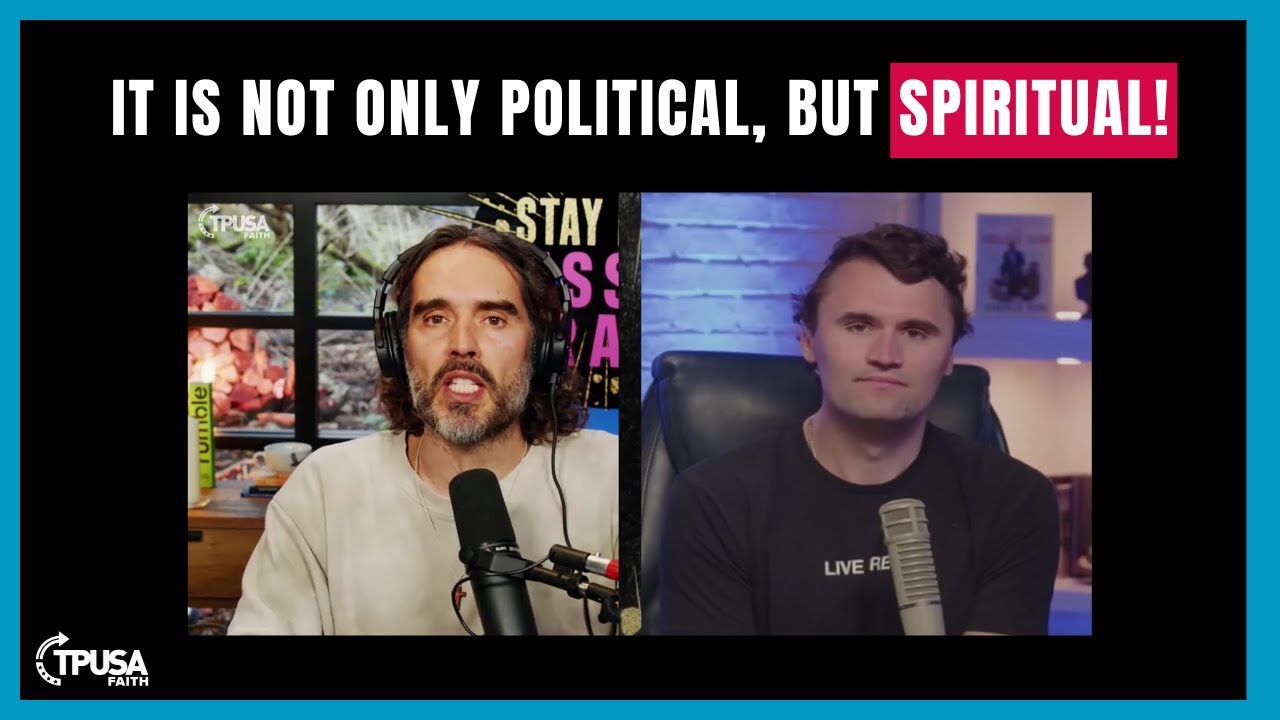
Charlie Kirk on How Christianity Informs Politics and Why Biblical Principles Must Shape Western Civilization
9:19

Steve Deace and Charlie Kirk Confront the American Church's Crisis of Courage and Masculinity
58:04
Steve Deace and Charlie Kirk Challenge American Churches to Reclaim Masculine Leadership and Biblical Truth
Steve Deace joins Charlie Kirk at Dream City Church's Freedom Night in America to deliver a confrontational message about the state of American evangelicalism. Deace, who survived a near-abortion and found Christ at a Promise Keepers event, argues the church has become dangerously feminized and corporatized. He challenges pastors to stop fearing people more than God, calls for vibrant men's ministries that give men structure and mission, and warns that both secular progressivism and Islam are squeezing Western civilization. The conversation tackles why young men are fleeing to Catholicism, when to leave weak churches, and why the greatest commandment has been replaced with conflict avoidance. This is an unapologetic call for the church to fight harder in the spiritual battle facing America.
From Abortion Survivor to Culture Warrior
Steve Deace opened the evening by sharing his remarkable testimony. Born to a 15-year-old mother in 1973, Deace nearly became an abortion statistic. His biological father's prominent Democratic family in Des Moines offered his mother and grandmother $500 to abort him. When she refused, they moved to California to start over. Deace grew up without strong masculine role models, struggled with aimlessness, pornography addiction, and obesity, and worked his way from a mail room to sports reporter before finding purpose.
The transformation came at a Promise Keepers event in Kansas City on September 18, 2003. Despite initial resistance to the masculine-focused Christian gathering, Deace experienced a profound conversion. He describes sobbing on the arena floor, purging years of sin and pain. But the conversion required follow-up. A community of men surrounded him afterward, providing accountability that continues two decades later. When one of those men recently lost his job, he immediately texted Deace for prayer, demonstrating the lasting power of authentic male Christian community.
The Feminization of the American Church
Deace argues that American evangelicalism has systematically driven away men by prioritizing emotional expression over mission and action. Churches have become designed around reaching "Karen" rather than "Ken," with every decision filtered through Church Growth Incorporated principles aimed at suburban mothers. The result is worship music, programming, and preaching calibrated to avoid offense rather than proclaim truth.
Men, Deace insists, are fundamentally different from women in their spiritual needs. While men may initially need to confess and purge their sins to brothers, they do not want perpetual emotional processing. They want a mission, competition, structure, and clear marching orders. When churches fail to provide this, men drift away or remain spiritually passive. The principle of headship means that reaching men brings families. Reaching only women often results in losing everyone.
Deace challenges pastors directly about the state of their men's ministries. Many pastors, he suggests, actively avoid vibrant men's ministries because equipped, organized men will eventually ask, "When do we go to war?" They will demand the church engage culture rather than retreat into comfortable suburban isolation. This makes them inconvenient for pastors who prefer Pottery Barn churches with Hawaiian shirts and pleated khakis over spiritual warriors ready for battle.
The Two Great Commandments Inverted
One of Deace's central theological critiques focuses on how evangelicalism has inverted Jesus's summary of the law. The two greatest commandments are to love God with all your heart, soul, strength, and mind, and to love your neighbor as yourself. The first commandment establishes vertical relationship with God. The second addresses horizontal relationship with people.
The modern church, Deace argues, has made loving your neighbor the supreme commandment, effectively placing people where God belongs. This results in paralyzing fear of offending neighbors while casually trifling with God. Pastors convince themselves that salvation depends on their marketing, their presentation, their ability to put the right frosting on the gospel cake. They forget that Jesus already did everything, pronounced it finished, and that human beings are not intermediaries in salvation.
This people-pleasing orientation produces what Deace calls evangelical monasticism—churches that exist as isolated suburban compounds with no intersection with their communities except someone on a riding lawnmower. It creates a generation of pastors more concerned with filling pews and paying bills than equipping saints for spiritual warfare. The job description of a pastor is simple: feed the sheep and shoot the wolves. Most churches have abandoned the second part entirely.
From Weak Church to Strong Church
Deace shared his personal journey of leaving a church he loved because it had become weak. The pastor was a good man, but the church's number one doctrine was non-confrontationalism. The breaking point came when the church brought in Preston Sprinkle, a figure known for introducing gender ideology into evangelical spaces. When Deace raised concerns, he was dismissed.
His 16-year-old son finally spoke up, saying he respected his father too much to complain but never wanted to return to a church where he thought he could beat up the pastor. This brutally honest assessment captured the spiritual impotence many young men sense in contemporary evangelicalism. They are not looking for emotional safety. They are looking for strength, conviction, and men worth following.
Deace offers a simple test for evaluating your church: If a drag queen story hour set up in your church parking lot during service, would your pastor immediately stop the service, gather the elders, and remove them from the premises? If yes, stay. If no, leave immediately. This single question cuts through all the justifications about relationships, history, children's programs, and coffee quality. It reveals whether a church understands the spiritual battle or has surrendered to cultural accommodation.
The Megachurch Mentality
Deace distinguishes between megachurch as population and megachurch as mentality. Calvin preached to thousands in Paris and Geneva. Spurgeon preached to thousands in London. Three thousand men, not counting women and children, were saved at Pentecost. Size is not the issue. The mentality is.
Does your church have elders who hold the pastor accountable, or a board of directors that acts like investors in a stock? Do you have people in leadership pretending to be irreplaceable? Can you name the successors being prepared to take over from the greatest evangelical teachers of this generation? The people knew Joshua would succeed Moses, Elisha would succeed Elijah, and that Jesus had apostles. Where are the successors today?
Deace insists that no Christian leader is indispensable. Salvation is between individuals and God. The veil is torn. There are no more intermediaries. If Dream City Church did not exist, the stones would cry out. This is not about diminishing the importance of the church, but about refusing to turn pastors and ministries into brands that eclipse God himself.
He describes watching Chris Tomlin and his band perform "Famous One" at a Promise Keepers event. When they finished, they set down their instruments, put away the microphone, and walked off stage without taking applause. They refused to accept a standing ovation for a song declaring that only Jesus is famous. This is the posture the church needs to recover—one that consistently deflects glory back to God.
Corporate Social Responsibility and Neutral Spaces
When asked about corporate social responsibility, Deace dismantled the entire concept of secular neutral spaces. Someone will always rule, something will always be worshiped. This is an iron law of the universe. Secularism was introduced to disarm Christians by convincing them that schools could just teach reading, writing, and arithmetic without worldview implications. Once Christianity was removed, new religions immediately filled the vacuum.
In France, where only about 2% of the population is evangelical, the old Catholic cathedrals have become strip malls, vacant buildings, or mosques. Someone will always rule. Something will always be worshiped. This applies to the corporate sector as well. Rush Limbaugh used to say a corporation's only job is to produce profit for investors. Deace, influenced by his Christian faith, now sounds more like J.D. Vance. He rejects the idea of morally neutral economic activity.
Every piece of legislation has a moral basis. Every government is a theocracy—the only question is who the theo is and whether they are actually God. We are beyond culture war now, Deace insists. We are in a cold civil war. The social compact that binds a people together before they confirm it in a constitution is broken. Just as it was either going to be the West or the Soviet Union, it will be our worldview or theirs. Two worldviews are walking into a steel cage match. Only one is coming out.
Corporations will either promote traditional values, progressive values, or the values of the spirit of the age. There is no neutrality. We are either selling Michael Sam jerseys or Tim Tebow jerseys. There is no in-between. Make up your mind and fight accordingly.
The Islamic-Secular Squeeze on the West
Charlie Kirk added a crucial dimension to the analysis: Western civilization is being squeezed by two allied ideologies simultaneously. While evangelicals have become adept at criticizing secularism, they are wholly unequipped to critique Islam. Most Christians do not know the difference between Sunni and Shia, cannot explain the Hadith or the Hajj, and have not studied the theological foundations of Islamic governance.
Kirk describes this as the red-green alliance—Marxists and Islamists coming together to choke out Christendom. He recently debated at Oxford and Cambridge, and London struck him as a conquered country. The city is full of contradictions: Yemeni, Omani, Pakistani, and Afghan populations coexisting with gay pride flags everywhere. This is not harmony but a peace treaty between two enemy forces that have agreed not to attack each other while suppressing the native British voice.
Islam is incompatible with Western civilization, Kirk argues. This is not about individual Muslims, some of whom are wonderful people and good friends. It is about Islam as a governing philosophy. Islamic countries do not believe in separation of mosque and state, private property rights as understood in the West, freedom of speech, or freedom from blasphemy laws. There is a reason Christians are not moving to the 50-plus Islamic countries while Muslims migrate en masse to Christian-heritage nations.
Deace added theological depth: Hell has denominations too. The picture from Boulder, Colorado showing a bare-chested Egyptian illegal alien bragging about Molotov cocktail attacks with a Pride flag flying on a government building in the background is not a contradiction. It is two branches of the same axis. Islam does not have "love your neighbor as you love yourself" as a core principle, which is why accommodation cannot be reciprocal.
Christians will grant Muslims their God-given rights and the accommodations that Islam would never grant Christianity. But there must be a line: Muslims cannot use their rights to spread influence through Western institutions for a false god. Kirk made a bold prediction: if God raises up a generation of truth-tellers, the greatest revival yet to happen will be Muslims converting to Christianity. They still honor Jesus and have some canonical familiarity. This will be one of the greatest moves of God in the next century.
The Path Forward: Intimacy with God's Word
When asked what encouragement to give those who desire change but do not know where to start, Deace returned to the foundation: intimacy with God's Word. The Bible is the only perfect thing on earth. He referenced Adrian Rogers, who once went into the woods discouraged about his ministry, opened his Bible randomly, and landed on a verse in Ezekiel: "Though they are a wicked and stiff-necked people, they will know that a prophet was among them."
This revealed to Rogers that his job was not results. His job was to deliver the message. The same principle applies to every believer. Our responsibility is faithfulness to truth, not control of outcomes. Before Deace does any speaking engagement, he does nothing. He goes into a corner stall in the men's room, prays, and walks out without script or notes. Whatever he says after that is not his responsibility. It is freeing to realize there is a God and you are not him.
The night concluded with a simple exhortation repeated throughout: open the Bible, do not self-edit it, include even the difficult parts, and tell people exactly what it says. Stop fearing the one who can destroy the body. Start fearing the one who can destroy body and soul and cast them into hell. Make the first commandment great again: love the Lord your God with all your heart, soul, strength, and mind. From that foundation, you will understand what it means to love your neighbor as yourself.
Video Transcript
Thank you everybody. Please take a seat. Uh this will be brief because we have a very special guest and I could listen to our special guest talk all day long. But I just want to reiterate something that Pastor Tommy said everybody. It's been four years of doing Freedom Night in America. Can you believe it? Four years. It's just been extraordinary. And um I believe it's really made a big impact here locally. Every day I have people come up to me and they say, you know, I'm running for school board. I'm getting involved. I'm a better Christian. I'm a better father. I'm a better student. And this is exactly what the Bible tells us to do. In the scriptures, it tells us in Jeremiah 29:7, which is what we originally said when we started this together with the Barnettes, seek the welfare of the nation that you are in because your welfare is tied to your nation's welfare. We are called to care about our city, to call about our state, to care about our nation. And everybody, this church and what Dream City has done has been a leader to other churches in the valley. you know that before we do this I want to just praise and single out other pastors come from across the valley for a round table beforehand and please raise your hands guys they do an amazing job and they're here to get resources filled up in any possible way because if we're serious about saving America it must start with the church and we're going to talk about that tonight and so I want to make sure I give you an appropriate trigger warning for tonight if you put Steve and I in a room together starts to get a little bit uh let's just say aggressive, but it's always rooted in the truth. Because look, we could spend our entire time here together tonight doing a victory lap. Everything's great. We won a November and praise the Lord, we did. But let's be honest, the American church is nowhere nowhere near as bold or courageous or strong as it should be. And Steve is uniquely positioned, in fact, I think he's one of the most equipped voices in the country to talk about this. You can see him on the Blaze. His podcast is awesome. We're really going to talk about some, let's say, some love in truth. Some truth in love, I should say. Some hard truths about how the church needs to fight harder and fight stronger in the spiritual battle that we're in. Give it up everybody for Steve Dace, everybody. [Music] [Applause] [Music] [Applause] Welcome, Steve. Thank you very much. So, uh, both Steve and I literally talk for a living. Uh, so this is going to be fun. Is there a clock? Because I am trained to fill air time. So, I will just keep going unless someone has an alarm. I I I will I will cut you off. Uh, fair enough. Or you cut me off. So, Steve, why don't we just Why don't you introduce yourself? Where are you from, your life story? Sure. I'm Steve Dace. I do the show on the Blaze. I'm on after Glenn Beck, which if you're Gen X or older is a little bit like if you were doing the show after Cheers or Seinfeld on NBC. Like, you're going to have to really be terrible at this not to hold some form of that audience, right? So, I I get to kind of, you know, gravy train off of Glenn. Um, but um there is literally nothing in my background that would indicate I would ever be here whatsoever. Uh I'm a kid born to a 15-year-old mom. Uh my mom found out she was pregnant uh at 14 from her high school senior boyfriend uh over Thanksgiving break in 1972 and several of her friends had already had abortions and she had contemplated doing the exact same thing. Um my paternal father's family were very prominent Democrats in De Moine at the time. My uncle was on the city my great uncle was on the city council. My grandfather was a very powerful district court judge and they tried to bribe my mom and my grandmother with $500, which was the cost of an abortion at the time, to abort me. Uh they did everything they could. They pressured them everything they could to get my mom to murder her baby, but she just couldn't bring herself to do it. And so on July 28th, 1973, at age 15, she had me [Applause] um and she took that $500, actually her and my grandmother did, and moved out to California with it and started their life all over again. And I wish I could tell you things were great. She met a Navy shoreman while she was out there. That's where I get my last name. He came from a very dysfunctional family as well. His dad was an alcoholic, very abusive. He modeled a lot of that to us as well. So, you know, my biological didn't bother. My my stepdad um thought that he could uh emulate Robert uh you know, Dval's great Santini as a model of fatherhood. So, I didn't come into this with a lot of great masculine role models or anything at all. Um I was a good student and a decent athlete growing up, but then after I went to college and like a lot of young men of this era, I was aimless. um overexposed to pornography, aimless, um just no purpose, nothing going on whatsoever. Um and then I met a girl and she's my wife now. And that gave me my first real direction, this idea that I' I've got to do more than work in the mail room here for the rest of my life. And and that but that only took me so far, right? And and then sooner or later, I was at a promisekeepers event uh almost over 20 years ago in Kansas City, an event that the day they announced it at the church we were going to, I thought, whatever else is happening on September 18th, 2003, I need to be there. And then the day before the event, I felt like I don't care what is going on at that event, I sh I should not go. I can't go. It's the worst place in the world. I shouldn't go. And it was at this event that the Lord converted me. Uh, and my wife would tell you that she's on her she's on her second marriage now. It just so happens the guy had the same exact first and last name both times, you know, and and my wife and I basically met in the in the AOL dialup chat room version of Tinder. Okay, we we did we did not think we were going to be born again believers with like minivans who homeschooled our kids. The joke was on us, right? We were just trying to sin, frankly, and the Lord had other ideas. What we meant for evil, God used for good. And so now, we've been married now for 28 years. My wife is a Liberty grad and has a professional Christian counseling service. I put the fund and fundamentalism on the blaze every single day. And we have three kids and they all love the Lord. Nobody hates America, right? Nobody's hair is blue. So, we must be doing something right. Okay. I I I love that story for a variety of reasons. And I just also want to pause. Think about how many Steve Dases are aborted every single year in our country. It's just there's a heaviness to that. And also, it should be hopeful that for every life that we're able to save from abortion, it could be somebody that impacts millions of other people. Every life is precious in the eyes of God. Secondly, Steve, I love that story because it shows the American dream is still alive. Yes. And I I just want to make sure that your story is so uniquely American. Born into a 15-year-old mom, you travel across the country, not a great father figure, and you still figured it out. Y the Lord met you. You you now have material success. You have a big platform. Only in America is a story like that possible, everybody. And we we must fight to the end to defend that. Amen. Hope and that truth. And Amen. So Steve, let me ask you, when you gave your life to the Lord, the PromiseKeepers event in 2003, t walk us through what provoked you with that. Was it It was obviously an overly masculine type event. That's how they operate. And do you think that the church is missing some of what you actually saw in that event back in 2003? So, you know, we started going to church because we had our first child, Anastasia, who shows up on my show every now and then. and now as an adult and she's married. Uh her husband uh is in the military. They have a beautiful granddaughter, Autumn. She is cuter than your grandkids and I will fight you when this is over over that. And um when we brought Anna home from the hospital, Charlie, I remember the first time we brought her home. We were in our crummy two-bedroom apartment. I had just started out um I had moved on. I moved my way up to sports reporter at the De Mo Register. And now I'm doing a local talk show, but there had never been a sports show in De Moine, so it's not exactly bill and seven figures, okay? And my wife wants to be a stay-at-home mom with the daughter. So, we're on one income, and we live in this crummy two-bedroom apartment. And the second apartment is where I had my prolonged adolescence. All right. It's it's where I kept my porn collection. Uh it's it's where I kept my video games and all that kind of stuff. Well, that was the only place we had left to bring a crib to put a crib for our baby. And I remember shortly after we brought Anastasia home, I I go into that bedroom and I see her there and and I went from very athletic in in high school, I'm now like 400 lb. I mean, I I've essentially got every malady of aimless young men of this era. I am the proto version of it. All right. I'm abusing food. I'm abusing sex. I'm searching for purpose, direction. And I remember looking at Anastasia and I just had this feeling of dread like this kid is screwed with me as a dad. And and I I remember thinking this is the one I think I have found the one thing Hillary Clinton is right about. It is going to take a village to raise this kid. Okay. And and I can see and look back on it now and see that was the wooing process. That was the Holy Spirit calling me trying to get my attention. And you know when I went to that promisekeepers, this had been about two years. It took two years from that moment to get to that promisekeepers. And I remember being there and walking into the arena and these guys are holding hands and singing songs and I'm like, "Nope, nope, nope. That's not happening." Okay. And then um the very first speaker was a guy named Joe White and he's doing this talk where he's erecting these life-sized crosses and he's I see a head nodding over there, right? and he's talking about and somehow he parlay parlays this these three men at the cross Jesus and then the two criminals and and and and then essentially they're archetypes of different forms of manhood and masculinity both fulfilled and dysfunctional and he parlays this into the damage that fathers do to their sons and I remember looking around this arena there's 12,000 people in there that night and I'm like who told this cat I was coming all right like this whole thing is like to set me up it's to ambush me right and then they take an altar call and I remember thinking, man, altar calls are only for really bad Pentecostal television. Okay, which is funny now because I go to a Pentecostal church and my Pentecostal minister is in the audience with me here, so God has a sense of humor. Okay, and and and I remember thinking, I need to get up and answer this call. And and I and then I thought, no, I'm not going to do this. I'm not going to prove God, you were right about me. And so I set my size back then size 50 jeans back down into that well more like squeezed back into that seat. And the next thing I know I am I've gone from the upper deck of Keer Arena in Kansas City. I'm on the concrete floor sobbing just years and years of tears of of sins that I have committed that have been committed against me. It's like I am purging darkness. Now here's the thing though. For that to take root, one plants and other waters, God gives the increase. For that to take root required a community of men who came around me after that. And some of And some of those men, I just got a text from one of them on my ride over here. He just lost his job. Now, we don't even see each other anymore all the time because we're busy now. And it's been 20 years. But 20 years later, he knows. 20 years later, he knows. He can text me right away and say, "Can you pray for me? I need some help. Can you call me when you get back from Phoenix because I I've got to pick my life up again, you know, at age 50 and I don't know what I'm going to do. Do you have those kinds of men around you men? Because I can promise you your chances that you're going to reach the finish line and hear well done, good and faithful servant decrease and diminish if you do not. You need to seek that community are churches. Our churches, you can tell a lot about a church by the condition of its men's ministry or the lack thereof. because frankly a lot of pastors don't want a vibrant men's ministry. So ladies, forget that you're in the room for a second and I'm just going to talk to the guys. We are not like them. We don't want to perpetually sit around and talk about what's going on in our lives. We will once or twice come to a barbecue or a steak fry and we'll purge our sins to our brothers and then after that we're like, "Okay, cool. I've got things to do. Are we going to go to war or not? And if we're not going to go to war, I don't have time to do this every week because we're not like them. Just the purging of emotion doesn't do for us what it does for them. We want results. What is the bottom line reason why I'm doing this? And so, a lot of times a church does not want a vibrant men's ministry because the men are like that. Because the men will say, "Okay, cool. I came forward. I confess my sins. The Lord's doing a work in my life. So, when do we go to work, pastor? When's the I mean, the shooting's already started. When do we go to the front? When do we go to the war?" And instead, I'd rather have most pastors I'd rather have my sweater vests, my pleated khakis, my Hawaiian shirts, and I'd rather be really comfortable in my Pottery Barn church where I' where I've got an evangelical monasticism in the middle of this suburb that I don't intersect with at all. And if you approached my campus at 2:00 on a Tuesday, nothing is happening except somebody on a riding lawnmower mowing the lawn. And that's why get in a church that engages the men, that organizes the men. Men need structure. Men need a mission. Men need to be challenged. Right? Most one of the reasons why we need women in our lives. You guys give us direction. You guys give us a purpose. We need competition. And the church, because the family has fallen apart, frankly, the church is going to have to provide a lot of that structure for the next generation of men. Everything was done in the last generation of Church Growth Inc. which I would send to the lake of fire if I could. Everything was done in the last generation of Church Growth Inc. to reach Karen. Every Christian music network has has a composite of Karen whose biggest struggle every day is will I will I get to my drop the kids off from school in time to reach my Pilates appointment. And that's why the music has to be uplifting and hopefilled. It is time to reach Ken. It's time to reach Charlie. It's time to reach Steve. Because here's the way the principle of headship works. And this is how it works. If you reach the men, you know, CS Lewis once said, "Aim for earth. Aim for aim for earth or aim for heaven, you'll get earth thrown in. Aim for earth, you'll get neither. If you aim for the men, you'll get the wife and the kids, too. If you leave the men alone, you'll get neither." We need to now make it a purpose to go after the men. They're clamoring for direction. in ways they haven't for a couple of generations. So the question now is will the church answer that call? [Applause] I I totally agree. So I I have a two-part question. Number one, when and why did that change? Because the church used to be really good at this. And then number two, why is it that the evangelical church seems so hostily uninterested in picking up the $1 trillion bill on the sidewalk? You guys understand right now this is the greatest growth opportunity ever for the Catholic Church with young men. It's like growing like crazy. They don't want to come to evangelical churches. They tell us that. We were just talking about this backstage. They're like too weak, too woke, too feminine, too feelings based. I want something that doesn't change. I want tradition. I want s I want something sacred. I don't want modernity. So evangelicalism is falling out of favor. And evangelicalism is a catch-all term for just what we all believe here, right? solos scriptorra, you know, just whatever you want to fill it in. Falling out of favor with young men. We could talk about the Catholic thing separately, but when and why did this change? And then just more interesting and curiously, why does the evangelical world just seem so just like, yeah, we don't need men. They're not they're doing nothing to reach them. Nothing. Well, you know, it's it's interesting. I was um I was on America Family Radio with the American Family Association earlier this week and and I said on their network I said when Don Wildman founded this ministry he understood that he was downstream from the church and that ultimately the church did the job of basic disciplehip and catechesus. And then people needed specific marching orders of where they were called now to take their gifts and what they had learned and go impact the world for Christ with it. and they went to parurch organizations like the American Family Association. What's happened in the last generation now since Don passed away and Tim has taken over is the American Family Association is now doing the Bible teaching that the church used to do. I will tell you the number one piece of feedback I get on my show other than why are you like this? Okay. The other number one piece of feedback I get is why don't I hear more like this in my church? Why am I getting more of this from a podcast than I from you than I'm getting from my church? And and ultimately, we have made two uh foustian bargains in the last generation. Number one, the American pastor is more full of Esau's than Jacob's instead of troubled, flawed men who are actively though wrestling with God. They have a call on their life. They have a purpose. They have a plan. They're not perfect. They can fall away. Jacob's name literally means schemer, by the way. Usurper. And so in instead of troubled men who have a call that they seek to fulfill, instead we're Esau's just going after the birthright filling our bellies right now. What will draw them in today? What will fill the pews today? What will pay the bills today? What's the path of least resistance today? We don't have elders anymore. We have boards of directors. We don't have creeds. They have mission statements. And church now on Sundays in most evangelical churches is for the unbelievers. And if you really want to be discipled, come back on Sunday night and then maybe it'll happen. But we collect the tithe and and make sure the lights are on and the bills are paid on Sunday morning. Evangelism is part of what the church does, but your primary mission is to equip the saints for the work of the ministry. That is disciplehip. So, so on one hand, the church has become heavily corporatized and and then what happened in the counterculture made it convenient and incentivized it. Feminism was the greatest thing that ever happened to boys who can shave. You may not get sex with women with no requirements, no responsibilities whatsoever. And then the woman's not stigmatized anymore either for acting out immorally, but now that's asserting her femininity. The the Babylon B ran a headline the other day. You might get mad at me for saying this. I'm going to warn you. Um but the Babylon Bee ran a headline the other day about Nancy Mace. All right. Who wanted to who who Okay. Okay. Good. All right. All right. And and and who's just an absolutely craven politician who's actually now showing nude pictures of herself in the Congress and and and the headline was Nancy Mace vows to keep showing naked pictures of herself until she finally stops the exploitation of women. All right. I mean, this is what feminism has wrought. Men who want to be sons of Adam, you know, we always we always read the story about Eve being tempted and succumbing. You ever wondered what's Adam doing the whole time? Just sitting there with his hands in his proverbial pockets. I got nothing. Nothing. Nothing's going on. And notice later, by the way, after the fall, God does not call Eve forth in the garden, does he? Who does he call? Adam. You ever wondered what how history might have changed if Adam would have said, "Listen, I had one job. You gave me headship here. You gave me a dominion mandate. I fell down. This is on me. I accept responsibility. What do I have to do here to make penance and atonement? Instead, Adam says, "Well, it's this woman you gave me and makes excuses." We follow in those footsteps as men. We want to make excuses because here's the thing we really understand about headship, but we don't want to admit. We think it's about authority. It is not. It's about responsibility. There already is an authority in this world. It's God. We don't want the responsibility of that authority then coming to us first when that family falls apart. When he comes to us first and says, "Uh, Adam, what you doing? Steve, what you doing? Richard, what you doing? Mark, what you doing?" We don't want that authority. And so, feminism and all the isms and social pathologies of the last generation gave us a let's get out of jail free card. And then what the church has done internally in the last generation with its theology is we have taken the the the the two greatest commandments that Jesus summarized the the ten commandments, right? Moses comes down the mountain with two stone tablets. The first is the vertical relationship between us and God. The second the horizontal relationship between one another, right? So the first is love the Lord your God while your heart, soul, strength, and mind. What does that look like? It's the first five commandments. And then the second is just like it. Love your neighbor as you love yourself. What does that look like? Well, it's the next five commandments. What the last generation of the evangelical church has done is said love your neighbor as you love yourself is actually the greatest commandment. Wow. People are now in the place of primacy where God is. Now listen, people are important. As far as we know, the only thing in the cosmos made in the likeness and image of the creator are people. I am a systematic theology nerd. I will sit here and the nerd out with you all night long. Okay? But Jesus did not die for a theology. He died for people. There is nothing more important in the kingdom of God, all right, that he has given us in his creation other than us. People are important, but they're not God. And so, we have made offending our neighbor worse than offending God. So, we will inject all forms of cowardice, all forms of heterodoxy, if not flatout heresy, into the church because I might drive somebody away. God has placed their entire salvation. Jesus went to the cross. He did it all. Pronounced it finished. But by golly, if you don't put the right frosting on Jesus's cake, people won't get saved. It's all on you. They're all up in heaven now waiting to see if you'll do your job. That's not how this works. That's not how any of this works. There is no way for your church. There's just the way. And his name is Jesus. You're not a way. You're a human being. And start stop fearing the one who can destroy the body. Start fearing the one who can destroy the body and cast the soul into hell. Amen. There is not enough fear of God. There is a lot of trifling with God. There's a lot of, "Well, God will just overlook things and let things go." No, he won't. And ultimately, we have to make that first commandment great again. Love the Lord your God while your heart, soul, strength, and mind. And then you will understand what it means to love your neighbor as you love yourself. Now, Charlie, I will tell you this though. I am concerned. there is an emerging movement in the church that is reaching the young men that agrees with everything I just said. But I am fearful that without proper guidance, they will actually fall into the opposite heresy in our time, which is they will stop loving their neighbor as they love themselves and they will turn people into ideological constructs. Listen, I was born white trash to a 15-year-old mom. I met my wife in the Tinder version of America Online. There was nothing in my background at all that would have indicated I'd be here doing this tonight having this discussion with you. So, we still need to give the Lord's grace room to work. Amen. All right. The the the the loving our neighbor as we love ourselves is eternally important. But I think it's way past time that we stop being way start being way more concerned with offending God than offending the pagans. And there are some churches that are getting it right. Dream City here, some of the churches here present, there is a remnant. But explain to me, Steve, why is it that the church has slipped and has fallen so significantly from what the church should be? I have my own theories. It's because actually it comes down to a first principle question. They have a different definition of what a church is. And therefore also secondly the other first principle error a category error is we have a different definition of what a pastor is. So if you can't answer those two questions then the third fourth fifth sixth seventh sequence you're going to be completely off chart off course please. I mean if you want to be a pastor your job description is very simple. Feed the sheep and shoot the wolves. That is the job description. Jesus says to Peter, "If you love me, you will what? Feed my sheep." One of my favorite quotes from Augustine, "There are many sheep without, but many more wolves within." All right, we we you know, now here's the thing, though, because we do want we are after all evangelical. So, it kind of means we're supposed to be evangel evangelistic, right? That's kind of in the brand, right? Okay. So, how do we know who's a sheep and who's a wolf? Boldly pro proclaim the truth in season and out of season. The consequences of how that truth is received is not your responsibility as a church or a pastor. That is not your responsibility. All right. But you'll find out a sheep will say, "Oh man, I didn't know." I was talking to uh one of your guys, Sloan, tonight before we came over here. Yeah. Great guy. and he was telling me about his wife and that his wife was originally a card carrying New York City Democrat and then she did this thing where she read the Bible cover to cover and she's like, "Oh, God hates that, hates that, hates that, hates that, hates that. I'm on the wrong side." The last great revival of the Jewish people is led by a king named Josiah. But it doesn't start with him. There's a priest named Hilkaya who one day is cleaning out the temple. And they've got all the pagan relics they've allowed to infest God's house. The starry hosts, all the Baal worship, all the asherupoles, all of the disgusting filth is in there. And one day he stumbles upon this dusty scroll and he picks it up. It's the word of God. It's the Torah. It's the law. And it ends in Deuteronomy with Moses saying, "I have set before you blessing and cursing. Choose life so that you may live in the land." And he's like, "Oh, snap." And he takes this to King Josiah. And Josiah now does not just reset the festivals and the law, but Josiah is the final king of Israel that goes to the high places and tears down the idols to Asher and the sex cult that bedeled the the the Jewish people for hundreds of years. All right. Open. I've got a I'm going to do I do strategy and messaging for a living. I do it on my show. I've done it for political campaigns. I People pay me. I think I'm pretty decent. I'm going to give you a freebie, though, if you're a pastor. Okay, here's my bright idea. Walk into a pulpit, open the Bible, read it out loud, and tell people what it says. That's what I got for you tonight. And you will be amazed at the transformation that takes place. the the the greatest weapon of mass destruction in any spiritual cultural war is a man of God with the courage to open up that book and tell people what it actually says come what may and ultimately and ultimately that is what is lacking the most and you'll know who the sheep are the sheep will respond and say wow like Sloan's wife we didn't know the wolves you'll find out they already knew they just didn't care throw the wolves out and feed the sheep So I love that. What is your me because this this is kind of part of your last two years. What is your message to somebody in this audience that is currently attending a weak or a woke church? What is the threshold for which they should leave and go to a church like Dream City or go to one, you know, a much better church that is biblically grounded? talk about your experience because the objections that we will receive are this. I got married in this church. I have memories in this church. They have a great kids ministry. They make great coffee. The parking is very organized. I like their worship music. There is some great coffee out there if we're going to, you know, be fair. But I mean, it's the part of what I hear, right? So, I I mean, I hear the whole gamut. And however, all of those are excuses. The one excuse that I do have a little bit of a tenderness for and I want you to just go into it and you can obliterate it is Charlie I have a relationship with the pastor and I'm making progress and I think I can you know get this towards a better conclusion. I say okay after five years through COVID and Floyd Palooa and the 2024 election you're still you know we're not there yet it might be time to move on. So you understand my question, Steve. It's very important. We're going to post this on podcasting, streaming. Millions of people listen to this and yet still there is a stubbornness in our audience that does not want to leave weak or woke churches. Steve, so the church we used to attend was not woke at all. Uh but it was weak. And frankly, I thought it's what I needed. I don't know you guys have picked this up in the last 20 minutes. I'm a little intense. All right. I I have actually tried to keep it fairly subtle for you guys tonight since he's the main event and I'm just the undercard. All right. But um this is me on the down low. Okay. And so I actually thought that a softer church would be good. I was always concerned with our kids that the fact that dad's job was the culture war would make the faith almost overbearing to them. All right. And so I thought maybe I needed to actually downplay some of the formalities and of of our liturgies so that the kids had room to breathe and work out their own salvation. Yes. And so I thought maybe it was therapeutic for me just to go to a church, you know, on Sundays and not hear the culture war. And then we get to the summer of 22 and Roie Wade is overturned. And in the middle of that message, my church made me feel like as you know, I helped lead the fight in my state for passing one of the very first heartbeat bills in America in America. And I mean, I I got to sign the proclamation in my state legislature the day that passed our legislature. And and and that's one of the bills that was used to overturn Row. and I'm and my pastor's making me feel like I'm some kind of a freak show because I devoted, you know, my faith and ministry to this cause. And then he basically apologized for the overturning of row. Hey, we're a pro-life church. But then he said, but we understand not everybody here agrees. And I thought, why are there people in this room who think child sacrifice is okay? Why are they why are they not made uncomfortable by feeling like this? And I I loved our pastor. I still he's a dear dear man. And and I had the same thing. I was meeting with him. I thought I was making some progress. And then one day we got an invite for a guy named Preston Sprinkle. That name ring a bell to anybody? Oh, he's the he's the protranny youth theater for um Campus Crusade. Yeah, he's the guy. Yeah. Yeah. I I He's on the Rob Bell character on Facebook. Yeah. Yeah. No, I I That's right. I've always wanted to attack him publicly, so please continue. [Applause] So, I'm like, it's weird. I don't know who this guy is. And with all due respect, my show is not as big as Charlie's, but it's a pretty big audience. I've have a lot of connections in the evangelical world. And I kind of think if we're inviting a speaker, and I've never heard of him, who is this? So, I called up a buddy of mine who's the pastor of apologetics for Jack Graham's church in Dallas, uh, Jeremiah Johnston. Jack is great. Yep. And I called him up and I said, "Hey, do you know of Preston Sprinkle?" And as soon as I got the words out of my mouth, Jeremiah goes, "Oh, so I know what that means." He goes, "Do not let that camel's nose in under your tent. Don't let him in." He goes, "He is absolutely sent by the enemy to disarm our churches. He's going to gain enough of a beach head. And then once he's got enough influence, just like Rob Belly told me, that's when he's going to write his love wins and show he was a heretic all along." Okay. So I'm like, "Uhoh." All right. So, I go to our pastor and he's like, "Yeah, but you know, my daughter handles that and she thinks new voices would be good." It was just very clear that the number one doctrine of this church was non-confrontationalism on every front. And at that point, I'm I'm kind of the Holy Spirit's working on me. And I go home one day and um at this point, our daughters are grown now, moved out on their own. So, it's just me, my wife, and my son. And he's 16. And I I call them together and say, "Hey, you know, I know you guys are ultimately going to say you believe in me. it'll be my decision, but I want your input. All right. I'm thinking it might be time to change churches. And my son jumps right up right away. He says, "Dad, I I I'm I'm so glad you said this. I He I respect you too much that I've just not said anything for the last few years, but I don't ever want to go back there again." And he said, "Dad, can we please go to a church where I don't think I can beat up the pastor?" Those words are literal words. And um the next weekend I thought I would check out Pastor Jesse's church because one of my one of my good buddies from my original men's group when we all got saved together at that promisekeepers goes to his church and he had told me a few months ago that pastor Jesse wanted to know why in the world is Steve Dace of all all people going to a weak church and I felt really convicted by that. I don't think I've ever said that to Jesse actually. And so on my own, unannounced, I went in there to check it out uh before I took the family. And I really just thought um I could just sense I'm like, "Wow, what is the difference between we're doing church and I can really feel like the spirit is moving here? Something is happening here and and we've been there ever since." So can you distill that into a rubric or a one, two, three way of thinking about it in practice? Let me make it very simple. Make it very simple. If if the training brigade showed up in the parking lot while service was going on and began doing drag queen storytime hour in the parking lot of your church, would the pastor of your church stop service right away to assemble the elders go out there to confront them and remove them from the premises? If the answer is yes, remain. If the answer is no, never go back. [Applause] [Music] And this is already happening organically and I think it needs to accelerate. And but Steve, what's been interesting to me and then I do want to get to some questions. I could, by the way, you're on fire tonight, Steve. I could listen to you. It's amazing. Uh, are you seeing, for example, your former weak non-confrontational pastor? Has he made any adjustments? Did your exit change him at all? And if not, why? You know, now that I'm 50, I have a lot of sayings that I'm repeating over and over again that aren't as cool as I originally thought they were. But one of them is this. No one can rise above their own worldview. And I I I just think he came out of a model and is invested in a model from another era. You know, between Francis Schaefer and Adrien Rogers and Jerry Fwell Senior, essentially the men who formed the original religious right, Billy Graham, James Robinson. between those people and what we have now and and churches like this that we're at tonight. We had Bill Hibles and Rick Warren. I grew up next to that church and and that and they were essentially the the bishops and the popes of American evangelicalism. And you know, the culture runs the world runs on the principle of headship that God's economy runs on headship. As great as this ministry is, it would be broken if you found out tomorrow that the head of the ministry had been keeping a great moral failing from you all these years. Look at what's happened to Gateway Church in Dallas with Robert Morris, for example. That's headship. That's why studies show that if mom takes the kids to church every Sunday and dad never goes, it's a flip of a coin whether the kids will go when they're adults. But if dad goes, regardless of what mom does, the kids will almost always go to church when they grow up. That's headship. That's responsibility. And and so ultimately the team takes on the identity of its coach. And the most influential voices in evangelicalism in the last generation were guys who wore Hawaiian shirts in in January and sweater vest in July. That's how we got here. And and the church is the team is their team and it's taken on their identity. You guys want to be blown away from by something? I was listening to a sports podcast while working out the other day and and one of the hosts was ragging on the other guy for dressing like a youth minister, like an evangelical youth minister. There's never Yes. There's never been anything about Christianity even alluded to ever in this sports podcast. But yet the the uniform of the hipster uniform of the American youth pastor has crossed over into the mainstream that even the unchurched know what that knows that uniform and knows what it looks like. All right, that is a problem. We are known way more guys for what's on the outside of the cup than what's on the inside. And here and here's the great irony of this era is the Pharisees are rampant. But now they don't have the furrowed brows anymore. They're not the fur. Well, except for Mike Pence. They're not the perpetually furoughed brow brigade anymore. All right. Now, the Pharisees, they look hip. They look welcoming, right? The orange juice is always crisp. The donuts are are is always fresh. The donuts are always crisp, right? And hey, if you've got donuts and juice at your church, that doesn't mean you're a bunch of sellouts. But is that what you're actually known for? And let me say this, too. I want to make sure this point is very clear. Mega church is not a population. It's a mentality. Calvin preached to churches in the thousands in Paris and Geneva. Spurgeon preached to churches in the thousands in London. That Pentecost 3,000 men, not counting the women and children get saved. By our modern measurements, that would be a mega church. Megaurch is a mentality. Do you have elders that hold the pastor accountable or a board of directors that act like they are investors in him as a stock? Do you have people in your church in leadership that you pretend are irreplaceable that they just they could never be replaced? You know what? Let me say this to you guys. I said this backstage. Let me say it here. I want everybody in this room to think of the five or 10 greatest evangelical teachers still alive and at work today and ask yourself, do you know who the men are positioned in their own congregations to take their place? Do you know who that is? And I promise you, you're not the answer is going to be no. That's a problem. The people knew that Joshua would succeed Moses. The people knew Elisha would succeed Elijah. The people knew there were that Jesus had apostles. Who are the successors of this generation? Where are they? You're not that valuable. You're not that indispensable. Nobody is. All right. The salvation of the people is up to the Lord between them and the Lord. You're not. If you want to if you want to pretend that your church is an intermediary, congratulations. Go back to 1516. You just undid the reformation. There's no more intermediaries between God and man. The veil is torn. We individually approach the throne of grace and whether even Dream City Church didn't exist, the stones would cry out. We have forgotten that. Get off your high horse. You're not a brand. You're not that important. All right. One of the coolest things I ever saw in my life is is after getting saved, I went to a promisekeepers a few years later in my hometown of De Moine and and there and Chris Tomlin and his band were the music and they sang his song Famous One and when they got done they all as we were all as men. Now what's funny now at first I was like I am not singing with these freaks. Now I'm like singing my heart out a few years later. All right. And and as we're all singing along to the chorus, they all took their took their instruments, they set them down. He put his microphone away and they walked off the stage so they didn't take any applause because it would be kind of ironic to sing a song called Famous One that only Jesus is famous and then take a standing ovation for that at the end. You know what I'm saying? We're not that important. And here's the cool thing about that though. When we accept that, it is one of the most freeing things we will ever experience, ever. You mean there is a God and I'm not him. This really isn't all about me. This really doesn't rise and fall completely on me. Really? And and I can now sit on his shoulders. I can rest on his shoulders, rest on him. You know, you want to know what I do before I come out and do one of these speaking engagements? Nothing. I go into the men's room in the corner stall. I get prayed up. No script, no notes. And then at that point, whatever I say is not my responsibility. Take it up with him. All right. That is so very freeing to think I have to prepare all of the time. Script everything all of the time. We have a script. Genesis to Revelation, 66 books. Here's my big bold idea. I'll repeat it again. Open the book up. Don't self-edit it. Even the icky parts. Those are the those are the most fun ones. Open the book up. go all the way through it and tell people exactly what it says. Let's do some questions. Let's start lining up here. Steve, uh, while we get the questions going here, how can people follow you, listen to you, the that are uh, moved by what you're saying tonight. Thank you, brother. You know, the easiest thing to do is to follow me on X, formerly Twitter, because that kind of centralizes all the content I put out. That's Steve Dshow on X. Steve Dace Show on X. Shameless plug. Um, Amazon is actually trying to shut our book down as we speak because it's never easy. All right. First they approved it, now they're telling us it's in review. But I have a mock to me. I I think we need to bring there are some things the Catholics are right about. For example, the old Irish Catholic saying, what the devil hates the most is to be mocked. I think we need to make mockery and scorn great again. All right. I'm talking Elijah and Mount Carmel like mockery. Like when Elijah says to the prophets of Baal while they're cutting themselves and getting nothing and he says, "Well, maybe your god's on maybe your fake demon god's on the toilet, so he can't respond." He's mocking them, trolling them. Why? Because the people need to see this isn't real power. To quote the great prophet Rocky Balboa, he bleeds like I bleed. They need to see there's no power in these shibilits. There's no power in these idols. Mock them, scorn them. That's why Elijah did that. He wanted the people to see what they worshiping has no power. It's not worth your fear and reverence. Only God is. And so in that spirit, I think it's time once and for all to take Pride Month down. And so my little effort to do that, to pull Pride Month's pants down, but not in the way that they would like, is with a new book called Richie Meets the Rainbow. And it's I endorsed it, right? You did. Yes. And it's a children's book, but it's really for adults. And it's really for dads. And I'll give you a hint. The dad when when his kid comes home and says, "Dad, why is my blue-haired teacher trying to trans me and show me rainbows with only six colors?" The dad does this really cool thing. He takes out the Bible, shares the actual story of the rainbow with his son, but then he gives an action step and he says to his son, I am going to become a very familiar presence at the local schoolboard meetings here on out. All right. So, we make the dad the hero at the end of this. And so, if you want to get more information about that, you can go to Richie Meets the Rainbow with Ricie. Richie meets the rainbow.com. Phenomenal. Thank you, Steve. Let's start right here. Hey, guys. Hey, Steve. Nefarious is amazing, by the way. Just throwing that out there. Hey, um I just got newly activated and saved a few years ago and I just became familiar with the book of Enoch and I'm wondering if you guys consider that cannon that was taken out by I don't know conspiracy theory stuff because I read it's in the Ethiopian Bible but not here. So it's not canonical. Do you want to start and I can Well, my understanding is is although it's we believe that Jude we think quoted Enoch, right? Correct. Okay. So my understanding is it's not canonical for the re not the reason some of the other books are not in this case it's not necessarily that they thought the the church fathers thought the teaching or the protestant church fathers at the reformation thought that the that the book was heretical necessary necessarily but it's a it's a it's the authorship could not be authenticized and that was the big issue with Enoch well yeah but also it's not I I could be wrong it's not even apocryphal I mean meaning that even in the Catholic Bible the book of Enoch is not I could be wrong no I know I first and second Mcabes But let second events. No, no, no. It's not. I don't think it is. So, for those that don't know, the book of Enoch, we we only have it because of the Dead Sea Scrolls, which is only about a 60-year discovery. There is some mysticism in the book of Enoch that gets in who the sons of God are in Genesis that has some great tension with normative trinitarian Christian theology. Here's the one thing that we will say. Enoch, interestingly enough, in the Bible, here's a fun trivia question. Only two people to go to heaven besides Jesus. Elijah and Enoch. Uh Enoch actually ascended to heaven. The more interesting question that we need to ask is the term Enoch, who exactly was he in the first couple books of Genesis. Uh who were the Nephilim? You guys could go, you know, into like, let's just say dangerously deep rabbit holes on that. That is what we call an openhand theological issue, not a closed hand theological issue. Right? If you think the Nephilim are like an alien race that came down to the earth, great. You might be right. They built the Aztec temples. Couldn't care less. Most important question is who is Jesus Christ? Right? So it it you guys can kind of go in those different circles, but it's also not canonical for the reason that we as so this is a really important point that we as Christians and we as non-atholics have an identical Tanakh TNK Torah and Ketchum of the of the Jews. The Jews do not believe the book of Enoch is canonical. So in about AD80, right after the life of Christ, there was a huge meeting of rabbis where they established what we consider to be the Old Testament. So if you go to a Jew in Jerusalem, they will have an identical Old Testament as we have. The Catholics do not have an identical Old Testament. They have first and second Ma Mcabes. They have the wisdom of Ben Sarah. They have other books that I think are um like let's just say uh the extended edition. Um now there's wisdom in those books, but they're not canonical for a lot of different reasons. So we actually draw what we think is divine as to what Jesus was taught was divine when Jesus walked on the earth. And when Jesus walked on earth, the book of Enoch was not central doctrinal theology of normative Judaism at the time. Would that is that correct? Correct. And in fact, you the point you made there about the rabbitical conclave that was held in 80 AD. Uh that reminded me a lot of the Jewish um spiritual ecosystem at the time Christ arrived was very similar to the world that we have today. All right? There there was a lot remember God had not spoken for 400 years, right? So we get the we get the Dead Sea Scrolls because this sect called the Ascends going out on the Dead Sea to they're go they're out there to copy the Old Testament and essentially they think Messiah is coming. So they're out there to wait for him and copy the the scriptures while they're awaiting him. There was just as there's great fascination in esquetology and our day there was great uh fascination at the time of Christ in the time leading up to it with messianic prophecy and would it be fulfilled when God would speak again? There were all kinds of people claiming to be Messiah that were false messiahs. Um there was a lot of mysticism that came out of this period. And so one of the reasons why just like we had a council in Nika to correct some of the Gnosticism and Aryanism that happened in the first couple centuries of the church. One of the reasons that the rabbis had this conclave in 80 AD is be around there is because they also were very concerned at the amount of error that was cropping up within Judaism at this time as well. You know, there's a great podcast out there called Haunted Cosmos by guys who are hard that are both pastors that get into this stuff biblically and it's very fascinating. I don't ever miss an episode. I find it very interesting. But let's make sure we don't turn it into an idol and that ultimately the heart of the gospel. Now, the heart is the central organ of the body, right? Did I say it was the only organ of the body? And if other organs fail, your body could still die, right? But we know if the heart fails, you will die. We know that for sure. some other organs may fail. You may or may not die. But we know if the heart fails, we die, right? Never remove the heart of the gospel. Okay? Sin, salvation, repentance, redemption, restoration. That's the heart of the gospel. So there should be a there just like you have just like heart disease is the number one killer in our culture. And so there's an inordinate amount of medical care predisposed and targeted towards what's going on in terms of your cardiac health. The amount of time you spend in the Bible should also focus and have an inverted ratio towards the heart of the gospel rather than some of these other issues which I'm not saying are not important but should never be a substitute for the heart of the gospel. And and last thing, so the Dead Sea Scrolls, all the attention goes to the book of Enoch when it shouldn't be. The most amazing discovery in the Dead Sea Scrolls is an exact copy of Isaiah word for word, syllable for syllable, going back thousands of years. basically saying because one of the ways that they tried to refute Jesus Christ was like, "Oh, all these prophecies you say that he fulfilled was actually just like after editing of Isaiah. It wasn't like virgin birth and that he came out of a root shrew of dry ground. Basically a retcon." Yeah, exactly. Isaiah 53. No, no. The Dead Sea Scrolls had a perfect intact copy of Isaiah identical to our Isaiah going back thousands of years, shifting the window so much that even like the Bible skeptics were like, "Whoa." The fact that Isaiah was like word for word in the Dead Sea Scrolls shows that the Bible of course is true, but the Bible skeptics set back their argument generations. Thank you very much. Next question. Hello. Uh, thank you for coming here. Uh, my name is Micah and you mentioned multiple times that we were in the last generation. I was just hoping that you could tell me what that mean. Oh, um, well, I don't know if we're in the last generation esqueologically or not. And the church has throughout the centuries from the very first century thought that it was in the last generation. I do believe as as a culture to me the minimum stakes if if if the current spiritual war were um were played for stakes. The minimum stakes were playing for is what's left of Western civilization. And if western civilization is defeated and goes away, what will what will replace it? Well, what came before were the dark ages. Now, the new dark ages will not be like the old ones. You're not going to have, you know, rat droppings cause black plagues. We've got indoor plumbing, but the new dark ages will look like an episode of Black Mirror. You want to have a black plague, you'll have Black Mirror. Everything will be technocratic. You'll be governed by social credit scores. Your electric car will be turned off if you're if they don't like what you say, right? I mean, it'll it'll be like an episode of the Twilight Zone or Black Mirror. And so, we are in the determinative generation, I believe, right now about whether or not Western civilization is going to survive. Now, what is Western civilization? It's basically what we used to call Christryendom. That's essentially what it is. All right. It is it is countries that were greatly influenced by the Christian church and adopted those traditions into their customs to the point that it influenced their way of life right down to the way that they adjudicated their laws, right? And and that's, you know, and and that's where America comes from. America really is the last outpost left of Western civilization. We are all that remains. Now, don't be too concerned about that, though, because that's happened before. In the greatest generation, we were all that was left, too. All that was left of Western civilization and stood between us and Hirohito and and and Hitler and Mussolini was us. So, other previous generations were the terminal generation and they answered the call. They were up to the task, right? We need to follow their example. Thank you. Next question. Hi Charlie. Hi Steve. Um I would love to know your thoughts on the idea of corporate social responsibility. So do largecale companies that affect lots of people's lives have um an obligation to weigh in on social and political issues or would everyone just be better off if they just stuck to selling? I mean I don't know if they could agree with us or not. That's kind of what it comes down to. I mean first of all I don't believe there's any such thing as the secular and there are no neutral spaces. All right. If if if anything I said tonight you will not remember, please remember this and take this with you. All right? Someone will always rule, something will always be woripped. Iron law of the universe. Someone will always rule. Something will always be woripped. So in the last generation, secularism was introduced to disarm us and to make us think, yeah, our schools could just teach reading, writing, and arithmetic basic skills and and get the Christianity out of there. That was all done to remove us so that the new religion could take its place. All right? And and and you see this in Europe about 2% of France is evangelical. The old Catholic cathedrals are now either strip malls, vacant or mosques because someone will always rule and something will always be woripped. Right? So that applies to the corporate sector as well. All right? And and this is where you know, listen, I don't want to be smurch Rush. His brother's a good friend of mine. None of us would have our jobs without him. But this is where my Christian faith has changed me as a conservative. And I frankly sound more like JD Vance now than I sounded when I was a Rush baby 30 years ago. Because Rush used to say the only job of a corporation is to produce a profit for its investors. And I was like, "Yeah, because I believed that there were moral neutral spaces." No, there's not. You've heard people say you can't legislate morality. It's the only thing you can legislate. Every piece of legislation has a moral basis to it. It's just a matter of whether or not it's actually moral or not. Well, you want a theocracy. Every government that's ever existed has been a theocracy. It's just a matter of who the theo is and whether they are really the theo or not. Okay? And so, we have to get out of our heads that there are going to be neutral spaces. There aren't. We are also beyond a culture war now. We're in a cold civil war now. That's where we're at with the social compact, meaning that which binds a people together before they they they confirm it in a constitution. If you've been married, you and your spouse had a social compact before you went to the altar. The things that bound you together were already determined. That wedding is not what determined those things. It's the confirmation of them. Right? So, the social compact is broken. And so, we're now in a we're in a cold civil war. And just as it was either going to be the West or the Soviet Union, it will be our worldview or theirs. It's a steel cage match. Two world views are walking in. Only one's coming out. Now, I don't know about everybody else in this room. I kind of like wars better when my side wins and their side loses. All right? And so therefore, we're going to have to recognize there are no neutral spaces. Corporations will either promote their values or the our values or the values of the spirit of the age. There is no neutrality. Now, we're either selling Michael Sam jerseys or Tim Tibo jerseys. There's no in between. So, make up your mind and fight accordingly. And I will add to that, the only disagreement I have is that there's actually two allied ideologies that are trying to squeeze the West. And one of my I just stumbled into this, I guess, because I think the church is so neutered. And I think Steve will agree. the the theological um misunderstanding fear around Islam with Christians is so scary like okay 911 happened and everyone talked about Islam for like a decade and now for the last decade we're like oh we can get along with Islam like hold on there is an Islamic takeover of the west that is happening simultaneously with a secular and I call it the great squeeze the red green alliance the Marxists and the Islamists and the Muhammadans are coming together to simultaneously choke out Christendom or Western civilization. And we've gotten really good at criticizing secularism. I got to give us credit. Like, we're good at that. We are wholly unequipped at criticizing Islam. Agreed. Like, we don't know what the Hadith is. We don't know what the Haj is. We don't know the difference between the Quran or Shia or Sunni. And it's about time you start learning because if I just came from London a couple weeks ago, I debated at Oxford in Cambridge. Maybe you saw the video was mostly mostly peaceful and u Oxford Oxford's coming out in a couple days and that is a conquered country and it's a city full of contradictions. You have Yemen, Omani, Pakistani, Afghan. I mean it is completely Islamic with gay pride flags everywhere. You're like, well that's makes perfect sense because it's no different than two enemies that have taken over a land and they have a peace treaty. I won't take down your gay stuff. you won't go and you just kind of say but we're not gonna we're not gonna allow the westerners the native Britain any voice. So we understand that it's like a peace treaty between two different competing forces no different than Hitler and Mussolini or Hitler in Imperial Japan. So all that to say, we have to become more equipped and everybody, it is so glaring. This is it is actually easier to make the theological argument against Islam to the church than even the secular one because we we know this. We it's it's the it's the son of Hagar. It is I is Ishmael. It is prophesied. We know what they believe and it's not what we believe at all. And we could see it by their fruit. 50 plus Islamic countries and Christians aren't moving there, but they're all moving to our countries. They don't believe in separation of mosque and state. They don't believe in private property rights like we do or freedom of speech or blasphemy laws. Anyway, so lot that I can go there. I just want to make sure and it's just a pet project of mine. I sent out a tweet the other day. I said Islam is incompatible with Western civilization. 60 million people saw that tweet because I think I really struck a nerve because people are afraid to say that. And let me say it again. I'm not saying that you might not have good friends that are Muslims. My primary care doctor is Muslim. He's a moderate Muslim. He's amazing. Dr. Zuti Jasper. You might know him. Great guy. That's not the point. The point is Islam as a governing philosophy is it compatible with the West and it's completely at odds with Christendom and it's about time we start waking up to it. Can I add one thing to because I I want to make sure this if if right-wing watch or any of those uh periodicals are watching line. Okay. This is just so you guys know this is the part you should be sending your press release out about. I'm going to make your job easy for you. Okay. So just to add to Yes. Exactly. Ju just to add to that, just as we have denominations, so does hell. So just as we have denominations that and and have vehement arguments because sometimes you'll hear conservatives say things like, "Well, you're holding up here queers for Palestine sign." Have you ever tried being a queer in Palestine? As if we like got them in some like cosmic hypocrisy they never understood or didn't know, right? No. What? They're part of the the same axis. All right. Hell has denominations, too. So that's why the picture from Boulder, Colorado over the weekend with the bare-chested Egyptian illegal alien bragging about the scorched march from his Molotov cocktails on the sidewalk. Did you guys see what was over his shoulder? Not just that, even a flag. A flag on a government building over his shoulder flying proudly. Let me tell you, there's a that you don't get one half of that picture without the other. And the thing you need to understand about Islam too, there is no love your neighbor as you love yourself in Islam. So when Charlie says things like Islam is not compatible with Western civilization. Well, what does that mean then? You guys are going to criminalize my religion. You're going to eat. No, we're not. We we won't do to you what you do would do to us because we have to love our neighbor as we love ourselves. All right? So no, we will grant you your made in the image of God, too. We will grant you your God-given rights, the accommodations that you would not grant us, but you cannot use your God-given rights in order to spread and influence our institutions for a false god. Amen. That is where we will draw the line. We'll get to this question. And I'm going to make a prediction. If there if God will rise up a generation of truth tellers, the greatest revival that yet is to happen is Muslim the Christian. They still honor Jesus. They still have some canonical familiarity. Islam to Christianity will be one of the greatest moves of God in the next 100 years. Mark it down, write it, and go to work on it. I'm telling you, it's going to happen. Yes. Hello. Thank you guys for coming tonight. Uh Steve, I loved your testimony and learning about your radical transformation. What words of encouragement would you give to those who desire a change in their life but don't know where to start? All right. Um, I to me, you cannot have a more intimate relationship with God initially than with his word. And I I I'm going to sound like a broken record, but it is the only perfect thing on the earth. And I mentioned a name earlier, Adrien Rogers. And when he told a story about when he first got into ministry, he did an oldfashioned Baptist tent revival and like nobody came. And he thought, maybe I I I wasn't called to the ministry. Maybe this is what I'm supposed to do. I'm very discouraged. So he said, "I wouldn't recommend you do this, but I took my Bible." I went out into the woods and I said, "Lord, I need to hear a word from you. If you have truly called me into the ministry, I'm going to open up this Bible. And when I looked down, it better speak to me." And he randomly opened his Bible and he looked down and it was a verse in Ezekiel where the prophet says, "Though they are a wicked and stiff necked people, they will know that a prophet was among them." And he said, "Wow, that told me right away, my job is not the results. my job is just to deliver the message, right? But he got that intimacy
Related Books
Browse Conservative Books