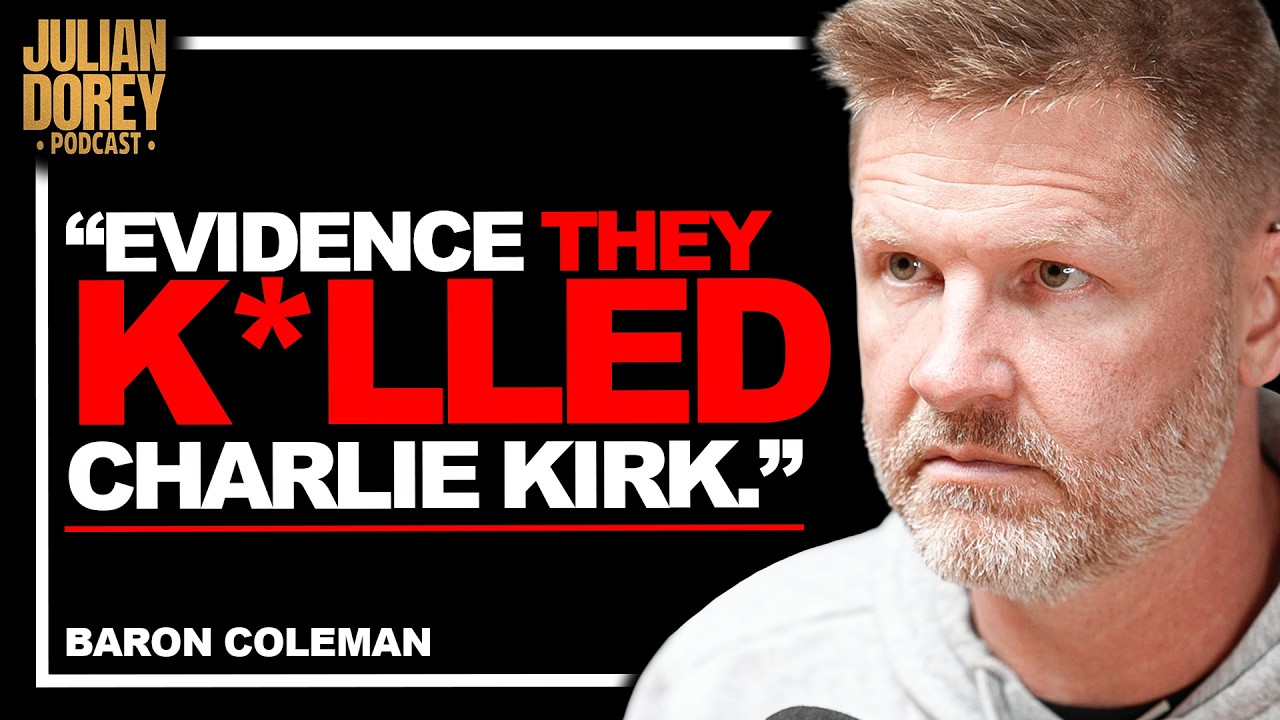
The Mystery of Charlie Kirk's St. Michael Necklace and What Federal Agents Were Really Looking For
Enjoying this? Share it with someone who needs to see it.
Up Next
Candace Owens Reveals Evidence Charlie Kirk Murder Camera Footage Was Edited by Terryl Farnsworth
14:54
Candace Owens Reveals What Erika Kirk Said During Four-Hour Meeting About Charlie Kirk Investigation
1:14:01
Candace Owens Reveals Never-Before-Seen SUV Evidence in Charlie Kirk Case as Turning Point USA Threatens Sandy Hook-Style Lawsuit
1:07:04
The Mystery of Charlie Kirk's St. Michael Necklace and What Federal Agents Were Really Looking For
Candace Owens examination of the unusual focus on Charlie Kirk's St. Michael necklace following the events of September 10th raises troubling questions about what federal agents knew and why. Multiple Turning Point USA members recounted personal stories about the necklace, while law enforcement reportedly searched for it at the scene. The intense interest in this piece of jewelry, combined with other irregularities including soil excavation, missing footage, and the absence of standard forensic tests, points to a theory that challenges the official narrative. This analysis explores why explosive residue, not a rigged necklace itself, may explain the federal fixation on recovering this specific item.
The St. Michael pendant that Charlie Kirk wore on September 10th became the subject of extensive storytelling among Turning Point USA members. Multiple people within the organization shared personal accounts about the necklace, creating what some observers found to be a bizarre amount of attention on a single piece of jewelry.
According to various accounts from those close to the situation, the necklace featured a cross and St. Michael's medal. Erika Kirk explained that she had given Charlie the necklace when they were dating, encouraging him as a Christian to wear a cross. Initially resistant because he wasn't a jewelry person, Charlie eventually put the cross on during a moment when he felt the weight of the world on him and never removed it again until the events of that day.
The necklace was reportedly ripped off as people tried to save his life. What happened next raises significant questions about law enforcement's priorities and knowledge.
Why Were Federal Agents Searching for the Necklace?
One of the most perplexing aspects of this story is that law enforcement was actively looking for Charlie Kirk's necklace. When someone from the team retrieved belongings from the vehicle, they discovered the necklace draped over a bag. A cop reportedly said, "Oh, we've been looking for that."
This raises immediate questions: How did the cops even know that Charlie was wearing a necklace that day? Why would a necklace be a priority item in their investigation? The level of interest federal agents showed in recovering this specific piece of jewelry suggests they believed it held evidentiary value.
The necklace was eventually given to Mikey to pass along to Erika, who now keeps it with her at all times.
The Explosive Residue Theory
A theory emerged suggesting the necklace itself might have been rigged as a weapon. However, this theory can be strongly discounted for two critical reasons. First, it would introduce uncontrollable variables into a carefully planned operation. There was no guarantee Charlie would wear the necklace that morning. Second, placing an explosive on someone traveling in a highly pressurized airplane cabin alongside Mikey McCoy, Blake Neff, and the entire team would have been extraordinarily reckless.
A more plausible explanation for the federal focus on the necklace centers on explosive residue. If an alternative theory about what happened is correct, the necklace would likely contain the most explosive residue of any item because it was positioned directly on Charlie's chest. If federal agents were involved in a cover-up, securing that necklace would be essential. The safest way to make it disappear from the investigation would be to give it to his widow, effectively removing it from the chain of evidence.
A Pattern of Anomalies That Suddenly Make Sense
When examining the theory that Charlie's microphone was rigged rather than a traditional shooting taking place, numerous oddities from September 10th onward begin to align in a coherent pattern. Each strange detail that seemed disconnected suddenly fits into a larger picture.
The bomb dogs were kept away from the scene, which would make sense if explosive material was present that investigators wanted to conceal. The crime scene was immediately paved over and the soil was excavated, an unusual step that becomes logical when considering the properties of explosives like PETN.
The Science of Explosive Residue in Soil
Scientific research shows that PETN in particular has low water solubility and high soil absorption. This means explosive residue clings tenaciously to soil, making it extremely difficult to eliminate without physical removal of contaminated earth.
Dan Merrill, a production assistant called in on a Sunday to work the scene, described arriving to find that another government team had already excavated 8 to 10 inches of soil from around the entire area. Everything under where the pavers were located had been removed. When asked why so much dirt was excavated, Merrill admitted he wasn't looking at the situation with a suspicious lens and it didn't cross his mind to question it.
The high soil absorption characteristic of PETN would explain why such extensive excavation was necessary. This wasn't about recovering bullet fragments; it was about eliminating evidence of explosive residue.
Additional Anomalies Explained
Several other irregularities fit this alternative theory. Shattered black plastic or glass was reportedly seen all over the SUV that transported Charlie to the hospital. Under the rigged microphone theory, this would be debris from the road mic.
No available footage or eyewitness reports exist of someone firing a shot from the building in question. Despite the official narrative, no one has come forward saying they saw the shooter take the shot. This absence becomes less mysterious if no shot was actually fired from that location.
Federal agents did not conduct a standard GSR (gunshot residue) test when Tyler Robinson was brought in after what was described as a 33-hour manhunt. If Robinson was wearing the same outfit and had fired a weapon, this test would have been standard procedure. The failure to conduct it suggests investigators knew he would fail the test, which would undermine their case.
The SD Card and Missing Evidence
Another anomaly involves someone violating the crime scene to remove an SD card from security footage. This footage would have captured whether the fatal injury matched the official narrative. If the evidence contradicted the gunshot story, removing that footage would be essential to maintaining the official version of events.
No Ambulance on Standby
Unusually, there was no ambulance on standby at the event. This represents a significant departure from standard security protocols for high-profile political events. The speaker notes that ambulances were always on standby at Turning Point USA events during their touring days.
Under the alternative theory, the reason becomes clear: paramedics would have seen shattered road mic pieces and other evidence that did not support a gunshot wound. Having the security team transport Charlie instead avoided having trained medical professionals examine evidence at the scene.
The Forgiveness Paradox
Perhaps one of the most psychologically revealing details is that Erika Kirk was quick to forgive Tyler Robinson publicly, yet took much longer to address her feelings about Drewski. When she finally spoke about Drewski weeks later, she appeared looking like an assassin and expressed far more anger toward him than she had shown toward Tyler Robinson.
This inversion of expected emotional responses is bizarre. It becomes easier to understand if Tyler Robinson didn't actually do what he was accused of doing. Forgiving someone who didn't harm your loved one is considerably easier than forgiving someone you believe bears actual responsibility.
Connecting the Dots
Each of these anomalies standing alone might be dismissed as coincidence, administrative oversight, or the chaos of a traumatic situation. However, when examined together under the framework of the rigged microphone theory, they form a coherent pattern. The necklace, the soil excavation, the missing GSR test, the removed footage, the absence of an ambulance, and the paradoxical forgiveness all align with a narrative that differs substantially from the official account.
The intense federal interest in recovering Charlie Kirk's St. Michael necklace may represent the most revealing detail of all. It suggests investigators knew the necklace would contain evidence that contradicted the official story, making its recovery and removal from the investigative process a priority.