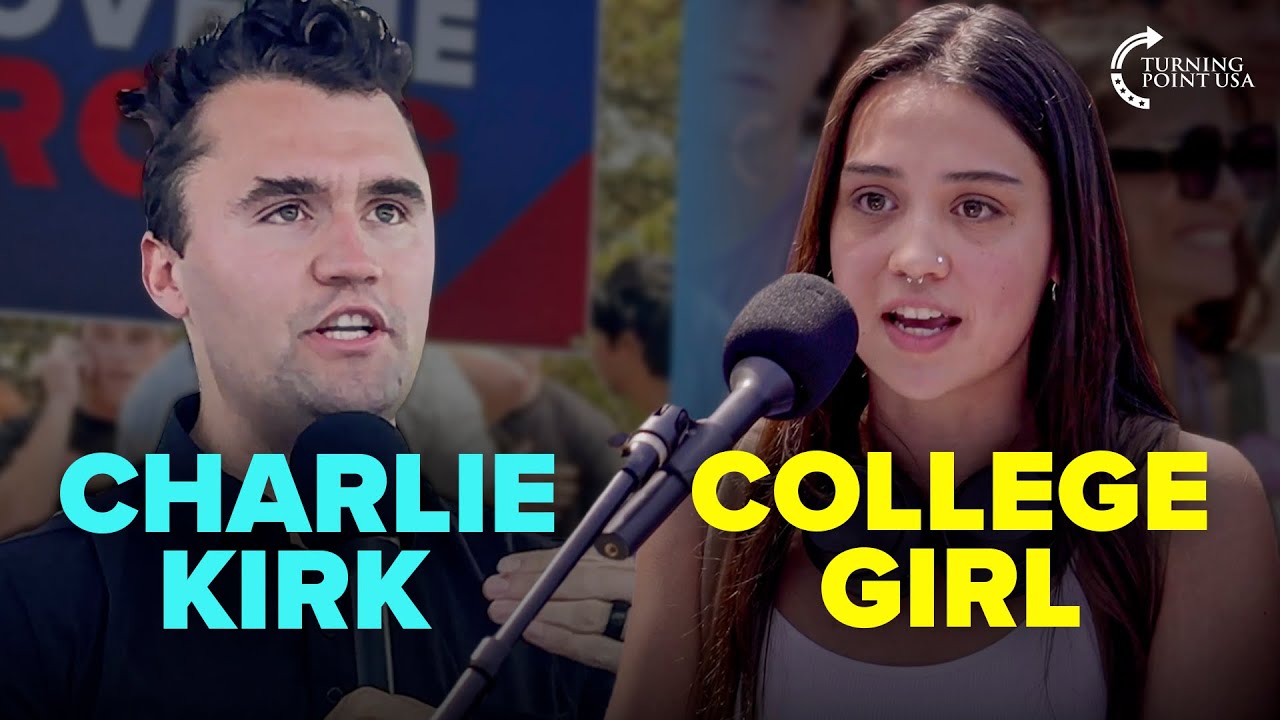
Charlie Kirk Challenges Student on Democracy Versus Republic and the Value of Higher Education
Enjoying this? Share it with someone who needs to see it.
Up Next
Charlie Kirk Challenges University of Washington Students on Democracy, Immigration, Feminism, and the Value of College Education
49:26
Charlie Kirk Explains Why Democracy Is Not an American Value in Heated Constitutional Debate
6:02
Charlie Kirk Explains Why America Is a Constitutional Republic Not a Democracy to Confused Student
6:11
Charlie Kirk Challenges Student on Democracy Versus Republic and the Value of Higher Education
Charlie Kirk engages in a heated exchange with a college student about whether democracy is truly an American value. Kirk argues that the Founding Fathers deliberately created a republic, not a democracy, and defends his criticism of modern higher education. The conversation tackles everything from the Constitution and Federalist Papers to accusations of anti-intellectualism and the purpose of college in America. Kirk maintains that wisdom matters more than formal education and that universities have created an ungrateful generation disconnected from core American values.
Democracy Versus Republic: A Fundamental Distinction
When asked if democracy is an American value important to the fabric of the country, Charlie Kirk offered a blunt response that set the tone for the entire exchange. Kirk challenged the student to find the word "democracy" anywhere in the US Constitution, the Federalist Papers, or the Declaration of Independence. When the student acknowledged that the word isn't in the Constitution, Kirk pressed further, pointing out that the Founding Fathers actually mentioned democracy negatively in the Federalist Papers as a problem to be avoided.
Kirk clarified his position emphatically: "I am pro-representative government but I'm not pro-democracy. That's a big difference and that distinction is important." He explained that democracy means majority rule no matter what, with no provisions for checks and balances, no inalienable rights, and no separation of powers. According to Kirk, pure democracy means whatever the majority wants happens as quickly as possible, which is fundamentally different from the representative republic the Founders created.
The student pushed back, noting that figures like Alexander Hamilton held elitist viewpoints about who should participate in government. Kirk acknowledged Hamilton's anti-democracy stance but stood firm on the constitutional framework, emphasizing that the distinction between democracy and representative government isn't just splitting hairs but represents a fundamental principle.
Education, Wisdom, and Civic Participation
The conversation shifted to whether citizens need education to participate effectively in the country's civic life. The student argued that even in a representative republic where people vote as part of their civic duty, citizens should be as educated as possible to participate meaningfully. Kirk agreed with part of this premise but drew a crucial distinction: "I think they should be as wise as possible and I don't think that education and wisdom are the same thing."
Kirk went further, suggesting that college actually "disincentivizes the cultivation of wisdom." This statement captured his broader critique of modern higher education, which became a central theme of the exchange. The student questioned how self-directed learning could provide a thorough education in an era of information saturation and polarization, where people get their news from wildly different sources and rarely interact with opposing viewpoints.
Kirk responded that his learning isn't limited to one form. He meets people, learns from conversations like the one he was having with the student, and actively listens during exchanges. He contrasted this with what he described as the typical college experience: "sitting in a classroom listening to a professor drone on for 90 minutes and pretending to read his book and paying 20,000 a semester to cheat on the exam at the end of the semester."
The Purpose and Value of Academia
The student defended academia by pointing out that it has standards—peer-reviewed papers and rigorous requirements that don't apply to starting a podcast. Kirk acknowledged this applies to PhD programs but questioned whether the student was suggesting he personally lacked knowledge or wisdom. The student clarified they weren't making claims about Kirk specifically but addressing the broader right-wing rhetoric against higher education.
When Kirk asked why the student thought conservatives oppose higher education, the student suggested it's easier to control less educated people. Kirk immediately rejected this as conspiracy thinking and labeled the student's approach as such. The student then invoked a common criticism: "Anti-intellectualism is a hallmark of fascism."
Kirk offered his own explanation for conservative opposition to much of modern higher education. He argued that higher education has largely created "an ungrateful, unprepared generation that goes into the American body politic and does not share the core American values of freedom of speech, gratitude for our founding, consent of the governed." According to Kirk, modern education produces people who are "hyper radical" and against American traditions, norms, and customs, creating what he calls "the woke mind virus."
Learning Versus Indoctrination
Kirk emphasized that conservative criticism of higher education isn't about opposing learning itself. "We love learning. I learn every day," he said. He pointed to Hillsdale College as an example of the kind of education he supports—"probably one of the hardest colleges in the country to get into and graduate from." The problem, according to Kirk, is when students are "learning largely trash and crap" rather than pursuing "truth, beauty or goodness" and not trying to "inculcate wisdom or good character."
The student countered by pointing out that there's no oversight on online political commentary to ensure it pursues wisdom and goodness either. The student suggested that Kirk directly profits from "propagating viewpoints that are more polarizing and that suck people deeper into more conspiratorial thinking."
Audience Value and Market Validation
Kirk responded by turning the critique back on the student, suggesting they were actually insulting his audience rather than him. He explained that his audience rewards him financially because they find value in his content and learn from him. "Whatever I say is actually very popular and resonates with people," Kirk noted, rejecting the characterization of his work as exploitation.
The exchange concluded with Kirk thanking the student for their time, with both participants having clearly stated their positions on democracy versus republicanism, the value of formal education versus other forms of learning, and the state of American higher education. The conversation highlighted the deep philosophical divide between those who see modern universities as essential institutions for informed citizenship and those who view them as sources of ideological indoctrination that undermine traditional American values.