2,422 videos 1,389,747,653 views US Joined Aug 30, 2018
Charlie Kirk is the Founder and President of Turning Point USA, the largest and fastest growing conservative youth activist organization in the country with over 250,000 student members, over 150 full-time staff, and a presence on over 2,000 high school and college campuses nationwide. Charlie is also the Chairman of Students for Trump, which aims to activate one million new college voters on campuses in battleground states in the lead up to the 2020 presidential election. His social media reaches over 100 million people per month and according to Axios, he is one of the "top 10 most engaged" Twitter handles in the world. He is also the host of “The Charlie Kirk Show,” which regularly ranks among the top news shows on Apple podcast charts.
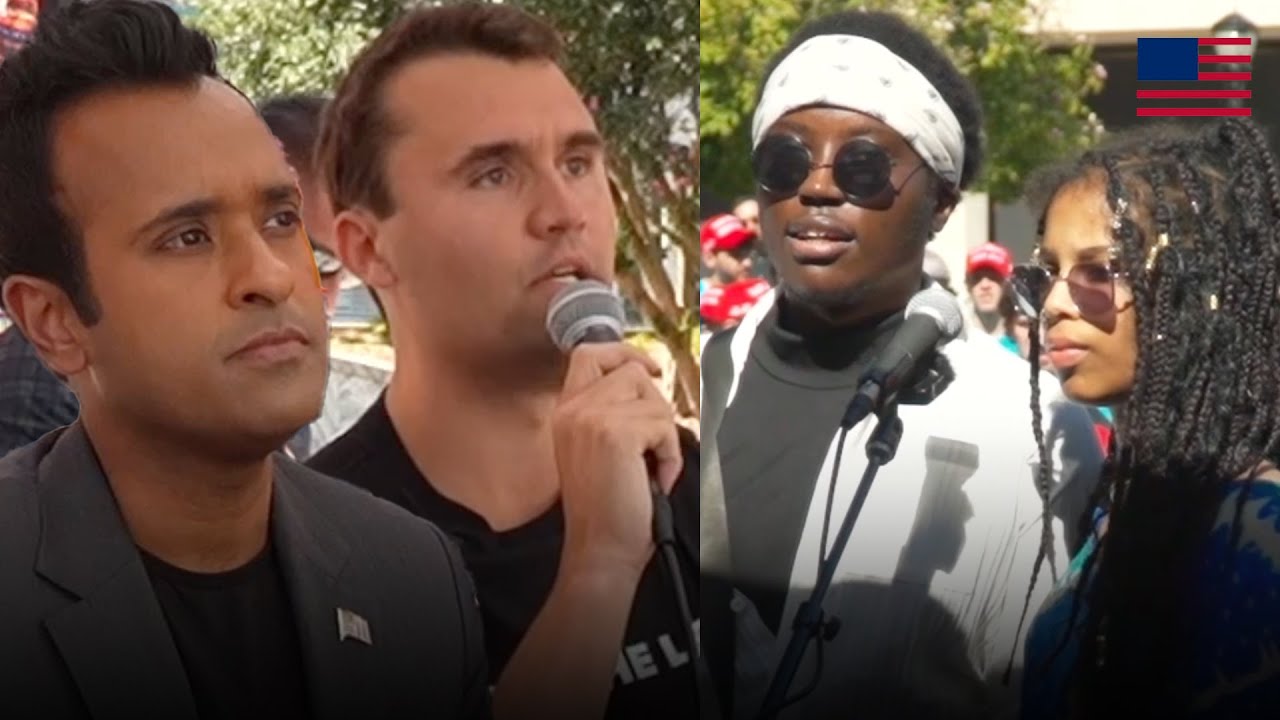
Charlie Kirk Debates Progressive Students on Border Security, Trump's Accomplishments, and Affirmative Action Policies
Charlie Kirk engages in heated campus debates with progressive students, challenging claims about Kamala Harris's border management, the child tax credit, and Donald Trump's record as president. The conversation shifts from border security and missing children to Trump's legacy as a peace president, ultimately examining affirmative action, meritocracy, and biological differences between men and women. Kirk defends Trump's accomplishments while dismantling arguments about representation and diversity policies, arguing that competence and values matter more than skin color or gender quotas in institutions.
The debate opens with a direct confrontation about military spending and government expansion. Charlie Kirk immediately redirects the conversation to one of the most pressing issues facing America: border security and child trafficking. Kirk challenges his opponent on Kamala Harris's record, stating that one of the reasons for current political opposition is because "Kamala Harris is a warmonger who wants to send hundreds of billions of dollars to Ukraine while our own border remains wide open and 320,000 kids are missing in sex trafficking because of your preferred candidate Kamala Harris."
When asked if the student is worried about the 320,000 missing kids, the response is tepid acknowledgment without accepting responsibility on Harris's part. Kirk presses the issue, reminding the student that Kamala Harris is "in charge of the Border" and that "Joe Biden said this is who's in charge of the Border." The student admits disagreement with all past administrations on border policies but attempts to deflect by bringing up a Senate border bill that was allegedly voted down because "Donald Trump himself wanted it to be a voting issue."
The Senate Border Bill Debate
Kirk challenges the narrative about the Senate border bill, asking a critical question: "How many people would have been allowed to cross the border every day in the bill?" The answer reveals the problem: 5,000 people a day. When Kirk questions whether this constitutes belief in borders, the student claims to believe in borders but isn't "against limiting by a random number," arguing that "context is important" when people are crossing the border.
This leads to a pointed exchange where Kirk asks if someone who is poor should be able to break into America based on context. The student attempts to distinguish between legal and illegal border crossings, but Kirk clarifies that the 5,000 a day figure refers to illegal entries into the United States. The student then claims there have been more arrests under the current administration than during Trump's presidency, to which Kirk responds that this is simply because "there's more people coming across the southern border" - approximately 10 million people illegally in the country.
Kamala Harris's Greatest Accomplishment
Kirk poses a straightforward question: "What is Harris's greatest accomplishment?" The student claims it was "cutting child poverty in half" through the child tax credit during the Biden administration. Kirk immediately corrects this misattribution, pointing out that the child tax credit actually comes from "the Trump tax cut" - specifically the tax legislation passed in December 2017. Kirk notes the irony that Kamala Harris is currently running against the very policy the student is praising as her greatest accomplishment.
Trump as Different from Washington's Den of Thieves
The student asks why Donald Trump is any different from "all the other thieves that are in Washington right now looting and pillaging the earnings of the working class." Kirk provides several concrete answers: Trump cut taxes, made it easier to own a home, and had no new wars, which Kirk describes as starving "the Beast of the military-industrial complex."
When the student questions whether Russia really was starved during Trump's presidency, Kirk presents a compelling pattern: under Bush, Russia took Georgia; under Obama, Russia took Crimea; under Biden, Russia took the Donbass. But for four years under Trump, "they didn't do anything." Kirk sarcastically asks, "Why is it for 4 years Russia stopped all of their incursions when under Bush Obama and Biden it was an all you can eat buffet in the Russian hemisphere?"
The Peace President Argument
The student challenges the characterization of Trump as a "peace president" by bringing up his use of the MOAB (Mother of All Bombs) against ISIS terrorists. Kirk defends this action, and when asked about the morality of killing terrorists, both agree that those threatening the lives of their fellow countrymen should be stopped. Kirk's key argument is that Trump "did not start a new conventional ground war where every president last 40 years including Reagan has."
Kirk further argues that what makes Trump truly different is the establishment's reaction to him: "If Trump was like all the rest of them they would not have impeached him twice indicted him four times and he would not have to survive the assassination attempts that he has. There's something different about Trump because he threatens to expose and uproot the entire cabal and the cartel that has been making everybody in this audience poor and them richer."
Trump's Business Success
When the student attempts to minimize Trump's business accomplishments by claiming he benefited from "the same cabal that allowed him to become a billionaire" and received "a loan from his father," Kirk challenges this perspective. He asks pointedly: "If I gave you a million dollar could you turn it into 5 billion? Probably not. So it's pretty talented for Trump to turn a million into 5 billion." The student dismisses this as expected when you "come from a dynasty of business man," but Kirk refuses to accept the minimization of entrepreneurial success.
Representation and Republican Values
The conversation shifts to representation in politics. Kirk turns the tables by asking about the Democratic Party's record: "How have the Democrats done?" He then poses a provocative question about when Republicans will nominate their first black Republican senator. The student suggests representation matters, but Kirk challenges this premise directly: "I think skin color is irrelevant. Why do you care so much about it?"
When the student argues that representation matters and brings up Christian values, Kirk responds: "The only representation that matters is values not skin color." The student attempts to discuss "black values," but Kirk demands clarification: "Tell me very slowly so I can understand what are black values." His answer is that black values "are Christian because they're one of the most Christian populations in the country."
Affirmative Action and Meritocracy
The debate moves to affirmative action, with the student questioning how to bring variety of opinions without it. Kirk advocates for a meritocracy. He points out that supporting affirmative action means being "okay turning to those three men and saying I deserve the position more than you based on something that doesn't matter."
Kirk cites evidence from the Harvard case, noting that affirmative action resulted in "nearly 40% lower test scores for people of color versus their white male counterparts and Asian counterparts." When asked why this gap exists, the student acknowledges that "people of color come from lower socioeconomic backgrounds that don't prioritize education." Kirk asks how to fix these socioeconomic statuses, leading to his critique of the current approach.
The Cost of Lowering Standards
Kirk argues that the current solution is fundamentally flawed: "What we're doing is our institutions are now becoming less excellent our country is not working like it used to because we basically told people that are very qualified and very competent that sorry we're not going to put a position for you here." He provides a concrete example with the US Secret Service, which has stated a goal of having 30% of all agents be women despite having "lower Fitness criteria" - fewer pull-ups, fewer push-ups, and slower mile times.
The student dismisses this example because "women will never be as strong as men genetically," but Kirk uses this admission to make his broader point about affirmative action and natural differences.
Biological Differences Between Men and Women
Kirk asks whether women can be as good at engineering as men "person for person," and the student responds "not necessarily." Kirk then explains how this relates to his Secret Service example and expands on biological and psychological differences between men and women. He argues that "the male mind is wired different than the female Mind" and provides examples of areas where each sex naturally excels.
According to Kirk, men will never be as good at "counseling or psychology sessions" or "nursing or elementary school education" as women. Conversely, "women are far better gifted at micro topics so individual connection empathetic type conversations healing people that are past trauma and wound." Men, he argues, are "much better at macro topics" like building skyscrapers, geopolitics, and similar large-scale endeavors.
Kirk illustrates this with social behavior: "When you go and you see five women eating lunch they're probably talking about micro topics conversations they had relationships friendships. Men they're talking about politics sports or the stock market." The student objects that this isn't necessarily true and that women have the capability of having political conversations. Kirk agrees there are exceptions but maintains these are "general truths" and "the general wiring or nature of women."
The debate concludes with Kirk arguing that biological differences extend to preferences for activities like contact sports, football, UFC, and hunting - differences the student attributes to "societal Norm" developed over time. Kirk rejects this explanation as insufficient, maintaining that these preferences reflect deeper biological realities, even as the student points out that some women play football and some men do drag, representing exceptions to the general pattern.