2,422 videos 1,389,747,653 views US Joined Aug 30, 2018
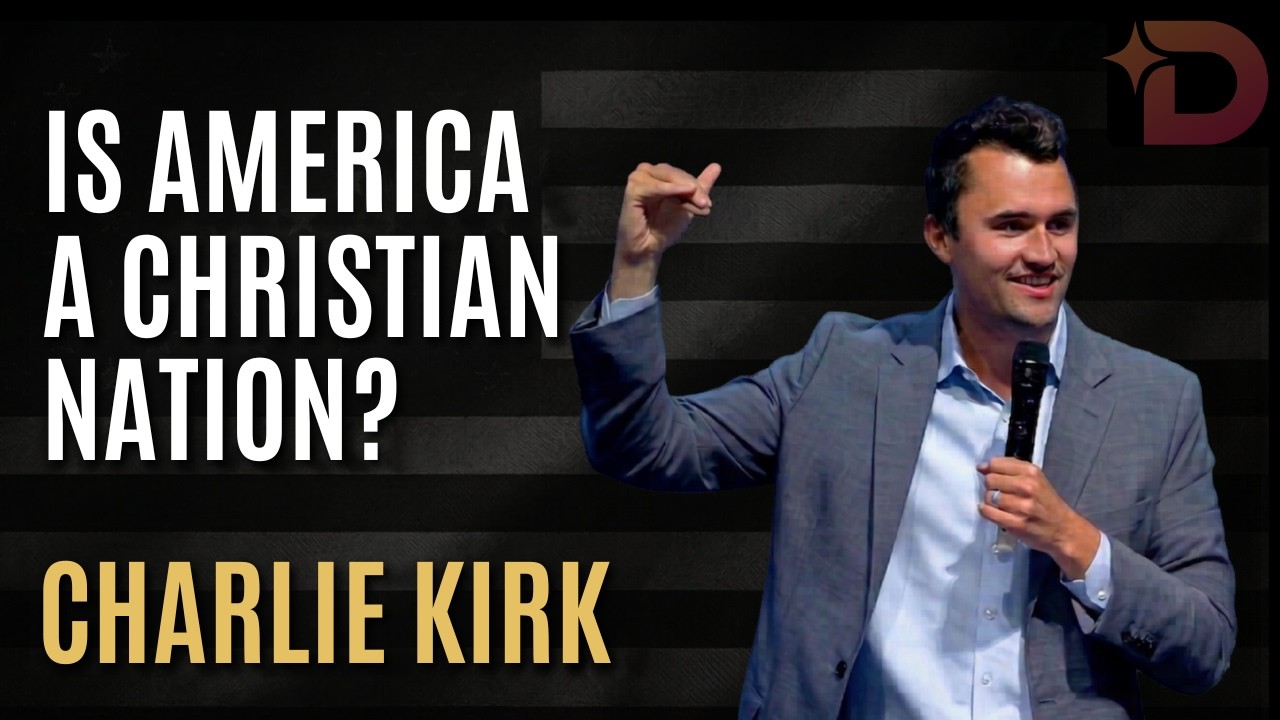
Charlie Kirk is the Founder and President of Turning Point USA, the largest and fastest growing conservative youth activist organization in the country with over 250,000 student members, over 150 full-time staff, and a presence on over 2,000 high school and college campuses nationwide. Charlie is also the Chairman of Students for Trump, which aims to activate one million new college voters on campuses in battleground states in the lead up to the 2020 presidential election. His social media reaches over 100 million people per month and according to Axios, he is one of the "top 10 most engaged" Twitter handles in the world. He is also the host of “The Charlie Kirk Show,” which regularly ranks among the top news shows on Apple podcast charts.
Why America's Christian Founding Is an Undeniable Historical Fact Despite Modern Revisionism
The claim that America was not founded on Christian principles but on secular common law fails under historical scrutiny. Nine out of thirteen original states required government officials to be Bible-believing Christians, with all thirteen requiring declarations of faith. The founders themselves, including John Adams, explicitly stated the Constitution was designed for a moral and religious people. From the Liberty Bell's Leviticus inscription to taxpayer-funded Bible distribution as one of Congress's first acts, the evidence overwhelmingly demonstrates America's Christian foundation, a truth that offers the nation's best hope for renewal.
When confronted with the argument that America was founded on common law rather than Christian principles, the most important evidence comes from the original state constitutions. Nine out of thirteen original states required government officials to be Bible-believing Christians at the time of the founding. In fact, all thirteen states required a declaration of faith—nine specifically required officials to be Protestant, with Maryland being the exception as it required Catholic faith.
Pennsylvania's original state constitution included the declaration: "I profess Lord and Jesus Christ as my Lord and Savior." This wasn't an anomaly—it was the norm. America was a collection of states before becoming a unified nation, and understanding the Christian foundation of these individual states is essential to understanding the nation's founding principles.
The Founders Were Bible-Believing Christians
Of the fifty-six signers of the Declaration of Independence, fifty-five were Bible-believing, church-attending Christians. This overwhelming majority completely contradicts the modern narrative that the founders were secular deists influenced solely by Enlightenment philosophy.
Furthermore, during the constitutional period, Deuteronomy was the most quoted book—religious or non-religious—surpassing even John Locke, Montesquieu, and Blackstone. The book of Deuteronomy, Moses's farewell address containing laws, customs, and traditions for governing a nation, served as a primary reference for how the founders structured American government.
Common Law's Biblical Roots
The argument that common law is separate from Christian principles fails to acknowledge that common law itself is an outgrowth of Scripture. Common law is inherited from Blackstone, who was Christian, and its fundamental principles are thoroughly biblical.
Consider three core principles of common law:
Presumption of innocence
Due process
Jury of your peers
All three are biblical principles wrapped into the ultimate biblical principle found in Leviticus 19: "You shall not favor justice if you are rich or poor." This passage, which appears just before the famous command to "love your neighbor as yourself," establishes the concept of blind justice that became foundational to Western legal systems.
The New Testament reinforces this with the principle that there is "neither slave nor Greek nor Jew—you are all one in Jesus Christ," which gave rise to the idea of human equality. These are biblical ideas, not Enlightenment ideas, though they are often conflated with Enlightenment philosophy.
God in the Declaration of Independence
The claim that God is only mentioned four times in the Declaration of Independence actually strengthens the case for America's Christian foundation. These references are profoundly significant. The Declaration references "laws of nature and Nature's God" and concludes with language that reads as a prayer: "We appeal to the Supreme judge of the universe."
Who is the judge of the universe? According to Revelation, Jesus Christ will judge the Earth on his throne. The founders were specifically praying to Christ in the Declaration of Independence, framing their revolutionary act within a Christian theological framework.
The Constitution and Christian Governance
While the Constitution doesn't mention God explicitly, this omission is often misunderstood. John Adams clearly stated: "The Constitution was only written for a moral and religious people. It was wholly inadequate for the people of any other."
The body politic of America was so thoroughly Christian and Protestant that the form and structure of government was built specifically for people who believed in Christ. One of the reasons America faces a constitutional crisis today is that the nation no longer has a Christian population, yet it retains a Christian form of government—these two elements are incompatible. Liberty cannot exist without a Christian population to sustain it.
Separation of Church and State: A Misunderstood Concept
The phrase "separation of church and state" does not appear in the U.S. Constitution. This concept comes from a single letter Thomas Jefferson wrote in 1807 to the Danbury Baptist convention in Massachusetts, assuring them that the government would not come after the church—the opposite of how the phrase is used today.
This letter was resurrected by the Warren Court and Burger Court in the 1960s and reinterpreted to mean something Jefferson never intended. The Constitution actually contains two relevant clauses: The Establishment Clause and the free expression clause. The Establishment Clause states that "Congress shall make no law prohibiting the free exercise thereof."
The founders' primary concern was preventing a Presbyterian, Anglican, or Quaker religion from taking over the federal government. They wanted to prevent a state-run religion, not remove religious influence from government entirely.
Early Government's Christian Practices
The historical record proves the founders never intended to remove Christianity from government:
One of the first acts of Congress was taxpayer-funded Bible printing and distribution
Church services were held in the Supreme Court building as late as the Jackson presidency in the 1820s
The Ten Commandments appear throughout Congress, the Supreme Court, and government buildings nationwide
These facts demonstrate that the founders believed the Decalogue—the Ten Commandments—should be the core morality guiding society and civilization.
The Impossibility of Moral Neutrality
The concept of separation of church and state is not only unconstitutional—it's not biblical either. More fundamentally, it's impossible. No one believes in separation of morality and state. All laws are reflections of morality, and all morality comes from somewhere. There is no such thing as neutral morality.
The founders understood this, which is why they embedded Christian moral principles throughout American government and its symbols.
The Liberty Bell's Biblical Inscription
Perhaps the most compelling evidence of America's Christian founding is the Liberty Bell itself. If the founding fathers were not Bible-believing Christians, why did they inscribe Leviticus on the Liberty Bell? Not John, not Psalms, not Proverbs, not Genesis—but Leviticus, a book most Americans can't even spell.
The inscription reads Leviticus 25:19: "Proclaim Liberty throughout the land of which you are in it." This choice of Scripture was deliberate and meaningful, connecting American liberty directly to biblical principles.
Why This Lie Persists
The claim that the founding fathers were Enlightenment deists rather than Bible-believing Christians is one of the most sinister and unsubstantiated lies in American discourse. It does not hold up against any academic scrutiny.
The reason this false narrative must be maintained is clear: if Americans actually returned to their Christian roots and went back to where the nation once was, it would be America's best hope for revival and a great future. Those who promote secular revisionism understand that reconnecting with America's Christian foundation would transform the nation, which is precisely why they fight so hard to deny that foundation ever existed.