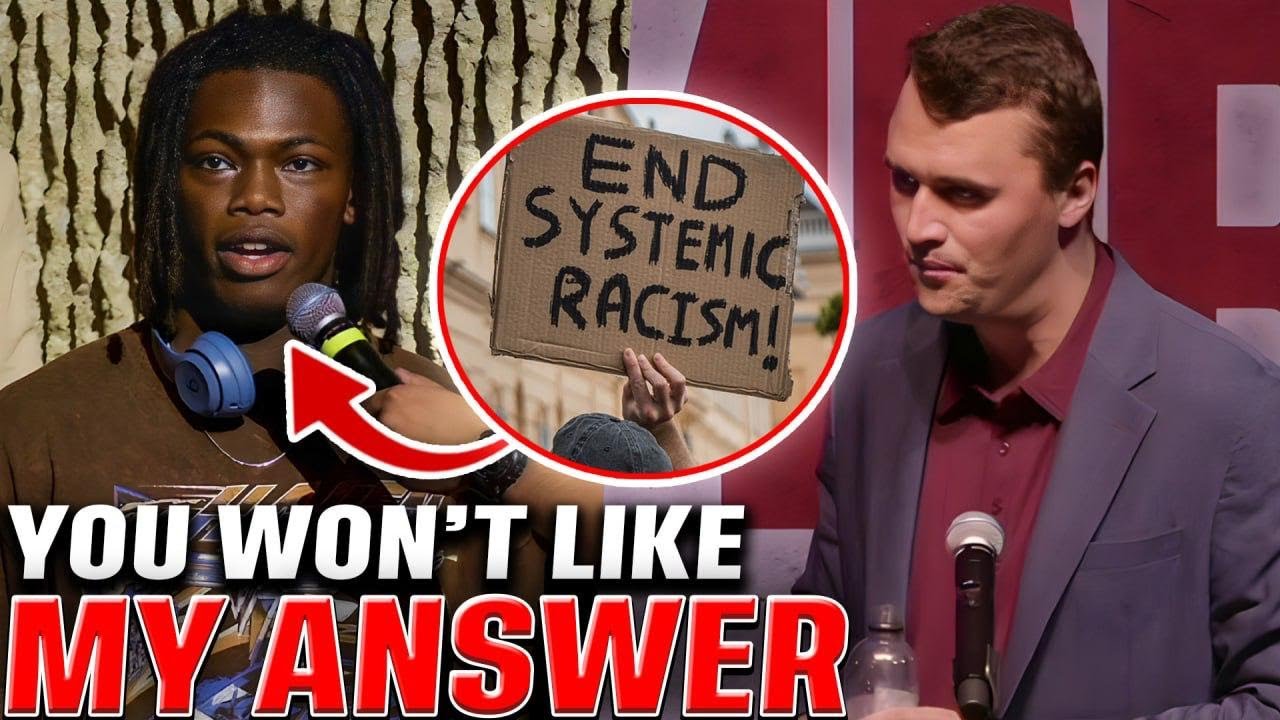
Charlie Kirk Responds to Reparations Question: Why Taxing Descendants for Ancestral Wrongs Violates Justice
Enjoying this? Share it with someone who needs to see it.
Up Next
Charlie Kirk Debates Marriage, Fatherhood, Crime, and Systemic Racism with College Student at Campus Event
19:34
Charlie Kirk on Feminism, Career vs. Motherhood, Reparations, Gun Rights, and Why Canada Has Fallen
11:46
Charlie Kirk on Racism, Class, and the Family Structure Crisis in Black Communities
4:16
Charlie Kirk Responds to Reparations Question: Why Taxing Descendants for Ancestral Wrongs Violates Justice
Charlie Kirk engages in a substantive discussion about reparations for descendants of slaves, explaining his opposition through principles of individual justice and responsibility. When asked why he opposes reparations for the black community, Kirk challenges the premise by questioning who qualifies, using the example of recent immigrants versus descendants of slaves. He argues that taxing individuals, including immigrants and those whose ancestors fought to free slaves, for crimes they didn't commit violates basic justice. Rather than cash payments, Kirk proposes breaking teacher union monopolies to enable school choice and restoring fathers to homes where 70% of black children currently grow up without stable father figures.
When asked about his stance on reparations for the black community, Charlie Kirk immediately poses a clarifying question: what exactly constitutes "the black community"? Does it include recent immigrants from Haiti or Nigeria? When the questioner, Blair, specifies he means descendants of slaves who can prove their ancestry with documentation, Kirk begins to unpack the deeper issues at stake.
Kirk challenges the framework by asking whether other mistreated groups in America should also receive reparations, using Jewish Americans as an example. When Blair responds that Holocaust survivors shouldn't receive reparations from the United States since America didn't commit those atrocities, Kirk identifies what he sees as an inconsistency in the logic.
The Principle of Individual Responsibility
Kirk articulates his core objection: "I did not own slaves and you were not a slave." He argues this represents a fundamental principle of justice—that individuals cannot and should not be held accountable for actions they didn't personally commit, nor should they receive compensation for harms they didn't personally experience. To do otherwise, he contends, violates the basic law of justice that prohibits holding someone accountable for something that somebody who looked like them did.
The problem with reparations, Kirk explains, is that it essentially means taking money from people for something they didn't do and giving it to people for something that also didn't happen to them directly. When Blair counters with the argument that past crimes have negatively affected current generations, Kirk acknowledges some people hold this view but maintains his position on individual justice.
The Tax Base Problem
Kirk raises a practical concern about implementation: any reparations program would tax the entire current population, including first and second-generation immigrants who had no connection to slavery. He points to Irish and Polish families who arrived in America a century ago, asking why they should be taxed for something their ancestors had nothing to do with.
He then offers a personal example: his own family fought on the Union side of the Civil War. Under a reparations system, descendants of those who fought to free the slaves would be taxed to provide payments to descendants of slaves—a scenario Kirk finds fundamentally unjust.
Alternative Solutions: Education and Family Structure
Rather than pursuing reparations, Kirk proposes what he sees as more effective solutions that could benefit all communities. First, he advocates for breaking the monopoly of public sector teacher unions and implementing school choice. He argues that providing quality K-through-12 education represents one of the most reliable pathways to success later in life, particularly for Hispanic and black children.
Second, Kirk emphasizes the need to restore fathers to homes. He cites the statistic that 70% of black children are raised without a stable father figure in the country. Blair agrees with this point, suggesting some common ground exists on the issue of family structure.
Kirk concludes by suggesting these approaches—improving educational access and strengthening family structures—would accomplish far more than cash payments to people related to historical injustices. He frames these as solutions that address current, actionable problems rather than attempting to remedy wrongs committed generations ago through financial redistribution.