Charlie Kirk and Lance Wallnau Confront the Crisis of Silent Pastors at Turning Point USA Faith Summit
Enjoying this? Share it with someone who needs to see it.
Up Next
Steve Deace and Charlie Kirk Confront the American Church's Crisis of Courage and Masculinity
58:04
Brandon Tatum Interviews Charlie Kirk on Masculine Leadership and the Conservative Movement at AmericaFest
14:53
Charlie Kirk Built the World's Largest Conservative Youth Organization from a Card Table and Conviction
1:35:50
Charlie Kirk and Lance Wallnau Confront the Crisis of Silent Pastors at Turning Point USA Faith Summit
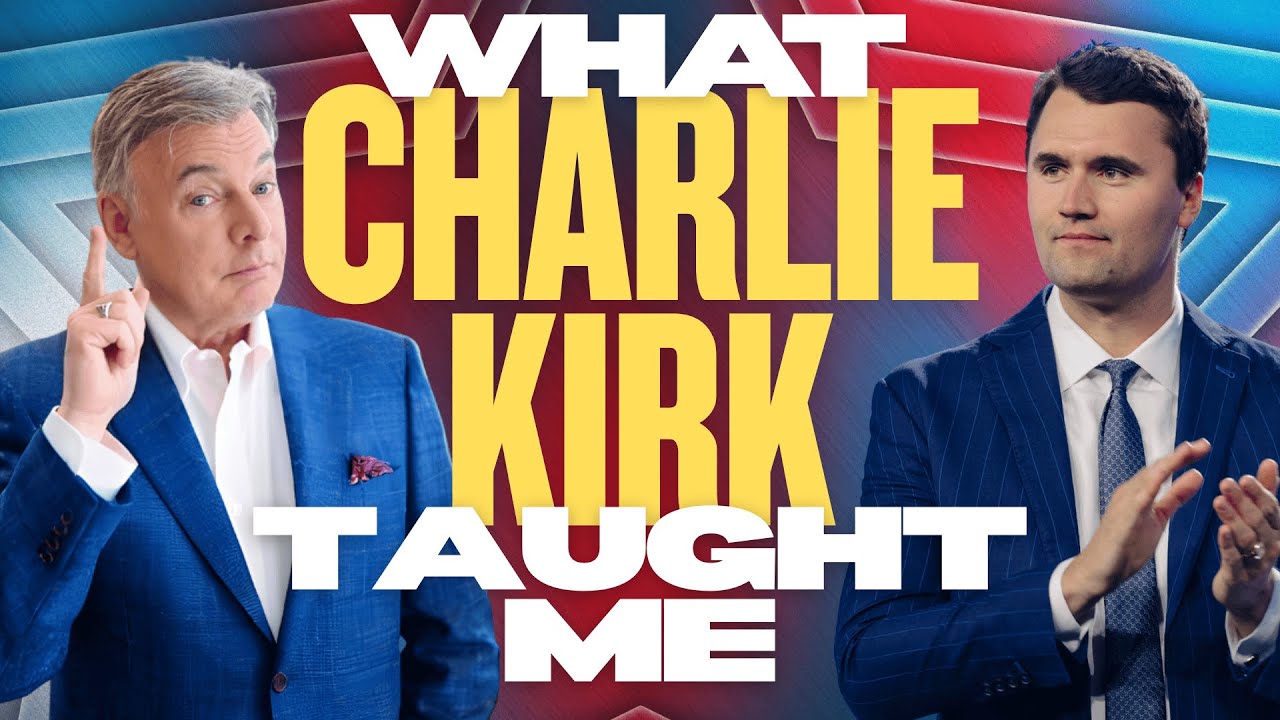
Charlie Kirk sits down with Lance Wallnau at the Turning Point USA Faith Pastors Summit, where over 1,100 pastors gather to address a pressing question: Why have so many American clergy abandoned cultural engagement? Wallnau, host of The Lance Wallnau Show and author of God's Chaos Code, explains why biblical illiteracy and institutional capture have left churches unprepared for the battles facing families today. From seminaries wrapped in ideology to the charge of "Christian nationalism," Kirk and Wallnau make the case that occupying culture until Christ returns isn't optional, it's commanded. They also tackle how congregants can approach pastors who refuse to speak on cultural issues, the prophetic patterns connecting ancient Israel to modern America, and why Andy Stanley's retreat from politics may have cost Georgia its freedom.
The Turning Point USA Faith Pastors Summit Grows Beyond Expectations
Charlie Kirk opens the program from the Turning Point USA Faith Pastors Summit, where over 1,100 pastors from across the country have gathered. Kirk reflects on the extraordinary growth of the summit, noting that this is the third such event in just 13 months, following gatherings in August of the previous year and a massive event in Nashville. The response has been so overwhelming that the summit now faces a seating problem, with more pastors wanting to attend than space allows. Kirk credits the growth to the work of the Lord and expresses gratitude for how TP USA Faith has resonated with clergy across America.
Joining Kirk for the full hour is Lance Wallnau, host of The Lance Wallnau Show on Real America's Voice and author of God's Chaos Code and God's Chaos Candidate. Wallnau brings years of experience speaking to the intersection of faith, culture, and national destiny, making him an ideal guest for this gathering of pastors seeking to understand their role in the public square.
Wearing "Christian Nationalist" as a Badge of Honor
Kirk immediately addresses the elephant in the room: critics have begun labeling attendees of the summit as "Christian nationalists." He asks Wallnau how Christians and pastors should respond when confronted with this accusation. Wallnau draws on wisdom from Rush Limbaugh, noting that media has the power to stigmatize any label through repetition and sound bites. He suggests that perhaps Christians should constantly rebrand—"Christian populist" might throw critics off for a week—but ultimately concludes that the approach should mirror that of Salvation Army founder William Booth, who told his followers to wear persecution like a badge of honor.
Wallnau explains that "Christian nationalist" simply means someone who is a Christian and loves their nation. If that's considered evil, he argues, then critics need to examine what they themselves represent: people who aren't Christian and don't love their nation. Kirk agrees, emphasizing that the movement isn't about taking over government but about restoring the Constitutional order. Christians should serve as counselors to leaders, be active in the public square, restore parental rights, and uphold the separation of powers and the Bill of Rights. When the church is active and Christians are engaged, Kirk argues, free societies flourish.
Why 35,000 American Pastors Remain Silent on Cultural Issues
Kirk turns to a sobering statistic: by their research, there are approximately 30,000 to 35,000 pastors in America, yet the vast majority do not speak out on cultural issues. Many are swayed by media narratives and criticism. Kirk asks Wallnau why this is the case and how it can be solved. Wallnau responds with a historical analogy: the first generation had to fight Indians and clear land, the second generation barely survived harvesting crops, and the third generation made a living off the store stocked with food already provided. American Christians, he argues, live off the borrowed peace won by the World War II generation. They never had to fight for the fundamental principles of social order, so the clergy was never trained to be on the front lines of protecting those principles.
Instead, pastors focus on more esoteric subjects—how to live a victorious life, how to overcome stress—the kinds of themes that built megachurches like Rick Warren's Saddleback. But now families face entirely different problems: suicidal children, schools attempting to change children's gender identities, and teachings that blame skin color for all iniquity in America. Pastors are completely unequipped to address these issues unless two things happen: pressure from congregations demanding answers, and the provision of tools and resources, since none of this was taught in Bible college.
How American Seminaries Became Left-Wing Institutions
Kirk expresses shock at how many seminaries have become left-wing institutions masquerading as Christian colleges. He mentions once-great institutions like Calvin College and Taylor College in Indiana, asking Wallnau what happened to these schools. Wallnau explains that 20 years ago, he began teaching what became known as the Seven Mountains of Culture: media, academia, government, business, entertainment, family, and church. He warned that Christians needed to pay attention to all these spheres because the enemy would target the gates of influence. If the gates are occupied, the traffic can be controlled.
Wallnau urged churches to train children to become influencers within the world system rather than hiding from it or viewing ministry as the only acceptable Christian career. The idea was applauded but never seriously implemented. Meanwhile, Marxist strategist Antonio Gramsci's model—the Long March through the institutions—was being executed. The left didn't skip the religious mountain; they went straight for it. They normalized same-sex marriage, changed laws about what churches could say, and then targeted seminaries and Bible colleges. Wealthy donors were placed on boards, funding institutions on the condition that they modify their orthodoxy. This incremental takeover happened across every mountain of culture. What Christians failed to protect and steward spiritually, the enemy took. Retaking a gate once it's been surrendered is far harder than defending it in the first place.
A Synagogue Wraps the Torah in a Pride Flag
An email from a listener catches both Kirk and Wallnau's attention: a practicing Jew writes that the synagogue where they grew up wrapped the Torah in a pride flag for the entire month of June, illustrating that the problem isn't limited to churches. Wallnau, who is 20 percent Ashkenazi Jewish on his father's side, finds the image so incongruent it strikes him as darkly comedic. He compares it to the absurdity of calling Ben Carson a white nationalist—the contrast is so extreme it becomes a punchline. An orthodox Jew wrapping the Torah in a pride flag represents the kind of ideological incoherence that has infected religious institutions across the board.
God's Chaos Code: The Prophetic Pattern Connecting Israel and America
Kirk asks Wallnau to explain his book God's Chaos Code, originally published a few years ago but still deeply relevant today. Wallnau begins by referencing Chuck Missler, a brilliant engineer turned theologian who said that the greatest miracle of the 21st century was God taking the people of Israel, scattered across the world for 2,000 years, and bringing them back to their homeland. They spoke the same language, retained the same customs and beliefs, and even found the real estate available. Missler suggested that Christians should study every book of the Bible that speaks of Israel's return to understand what God was doing.
Wallnau took that advice and began searching for prophetic patterns. He discovered that when Israel returned in 1947, there was a sequence of events that mirrored what was happening in America, particularly in relation to the nation's connection with Israel. It started with Cyrus, an outsider raised up to protect the Jews, described in Isaiah 45. Wallnau realized that the 45th president, Donald Trump, was the only political outsider among a field of evangelical Christians like Mike Huckabee, Ted Cruz, and Ben Carson. Isaiah prophesied 120 years before Cyrus was born that God would raise up a ruler named Cyrus who would conquer Babylon for the sake of God's people, though Cyrus himself would not know God.
After Cyrus came the command to rebuild the national house—a vital structure for the nation. God commanded the restoration of the house, and when the Jews obeyed, a great awakening followed. This gives the acronym C-H-A-O-S: Cyrus, House, Awakening. Following the awakening, Nehemiah and Ezra rose up to rebuild the walls destroyed during Israel's period of disobedience and restore the twelve gates of influence that had been breached by Babylon. After that came sovereignty—Israel became a sovereign nation, the land where the Messiah would visit. Jesus spoke of sheep nations and goat nations at the end of the age: nations that retain their sovereignty and refuse to persecute God's people versus those that bow to the spirit of empire. Wallnau believes America is in this exact battle right now. God, he argues, is in the chaos.
Kim Clement's Prophecies About Trump and the American Party Movement
Multiple emails pour in asking about Kim Clement, whom Wallnau mentions in his book. Kirk asks Wallnau to share about his time with Clement and the prophecies the late minister made toward the end of his life. Wallnau explains that he and Clement traveled together, with Clement delivering prophetic ministry and Wallnau explaining the prophecies to audiences. As Clement put it, he would get the nuts, but someone else had to crack them.
Before Trump appeared on the political scene, Clement, speaking in his South African accent, prophesied: "The spirit of the Lord says that I am dissatisfied with both parties." Wallnau remembers thinking this was revolutionary—whoever heard of God being interested in politics? Clement continued: "What I am about to do will be repulsive to the Democrats and positively distasteful to the Republicans." Wallnau couldn't understand how any candidate could fulfill that, given America's two-party system. Then Trump came along and precisely fulfilled the prophecy.
Clement also prophesied that God would raise up a movement that would be neither Republican nor Democrat but would be for America—an American party movement. Wallnau believes this aligns with the Tea Party and the current populist movement sweeping the nation. Clement had other specific prophetic words for individuals in his audiences that were remarkably accurate, but it's his words about the republic and the battle for America that remain most relevant today.
Occupy Till I Come: Why Escaping Isn't an Option
Kirk raises a concern he frequently hears from Christians: things look so terrible that they believe events aren't falling apart but falling into place. Jesus is coming soon, so what's the point of fighting? How should Christians who emphasize eschatology to the point of disengagement be addressed? Wallnau doesn't mince words. While he doesn't want to insult sincere believers, he says they suffer from biblical illiteracy. Jesus commanded His followers to "occupy till I come." When a commander-in-chief departs and says he will return, like General MacArthur declaring "I will return," the command to occupy isn't a cue to hide in the basement eating soybeans and watching YouTube prophets.
Wallnau references Jesus' parable of the ten virgins. All ten were virgins, all were believers, but only five were ready when the bridegroom returned. Only five had oil in their lamps because they were engaged. The other five were sleeping. Those who want to anesthetize themselves and retreat—especially prevalent in California, Wallnau notes—believe the sooner things fall apart, the sooner Jesus returns. But Jesus said to occupy. He said all authority in heaven and earth has been given to Him, so believers should go and disciple nations, teaching them His worldview.
The mistake the American church made was isolating itself, focusing on its own growth and spiritual empowerment while waiting for Jesus' return. Meanwhile, the secular world was teaching. The church should have been doing what Jesus commanded: preaching the gospel and teaching nations. Christians should have been in education teaching worldview, in economics teaching economic principles. Most of the progress of civilization—science, music, from Bach to Newton—came from the Reformation base of Europe and from people of faith. These weren't the God-rejecting elites of Harvard; they were enlightened Christians who gave the world the Renaissance, the Reformation, and the progress America enjoys. When Christians say they don't want to get involved in the nitty-gritty of cultural engagement, Wallnau sees people forsaking the front lines where occupation is needed most.
Andy Stanley's Dangerous Retreat From Cultural Engagement
Kirk reads from a book by prominent evangelical leader Andy Stanley, who argues that evangelicals have revealed what they value most through their reaction to political and cultural shifts: a relentless drive to win. Stanley writes, "But the church is not here to win. By every human measure, our Savior lost on purpose, with a purpose. We are not in it to win anything." He argues the evangelical church faces a state of emergency over politics and that Christians should not get involved at all.
Wallnau responds forcefully. The American church faces a crisis over whether it will remain under the influence of false teachers like Andy Stanley or whether congregants will be enlightened in time to protect themselves and their children from the loss of liberty. Stanley's logic is flawed: he evaluates evangelical engagement in political matters as a mere desire to win. But Wallnau offers an analogy. If Al-Qaeda is trying to break into the cockpit of a plane carrying your family on vacation, winning means keeping Al-Qaeda from the controls that will crash your future. Christians engage in battle out of love for the passengers of the plane—out of love for their children. This is a battle for survival, a fight to keep the lights on for liberty and freedom of speech.
Wallnau points to examples from Canada: Jordan Peterson spending $40,000 a month in legal expenses and being forced to undergo social media communication training under the Trudeau government to retain his license as a psychiatrist. Pastor Artur Pawlowski faces potential prison time for preaching to the truckers during their protest. Andy Stanley, Wallnau says bluntly, is out to lunch, and he feels sorry for those under his influence. The Apostle Paul said, "I don't run aimlessly, I don't fight aimlessly. I fight to score points. As an athlete, I keep my body under control." All of Paul's metaphors were about being in it to win it—to win the crown of God's approval for a job well done. The job of American Christians is to preserve the religious liberty and truth God has given this country before the lights go out. If believers do not occupy until Christ comes, the territory will be occupied by something seven times worse: perversion, communism, Marxism, and death.
Kirk adds that First Corinthians 15:57 says, "But thanks be to God, which giveth us the victory through our Lord Jesus Christ." He doesn't understand how Stanley could write that by every human measure, the Savior lost. Even by human measures, rising from the dead is the greatest victory ever.
How Georgia Pastors Cost Trump the State
Wallnau makes a controversial statement: Andy Stanley and Creflo Dollar, two of the most prominent and influential Georgia preachers, made the decision not to educate and engage their congregations, and that decision probably cost Georgia in the election. With Georgia's loss, Trump now struggles for his own survival as the most deranged zip code in the state—Fulton County—attempts to put him behind bars. That outcome, Wallnau argues, can be laid at the feet of two pastors who subscribe to the demonic idea that Christians shouldn't care about the government mountain. Kirk adds that Stanley and other Georgia pastors have done nothing to speak out about people wrongfully indicted by Fani Willis. If you are in ministry and abuse the holy calling, Kirk argues, you should not be in ministry—you should find something else to do. Those in ministry should be held to a higher standard.
Supporting Lance Wallnau's Ministry
Kirk gives Wallnau an opportunity to promote his work. Wallnau shares that The Lance Wallnau Show has reached around 11 million downloads since launching just two years ago. His challenge is unique: he's too Christian for secular radio and too political for Christian radio. He believes Kirk is one of the few who has successfully navigated both worlds. Wallnau made the decision to build a podcast where he doesn't edit what he says out of fear of censors. He agrees with Tucker Carlson's approach: say the thing they don't want you to talk about. Wallnau believes the awakening in America will be driven by Christian engagement but will ultimately become a populist movement. That's the focus of his show, available on any podcast platform. For old-timers, he still does Facebook videos—late-night rants around 11 p.m. that his studio team can't keep up with, where he ventilates and goes through what he jokingly calls Gestalt therapy.
What to Do When Your Pastor Won't Budge
In closing, Kirk and Wallnau address a question they receive constantly: "I love everything you're saying, but my pastor won't budge. He says we only preach the gospel. Should I confront him, counsel him, challenge him, or leave the church?" Wallnau offers practical advice. First, understand that the church operates somewhat like a political institution. Who is the pastor's primary client? Who is he trying to keep happy? He has elders, a board of directors or nonprofit board, and leadership on his eldership team—whoever brought him in if he's the successor to a previous pastor. If you're not a member in good standing, your opinion is essentially useless. If you're not a giving, participating, influential member, you're just another voice.
The key is to make sure you have a good relationship with the pastor and the church by investing in it. Second, don't go alone. One single voice isn't powerful, but if you can get two or three other people to join you, that gets a pastor's attention. If you can find one businessman, one significant tither or giver whose faith aligns with yours, and approach the pastor together, you'll have leverage. Frame the request not as asking the pastor to change the gospel but to address questions the congregation is hearing all the time. Barna's research shows that 90 percent of people in the pews want to know how the Bible applies to economics, race theory, sex, and gender. If the pastor understands that you have influence, that you have someone in business behind you, and that you're asking him to be informed on things 90 percent of the church wants to hear about, you'll have far more leverage than simply saying, "Why don't you talk about abortion?"